
Hoyt Pro Force Review

from $74.99
Pros
- Crisp, dead-in-hand shot - owners describe no vibration through the grip and a bow that sits still after the arrow leaves
- Tunes easily and groups like a tack driver - the zero-torque ZT Hyper Cam keeps nock travel straight and cams tracking nose to nose
- Genuinely fast for a long target bow - chronographed as the quickest of three name-brand target bows at a matched 29.5 inch, 60 pound, 350 grain setup
- True crossover feel - the same ZT Hyper Cam an archer trains on the 3D range carries straight into a hunting setup with no relearning
- Practical adjustability - the 4-angle modular grip bolts on and off in seconds, and draw length changes by rotating modules with no bow press
Cons
- At 4.7 pounds it is a deliberately heavy, stability-first bow - shooters who want a light rig to carry should know the mass is doing forgiveness work and is the point, not a flaw
- Some owners have noted a drop-away rest cord can rub the shoot-through bridge - a blade rest sidesteps it entirely, and a follow-away rest routed clear of the cage works fine for shooters who prefer one
- Out of production since 2020 and found only on the used market now - target archers who want a new Hoyt rig should look at the brand's current Invicta and target lineup
Video
content from YouTube
Editors' review
It out-shot the chronograph. Lined up against a Mathews TRX38 and a Prime Synergy at a matched 29.5 inch, 60 pound, 350 grain setup, the Hoyt Pro Force was the fastest of the three - and it was never the bow marketed on speed. From 2018 through 2020 this was Hoyt's long, forgiving, value-priced target and field bow: a 35 3/4-inch axle-to-axle, 7-inch brace height platform on the all-new ZT (Zero-Torque) Hyper Cam (the industry-standard chronograph rating, IBO, sits at 325 fps). Hoyt built it for "any target, 3D, or field archery range," and the do-it-all framing held up - indoor spots, twelve rings on a 3D course, gnarly field targets, all on one bow. What makes the Pro Force distinct is what it borrows from Hoyt's hunting line: the same cam, the same grip language, the same shot feel, so the archer who trains 3D all summer carries that exact feel into the fall. It replaced the Hyper Edge, it shared its geometry with the Double XL TGT, and across three near-identical model years it earned a quiet reputation as a tack driver that asks far less than a carbon flagship's price.
Finish
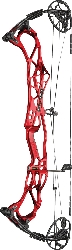
The Pro Force lived primarily in Hoyt's target palette, and that is where a spot or 3D shooter gets to make it their own. The Shred Color Series pairs a Black Out riser with bright limb colors - Green Envy, Blue Thunder, Purple Mist, Red Ember, Orange Torch - with custom strings and cables dyed to match the limbs. Shooters who prefer a single anodized tone could go with solid target colors instead: Championship Red, Cobalt Blue, Electric Teal, Rally Green, Silver Ice, Slate, or Jet Black. For 2019 Hoyt added the anodized Gold Medal colorway to the target line, a bright riser set off against carbon-look black limbs. Because the bow can also be hunted, standard hunting finishes were available as well, though the Pro Force was charted and marketed first as a target rig. The anodized and dipped coatings are the same durable finishes Hoyt runs across its flagship lineup, so wear resistance tracks with the rest of the brand rather than being a budget afterthought. Between the loud Shred limbs for the shooting line and the muted solids for a cleaner look, the Pro Force covered both kinds of target archer.Riser
The Pro Force is built on Hoyt's super-stiff TEC shoot-through riser - the central cage geometry that routes the stabilizer and cable system through a rigid, low-vibration bridge structure, and it is the single feature that most defines how the bow holds. A longer, stiffer riser does forgiveness work that a hunter rarely needs but a target archer lives by: with a long stabilizer and a long sight, any torque is magnified, and the shoot-through bridge pours strength into the system exactly where that torque would otherwise show up on the pin. In its 2018-2019 form the Pro Force shared its riser geometry directly with the Double XL TGT - a Hoyt rep described the Double XL as mirroring the Pro Force chassis, the shoot-through riser being the main hardware difference between the two. A sealed ball-bearing roller guard manages the cables with low friction, and a built-in lower bushing accepts a rear stabilizer for shooters who run a back bar. Hoyt also baked in offset weight distribution to help target archers running multiple stabilizers balance the bow. At 35 3/4 inches axle-to-axle the Pro Force is on the shorter side for a dedicated target rig, but the cam and string-angle geometry - covered below - make it shoot far more forgiving than that number suggests.Grip
The Pro Force carries Hoyt's 4-angle modular grip system, and it is one of the most practical features on the bow. The grip bolts on and off with two screws, letting a shooter dial the wrist angle to their own hand rather than adapting to a fixed shape - a feature owners single out as the kind of thing that should be standard across the industry. Just as useful is the consistency: the grip is the same width all the way through, which pushes the hand to a single repeatable contact point instead of drifting up or down the throat between shots, and on a target bow that repeatability is worth real points. The profile is on the narrow side, so it sits cleanly in the web of the hand and keeps torque out of the shot. Because the angle is adjustable rather than carved, a shooter coming off a different brand can usually find a familiar wrist position quickly. It is a target-archer's grip first - precise, low-torque, and tuned for the line - and it is part of why the bow holds as steady as it does.Limbs
The Pro Force runs 3/4 split QuadFlex limbs seated in Hoyt's Bi-Ax pocket system, in a beyond-parallel configuration that cancels post-shot shock. The Bi-Ax pocket is a genuine improvement on the prior approach: the limbs squeeze inward as they are inserted, and their natural outward pressure self-seats them to zero tolerance - owners describe the fit as super tight and super consistent, which is exactly what a target archer wants from a bow that has to return to the same place shot after shot. The beyond-parallel limb geometry means the tips travel toward each other through the shot, so the forces largely cancel and the riser stays dead in the hand. Draw-weight coverage spans 30 to 70 pounds in four module ranges, broad enough to cover a youth spot shooter at the bottom and a full-power field or hunting setup at the top. Hoyt's layered limb construction has a long durability record across the brand's flagship hunters, and the same pocket-and-roller-guard hardware carries over here, so reliability tracks with the rest of the lineup. This is a stable, repeatable limb system built for the line, not a speed-chasing experiment.Eccentric System
The heart of the Pro Force is Hoyt's ZT (Zero-Torque) Hyper Cam & 1/2 paired with a patent-pending Split-Cable System, and it is genuinely what sets the bow apart. The design goal is straight nock travel: the hybrid cam is tuned to perform at its best standing straight up and down, with a yoke wrapping both sides of the cam to hold that alignment through the entire draw. Hoyt's claim, made on camera by a company rep, is that this eliminated lateral nock travel "50 percent more than what a flex guard would do," pulling the steering work into the cam and cable system rather than a guard arm. A staggered, offset roller guard improves cable spacing and reduces cam torque, and the cable connectors are pre-compensated - the right side raised to cancel the natural slack a new yoke cable introduces - so the cam tracks straight out of the box with the bottom cam lean essentially gone. Owners report the cams running nose to nose and the bow tuning easily into a tack driver. Speed sits at 325 fps IBO rated at the #2 cam, and real chronograph numbers back it up: 292 fps average at a 29.5 inch, 60 pound, 350 grain setup, the fastest of three name-brand target bows measured side by side - so the IBO is honest, arguably even conservative for the class. Let-off ran a deep 85 percent (the percentage of peak weight the holding weight drops to at full draw) in 2018 and 2019, with a 70 percent low-let-off option added for 2020 - useful for the spot or field shooter who wants a firmer hold, and for practice in Western states that cap let-off at 80 percent. Draw length is set by cam size - #2 covering 26.5-30 inches, #3 covering 29-32 inches, and #4 reaching 31-33 inches "for the big guy" in 2018-2019 - with a slide-mod draw stop dialing the exact length inside each cam, no press required; the 2020 chart consolidated to #2 and #3, topping out at 32 inches.Draw Cycle/Shootability
Drawing the Pro Force, the first thing you notice is how solid it feels off the front of the cycle - the pre-loaded beyond-parallel limbs already carry tension, so the bow loads up early and you immediately read it as a fast bow rather than a soft one. From there the ZT Hyper Cam draws cleanly to peak and eases into a defined valley that is more generous than Hoyt's longer Prevail target bows, settling gently rather than snapping you forward. The 85 percent let-off means a long line session holds at a fraction of peak weight, which matters on a target rig where you stay at full draw long enough to settle the pin and execute. Where the bow truly earns its reputation is the shot itself: owners describe it as crisp with no vibration in the hand, the riser sitting dead and still after the arrow leaves - that comes from the beyond-parallel limbs, the StealthShot string stop, and the long, stiff shoot-through riser soaking up energy. The 7-inch brace height is forgiving for a target bow this size, giving a developing shooter a little margin on a less-than-perfect release. One worthwhile note for setup: with the shoot-through bridge in the way, a drop-away rest cord can rub the cage, so many target shooters run a blade rest or route a follow-away clear of it. Held on a target, the long riser and the zero-torque cam do their forgiveness work - the string angle stays comfortable even at a 31-inch draw, and the pin floats slow. This is a steady, quiet, accurate platform, not a snappy speed bow that demands flawless form.Usage Scenarios
The Pro Force is built first for the target, field, and 3D archer who wants a long, forgiving, dead-stable platform without paying carbon-flagship money. On the indoor spot line, the 7-inch brace and the zero-torque cam give a developing shooter margin while still rewarding good form with tight groups. On a 3D course, the moderate 35 3/4-inch axle-to-axle is short enough to carry through brush between targets yet long enough to hold steady on a downhill twelve, and the bow's speed flattens the trajectory on an unknown-distance target. On a field range, the deep let-off and slow-floating pin pay off across a long round of shots. The Pro Force also fits one specific archer better than almost anything else in its era: the crossover shooter who trains 3D and target all summer and hunts in the fall - the same ZT Hyper Cam, the same grip, and the same shot feel carry from the range into the woods, so there is no relearning the bow when seasons change, and the low-let-off module keeps practice legal in states that cap let-off. With a quick-load rest it would make a perfectly capable whitetail or western big-game bow at the upper draw weights. What it is not is a compact treestand carbine for tight, run-and-gun setups - a hunter who prizes a sub-32-inch bow for maneuvering should look elsewhere - but for the archer who lives on the shooting line, that long, steady hold is exactly the point.Versions
The Pro Force ran as one continuously-named model across three near-identical years, with the only meaningful changes arriving in 2020. The 2018 debut - "the all-new 2018 Pro Force" - set the template: 35 3/4-inch axle-to-axle, 7-inch brace, 325 fps IBO, 4.7 pounds, the ZT Hyper Cam, an 85 percent let-off, and three cam sizes (#2, #3, #4) spanning 26.5 to 33 inches of draw across a 30-70 pound range. It replaced the Hyper Edge in the lineup. The 2019 model carried over unchanged on spec; that was also the year Hoyt launched the Pro Force FX - a separate, shorter and faster bow (32 3/4-inch axle-to-axle, 6-inch brace, 332 fps), not a version of the Pro Force, so it lives on its own page. For 2020 Hoyt brought the Pro Force back "better than ever" with two practical updates: a 70 percent low-let-off option alongside the standard 85 percent, for shooters who want a firmer wall or need to stay under an 80 percent let-off cap, and a consolidated cam range that dropped the #4 cam, topping the 2020 model at 32 inches of draw. Hoyt did not publish a hard MSRP for the Pro Force in its catalogs; at retail it sat at Hoyt target-bow pricing, well under the brand's carbon flagships, and the Double XL TGT was positioned as the more affordable entry point into the same platform. The model was discontinued after 2020.Hoyt Pro Force vs Hoyt Double XL, Mathews TX-5
| Bow | Hoyt Pro Force | Hoyt Double XL | Mathews TX-5 |
| Version | 2020 | 2021 | 2020 |
| Picture |  |  |  |
| Brace Height | 7 " | 7.75 " | 5 " |
| AtA Length | 35.75 " | 35.75 " | 28 " |
| Draw Length | 26.5 " - 32 " | 32 " - 34 " | 23.5 " - 29.5 " |
| Draw Weight | 30 lbs - 70 lbs | 50 lbs - 70 lbs | 40 lbs - 70 lbs |
| IBO Speed | 325 fps | 345 fps | 345 fps |
| Weight | 4.7 lbs | 4.7 lbs | 4.58 lbs |
| Let-Off | 70% | 85% | 75% or 85% |
| Where to buy Best prices online | |||
| compare more bows | |||
For a Pro Force shopper the two real cross-shops are the in-house sibling and the cross-brand contrast. The Hoyt Double XL is the closest relative - in 2018 the Double XL TGT literally shared the Pro Force's geometry and configurations, both at 35 3/4 inches axle-to-axle, 7-inch brace, 325 fps on the ZT Hyper Cam, with the shoot-through riser being the main hardware difference. By its final 2020-2021 form the Double XL had grown into a dedicated long-draw rig - 345 fps IBO, a 7 3/4-inch brace, and a single #4 cam delivering a true 32-34 inch draw - so the choice within Hoyt comes down to reach: the Pro Force for the archer whose draw lands inside its 26.5-32 inch window, the Double XL for the tall shooter who needs to stretch past 32 inches. The Mathews TX-5 comes at the same target-and-field crossover need from the opposite direction: a compact 28-inch axle-to-axle, a short 5-inch brace, and a 345 fps IBO, with a 23.5-29.5 inch draw range. It is the pick for a shooter who wants a fast, maneuverable bow and is willing to trade brace-height forgiveness for it, where the Pro Force trades a little compactness for a longer, steadier, more forgiving hold on the line. The decision comes down to priorities: the Hoyt Pro Force for the archer who wants a long, dead-stable target and field platform with a crossover hunting feel; the Hoyt Double XL for the long-draw shooter who needs 32-34 inches; the Mathews TX-5 for the shooter who prioritizes a short, fast, compact frame.