
Hoyt Nitrux Review
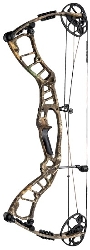

from $289.99
Pros
- Flagship hardware at a value price - the X-Act grip, torque-killing roller guard and StealthShot string stop come straight off Hoyt's REDWRX and Hyperforce flagships
- Smooth Nitrux cam that drops into a deep, relaxing valley and stops against a rock-solid limb-driven back wall - easy to settle and hold on target
- Draw length adjusts from 24 to 30 inches across two cam sizes with hex keys alone, no bow press required
- Quiet for its class - an upgraded string suppressor plus limb and pocket dampers take it whisper-quiet with 425-grain and heavier arrows
- Flagship-grade build with aluminum limb pockets and 12-inch deflection-matched Quadflex limbs, not the plastic pockets typical of mid-priced bows
Cons
- Some bare-bow hand shock and a slight jump in the handle at the shot - shooters coming off a flagship-quiet bow may notice it, though a light front-and-rear stabilizer or 425-grain arrows settles it down
- A do-it-all value hunter rather than a speed special - with hunting-weight arrows real-world speed runs in the 270s to low 300s against the 333 figure, so shooters chasing headline numbers may want a dedicated speed bow
Video
content from YouTube
Editors' review
Hoyt's marketing line for the 2019 Nitrux was blunt: its lowest-priced high-performance bow ever, at an $849 launch MSRP. What that undersells is where the parts came from. Pull one apart next to a Powermax and the truth shows - the Nitrux is essentially a redesigned Powermax that got promoted, wearing the same X-Act grip, the same torque-free roller guard and the same StealthShot string stop found on the carbon REDWRX flagships that cost twice as much. It is a 31.5-inch axle-to-axle aluminum hunting bow (axle-to-axle, ATA, is the tip-to-tip cam distance) with a 6.5-inch brace height, a 333 fps IBO rating and a 4.1-pound bare weight. The story here is trickle-down: how much flagship DNA Hoyt could pour into a sub-$900 chassis, and who that combination actually fits.
Finish
The Nitrux shipped in Hoyt's full hunting palette rather than a stripped value selection. Solid options ran from Blackout to the gray Storm, and the camo lineup covered Realtree Edge, KUIU Verde 2.0, and two Gore Optifade patterns in Elevated II and Subalpine, plus an Under Armour finish. Buyers who wanted a personality build could step into the platform's signature editions - the Bone Collector, Keep Hammering and Vicxen packages carried custom riser-and-limb graphics with matched strings. The finishes are dipped and durable in the way Hoyt hunting bows have been for years, holding up to brush and treestand wear without flaking at the cam ends. For a bow positioned below the flagship line, the color range is unusually broad - most of the patterns offered on the carbon bows that season were available here too.Riser
The Nitrux is built on an aluminum riser in the Powermax mold, using Hoyt's TEC truss geometry - a bridged, trussed center section that stiffens the riser against flex without piling on mass. That stiffness is the point: a riser that does not torque or twist under load is what lets a value bow hold like a more expensive one. Cable management runs through a roller guard rather than a flexing slide bar, which cuts friction on the draw and helps keep cam lean in check. The geometry puts the balance point slightly low, so the bow wants to sit still on target once you settle it. In my experience this is the part of the Nitrux that flatters newer shooters most - the riser does the steadying work that a tense grip hand would otherwise fight. It is conventional machined aluminum, not the hollow carbon of the RX line, and that is exactly the trade that brings the price down.Grip
The Nitrux carries the X-Act grip, the same one-piece thermoplastic grip Hoyt put on its REDWRX and Hyperforce flagships that year. It sits at a 17-degree angle - the more common, slightly more upright angle most shooters already know - and its reengineered width and shape encourage a neutral, repeatable wrist position shot to shot. The thermoplastic also insulates the hand from a cold aluminum riser, which matters more than it sounds on a November morning. Drawing it back the first time, what struck me was that nothing about the grip telegraphs the price point; it feels like the flagship grip because it is the flagship grip. Shooters who prefer their own setup can swap to aftermarket side plates, but most will leave it. It is one of the clearest places the Nitrux spends its parts budget on feel rather than spec-sheet bragging.Limbs
The Nitrux runs 12-inch Quadflex split limbs, deflection-matched in pairs so the two limbs load evenly, and seated in aluminum limb pockets rather than the molded plastic pockets that show up on a lot of mid-priced bows. That aluminum pocket is a genuine build upgrade - it gives a tighter, more repeatable limb-to-riser interface and is part of why the bow holds tune. Draw weight spans 30 to 70 pounds across the limb options in 10-pound increments, so a buyer can land on 40, 50, 60, 65 or 70 pounds at peak. That range is wide enough to cover a smaller-framed or younger shooter at the bottom and a full hunting setup at the top. Split limbs in this layout have a long reliability record across Hoyt's hunting line, and the Nitrux limb is rated to survive repeated dry-fires - a margin that speaks to how the limb is built, not an invitation to test it.Eccentric System
The heart of the Nitrux is its namesake Nitrux Cam, a Cam & 1/2 hybrid system tuned for a smooth pull and a forgiving shot. It pairs with a torque-free roller guard derived from the Zero-Torque cable system on Hoyt's flagships, which pulls cam and riser torque out of the equation and is a real reason the bow tunes easily. Draw length runs 24 to 30 inches across two cam sizes - Cam 2 covers 24 to 27 inches, Cam 3 covers 27 to 30 - and you change it with the cam's hex keys, no bow press needed. Let-off (the percentage the holding weight drops to at full draw) is 80 percent, so at 70 pounds peak you are holding 14 pounds while you aim. The IBO rating (the industry's fixed-setup chronograph standard) is 333 fps, but the numbers that matter on a hunt are the real ones: I logged a measured reading of 309 fps on a lighter setup, and a heavier hunting build at 29 inches and 72 pounds clocked 279 fps with a 447-grain arrow and 270 fps with a 481-grain arrow. The cam rolls over its peak cleanly and the back wall stops hard against limb-driven cable stops, so there is a true wall, not a mushy slope, at full draw.Draw Cycle/Shootability
This is where the Nitrux earns its keep. I expected a value bow to stack and buzz, and instead the draw is one of the smoother cycles in its tier - it builds off the dead stop, eases over peak weight, and sinks into a deep valley that lets you relax and hold without the bow trying to creep your hand forward. The wall behind that valley is firm and defined, which makes the aim-and-release feel deliberate rather than rushed. At the shot there is a quick but noticeable jump in the handle and a short burst of vibration on a bare bow - owners stepping down from a flagship-quiet rig will feel it - but it is brief, and the StealthShot stop plus the limb and pocket dampers keep the actual noise down. Hang 425-grain or heavier arrows on it and it goes genuinely quiet; a light front-and-rear stabilizer cleans up most of the residual hand shock. On target it rewards the setup - one shooter walked a two-inch group at 100 yards out of it, which is more about how steadily the Nitrux holds than about raw speed. For a bow under $900, the shooting experience punches above where the price tag suggests it should land.Usage Scenarios
The Nitrux is a whitetail hunter's bow first. Its 31.5-inch axle-to-axle length is compact enough to swing in a treestand or a tight ground blind without clipping rails, and at 4.1 pounds it carries comfortably on a long walk in. The 30-to-70-pound draw-weight span and 24-to-30-inch draw range make it a real do-it-all platform: a short-draw or smaller-framed shooter can run it at 40 or 50 pounds, and the same bow scales to a 70-pound elk or mule deer setup for a longer-draw adult. Picture a hunter who walks into a pro shop the week before opening day, has the Nitrux set to a 28-inch draw and 60 pounds by that afternoon, sights it in the next morning, and is in a stand by the weekend - the smooth draw and forgiving valley shorten the learning curve. It handles casual 3D and backyard target work happily, and its forgiveness makes it a strong first serious hunting bow. What it is not is a long-range speed specialist; hunters who want maximum kinetic energy at extended distances will lean on heavier flagships.Versions
The Nitrux is a single-SKU hunting bow that ran two model years - 2019 and 2020 - with identical specifications across both, so a 2020 Nitrux shoots exactly like a 2019. Launch MSRP was $849 for the bow, which Hoyt billed as its most affordable high-performance model. It was sold both as a bare bow and through Hoyt's ready-to-hunt package with sight, rest, quiver and stabilizer for shooters who wanted to walk out set up. Hand and draw-weight options were selected at purchase rather than sold as separate named versions. Because the model was discontinued after 2020, it now turns up mainly as used or remaining shop stock - a fresh string-and-cable set and a tune are worth budgeting on an older example before the first hunt.Hoyt Nitrux vs Hoyt Powermax, Bear Divergent EKO
| Bow | Hoyt Nitrux | Hoyt Powermax | Bear Divergent EKO |
| Version | 2020 | 2020 | 2021 |
| Picture |  |  |  |
| Brace Height | 6.5 " | 6.75 " | 6.5 " |
| AtA Length | 31.5 " | 31 " | 30 " |
| Draw Length | 24 " - 30 " | 24 " - 30 " | 26 " - 30 " |
| Draw Weight | 30 lbs - 70 lbs | 30 lbs - 70 lbs | 45 lbs - 70 lbs |
| IBO Speed | 333 fps | 328 fps | 338 fps |
| Weight | 4.1 lbs | 3.8 lbs | 4.1 lbs |
| Let-Off | 80% | 75% | 75% - 90% |
| Where to buy Best prices online | |||
| compare more bows | |||
The Nitrux sits between two cheaper bows that each make a different case. The Hoyt Powermax is the chassis the Nitrux grew out of - a 31-inch, 6.75-inch-brace, 328 fps value bow that launched at $499 - and it covers the same hunting jobs for $350 less. What the extra money buys on the Nitrux is the flagship trickle-down: the X-Act grip, the Zero-Torque-derived roller guard, the StealthShot stop, the aluminum limb pockets and the smoother Nitrux cam. A buyer who wants the cheapest dependable Hoyt hunter takes the Powermax; one who wants flagship feel without flagship pricing steps up to the Nitrux. The Bear Divergent EKO comes at it from the other brand - a 30-inch, 6.5-inch-brace bow rated at 338 fps with a $699.99 MSRP, whose EKO cam offers a wide, press-free range of let-off and draw adjustment that the Nitrux's two-cam system does not match for sheer tuning breadth. The Bear is faster on paper and cheaper, and its adjustability suits a household sharing one bow; the Nitrux answers with a quieter, more flagship-grade shot and Hoyt's grip and roller-guard pedigree. The decision comes down to priorities: the Hoyt Powermax for the lowest price, the Bear Divergent EKO for speed-per-dollar and adjustability, and the Nitrux for the buyer who wants the most flagship in a sub-$900 bow.