
Hoyt Podium X Elite 40 Review
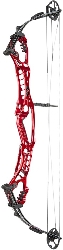
Pros
- Long 40-inch geometry and an 8-inch brace on the GTX cam settle the sight picture for a very forgiving hold
- Adjustable cable guard sets cam lean, riser torque and vane clearance at the range with no bow press
- Modular grip (0, +2, +4, +6 degrees) lets you fit hand angle to your form for a torque-free, dead-center hold
- Spiral Pro cam reaches a 32.5-inch draw at 322 fps - real speed and length for long-draw shooters
- Cam timing and alignment arrive dialed from the box, and the platform paper-tunes to a bullet hole fast
Cons
- Creep tuning rewards patience - a half-twist of the control cable can move groups at distance, so budget setup time
- At 40 inches and about 4.8 pounds it is a deliberate, long-ATA rig - shooters under a 29-inch draw hold better on the shorter Podium X Elite 37
Video
content from YouTube
Editors' review
The Podium X Elite 40 is the bow you reach for when steadiness beats handiness. It is the longer half of Hoyt's 2015 flagship target pair - where the 37-inch Podium X Elite 37 is the all-round length, the 40 stretches the same XT2000 target platform out to a full 40 inches axle-to-axle and, on the GTX cam, an unusually tall 8-inch brace height. That geometry does one job supremely well: it holds the pin still. For the field and 3D archer, and especially the long-draw shooter whose form runs past 29 inches, the extra length translates directly into a calmer sight picture and more margin for a clean release. Everything that makes the platform special carries over - an adjustable cable guard you tune without a press, a four-position modular grip, and a choice between the forgiving GTX cam and the faster Spiral Pro that here reaches all the way to a 32.5-inch draw. It launched at $1,599, the same as its shorter sibling, and it asks the buyer a simple question: how long is your draw, and how much do you value a dead-still hold?
Finish
Like its sibling, the Podium X Elite 40 wears Hoyt's target finishes rather than hunting camo - a blackout option alongside Hoyt's competition colors, chosen to read cleanly on a shooting line rather than to hide in timber. The coating quality held up well under the constant handling a competition rig sees, and archers setting the bow up spoke well of the finish. The look is consistent across both cam configurations, so a GTX or Spiral Pro buyer gets the same anodized riser and limb treatment. On a long target bow that spends its life on a field course or under indoor lights, the finish's job is to stay sharp and glare-free through years of use, and the Podium X Elite 40 is dressed exactly for that. There is no decorative pattern here because a target bow does not need one.Riser
The riser is Hoyt's long Tec-style target design on XT2000 limbs, and at 40 inches axle-to-axle it is built first for a settled hold. The defining hardware is the fully adjustable cable guard bar - four angle settings, internal locking teeth, two lock-down screws - that turns tuning into a range-side task. Sliding the guard in pulls rotational torque out of the riser and keeps the long bow tracking straight through the draw and the shot; its angle sets cam lean and vane clearance without a bow press, which on a competition bow you re-check often. Hoyt kept the low rear stabilizer mount that target archers use to hang a back bar and balance the bow's mass out where it steadies the aim. The longer riser and limb geometry give the 40 more rotational inertia than the 37, which is exactly why it feels planted at anchor. For the archer chasing a still pin at 50 yards or on a downhill field target, this riser is engineered around that single goal.Grip
The grip carries over the platform's modular system: four interchangeable inserts at 0, +2, +4, and +6 degrees, letting the archer set hand angle rather than accept a fixed one. The zero module holds a neutral wrist and each step rolls into a higher-wrist position; swapping takes minutes and the payoff is a torque-free, centered hold. On a 40-inch bow that reward is amplified - a longer riser magnifies any left-right torque the hand introduces, so being able to dial the grip angle to your exact form matters more here than on a short bow. Hoyt's decision to move the grip location back from the earlier Pro Comp Elite makes it easier to balance the stabilizer setup a long target bow demands and encourages the relaxed bow hand that keeps the shot clean. In my experience the combination of a settled long riser and an adjustable grip angle is what lets a shooter quiet the aim without fighting the bow, and that is the whole reason to choose the 40.Limbs
The Podium X Elite 40 uses Hoyt's XT2000 target limbs in a wide split-limb stance, and on this longer riser they give the bow its planted, deliberate character. Peak weight comes in the usual competition brackets - 30-40, 40-50, 50-60, and 60-70 pounds - so a target archer can pick a holding weight they can run through a full field round without fatigue. The wide stance spreads the load and, paired with the long axle-to-axle, produces the calm at anchor that the platform is known for; shooters setting it up described a hold with no hand jitter. This is a proven limb system across Hoyt's target line, tuned for repeatability and endurance rather than the aggressive energy storage a short hunting bow chases. Draw-weight changes are standard limb-bolt work, and the bow keeps its tune across the practice volume that defines competitive shooting. At roughly 4.8 pounds bare per retailer listings, the 40 carries a bit more mass than the 37 - mass that works in its favor as steadiness on a long shot.Eccentric System
The cam choice is the same two-way decision as the 37, but the numbers shift with the longer riser. The GTX Cam and a half offers 1.5 inches of draw-length adjustment through pivoting modules and a selectable let-off of either 65% or 75% (the share of peak weight your holding weight drops to at full draw), paired here with a tall 8-inch brace height that makes the 40 remarkably forgiving for a target bow. The Spiral Pro - the Spiral X family cam - adjusts an inch through interchangeable modules at a fixed 65% let-off and is the faster option, rated 322 fps against the GTX's 308, and on the 40 it reaches a 32.5-inch draw, the longest of the whole platform. That long-draw reach is the 40's quiet advantage: a shooter with a 31- or 32-inch draw who wants speed has a genuine home here. Both cams are modular, so changing draw length or cam position is a module job, not a full cam swap - a convenience the professional archers who set these up singled out. Out of the box, timing and cam alignment arrived good, which is what you want from a bow you plan to fine-tune rather than fix. The draw-stop ledge gives a firm, defined wall for a back-tension release, and the choice between the GTX's let-off flexibility and the Spiral Pro's speed-and-length is the real fork in the buying decision.Draw Cycle/Shootability
At full draw the 40's length is the story. The long axle-to-axle and, on the GTX, the 8-inch brace produce a sight picture that simply sits still - the pin float a shorter bow fights is noticeably calmer here, which is the entire reason a field or 3D archer accepts the extra length and mass. The GTX at 75% let-off is the forgiving choice for a long round; the Spiral Pro pulls firmer and heavier, as a competition cam should, and settles into a solid, ledge-defined wall that a pull-through shooter can lean on. What I keep noticing on this platform is how honest the shot is: with the cable guard set to strip torque from the riser, the long bow tracks straight and tells you exactly what your hand did on release, kicking in the direction you pushed energy through the grip. On the 40, that feedback sits on top of a hold that is already steadier than the 37's, which makes the bow forgiving of everything except a genuinely torqued grip. It is not a dead-in-the-hand hunting bow and does not try to be - it is a long target rig that trades quickness for calm, and for its audience that trade is the point. The short valley on the 65% setups keeps you engaged on the wall, a characteristic of a competition bow rather than a flaw.Usage Scenarios
The Podium X Elite 40 is a competition bow built around a long, steady hold. At 40 inches axle-to-axle it is the length Hoyt points shooters toward when their draw runs longer than 29 inches, and the Spiral Pro cam's 32.5-inch reach makes it a real option for the long-draw archer who has always had to compromise. Picture a field archer working a marked course with steep uphill and downhill targets, where the 40's long axle-to-axle keeps the pin planted through a deliberate aim. Or a 3D shooter who values a calm sight picture over a fast, flat arrow, running the GTX cam at 75% let-off for an easy hold across a full course. Indoor spot shooters with longer draws take the same steadiness to the paper line. It is not a hunting bow - the length, the target let-off options, and the geometry are built for competition, not the treestand - and a shooter whose draw is 29 inches or shorter will find the lighter, handier Podium X Elite 37 a better fit. For the long-draw and field-3D archer who wants the stillest hold in Hoyt's 2015 target line, the 40 is the answer.Versions
The Podium X Elite 40 is one model offered with a choice of cam system, and both configurations launched at the same $1,599 price:- Podium X Elite 40 GTX - GTX Cam and a half, 1.5 inches of draw adjustment via pivoting modules, selectable 65% or 75% let-off, a rated 308 fps, tall 8-inch brace height. The most forgiving configuration in the pair.- Podium X Elite 40 Spiral Pro - Spiral Pro (Spiral X) Cam and a half, one inch of adjustment via interchangeable modules, 65% let-off, 322 fps, brace height 7.5 inches, reaching a 32.5-inch draw. The fast, long-draw configuration.Both come in the 30-70 pound peak-weight brackets and right- or left-hand, and both share the same riser, limbs, grip, and adjustable cable guard - only the cam changes. The choice is whether you want the GTX's tall brace and let-off flexibility or the Spiral Pro's speed and long-draw reach.Hoyt Podium X Elite 40 vs Mathews Conquest 4, Bowtech Specialist
| Bow | Hoyt Podium X Elite 40 | Mathews Conquest 4 | Bowtech Specialist |
| Version | 2016 (Spiral Pro Cam) | 2019 (MaxCam) | 2014 |
| Picture |  |  |  |
| Brace Height | 7.5 " | 7 " | 7.5 " |
| AtA Length | 40 " | 40.625 " | 37.5 " |
| Draw Length | 25 " - 32.5 " | 28 " - 32 " | 26 " - 30.5 " |
| Draw Weight | 30 lbs - 70 lbs | 30 lbs - 70 lbs | 50 lbs - 60 lbs |
| IBO Speed | 322 fps | 310 fps | 330 fps |
| Weight | 4.8 lbs | 4.4 lbs | 4.1 lbs |
| Let-Off | 65% | 80% or 65% | 65%, 75% |
| Where to buy Best prices online |
|
| |
| compare more bows | |||
In the long-axle target class the Podium X Elite 40 lines up against the Mathews Conquest 4 and the Bowtech Specialist, two bows a field or 3D archer would seriously cross-shop. The Mathews Conquest 4 is the closest match on length at 40.625 inches axle-to-axle, with a 7-inch brace, a 310 fps rating, and a light 4.4-pound mass that many long-time target shooters prize for its dead-in-the-hand shot; it is the established long-target benchmark, where the Podium counters with its taller 8-inch GTX brace and its press-free adjustable cable guard. The Bowtech Specialist is the shorter and faster of the three at 37.5 inches and 330 fps with a binary cam, an easy-timing option for the archer who wants a bit more speed in a slightly more compact target bow. Against both, the Podium X Elite 40's signatures are the range-side tuning you get without a press and the two-cam choice - a 65/75% GTX or a 322 fps, 32.5-inch-draw Spiral Pro - on one riser. The decision comes down to priorities: the Podium X Elite 40 for maximum adjustability and long-draw reach, the Mathews Conquest 4 for a proven, ultra-light long-target hold, the Bowtech Specialist for a faster, more compact binary-cam rig. Shorter-draw archers in Hoyt's own line are better served by the Podium X Elite 37.