
Browning Impulse Review
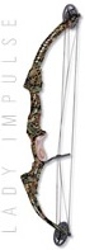

from $99.99
Pros
- Built around the female archer rather than cut down from a man's bow - Browning proportioned the riser and grip for a smaller frame
- At 2.5 pounds it is genuinely light, easy to hold up and carry for shorter-draw and small-frame shooters
- Adjusts at home without a bow press - 3 inches of draw length in half-inch steps, plus a 20-to-50-pound draw-weight span across its brackets by 2001
Cons
- The 25-to-27-inch draw window is built for shorter-draw shooters - taller-draw adults simply fall outside its fit range
- Discontinued since 2001 and found only on the used market - plan on fresh strings and cables and a tune, which brings any surviving example back to spec
Editors' review
Most compound bows marketed to women in the 1990s were men's bows with the draw weight turned down and a lighter color sprayed on. The Browning Lady Impulse was Browning's answer to that, and the company billed it as the first compound designed specifically around the ergonomics of the female archer rather than scaled down from an adult hunting rig. It arrived in 2000 as part of Browning's Micro-Class line - a family engineered for small-frame anatomy - and carried a short 25-to-27-inch draw, a featherweight 2.5-pound mass, and a women's-sized riser and grip. What stands out to me about it is less any single spec and more that intent: a bow sized for its shooter from the first sketch. For a used-market buyer today, or anyone curious where purpose-built women's compounds began, the Lady Impulse is where that idea first took physical form.
Finish
Browning kept the palette simple and seasonal. The 2000 Lady Impulse shipped in Mossy Oak Forest Floor, the muted leaf-and-ground pattern that suited early-season and ground-level hunting. For 2001 Browning added Mossy Oak Break-Up alongside Forest Floor, giving the shooter a choice between the broken-branch Break-Up pattern and the subtler Forest Floor finish. Left-hand models were offered in both finishes for a small upcharge. There is no high-gloss target option here - this was always a camo hunting bow - but the two-pattern choice was more than many budget women's bows of the era offered, and both patterns were full-coverage dips rather than painted-on graphics.Riser
The riser is machined aluminum, and the detail that matters is proportion rather than material. Browning describes it as a Micro-Machined riser meticulously sized for the small-frame shooter, which in practice means a shorter, narrower geometry than a full-size hunting bow carries - the reason the whole bow weighs just 2.5 pounds. It is drilled for two-piece quiver mounts and finished with a custom laminated wood grip rather than a molded plastic shell. Over its two years the riser geometry tightened slightly, with axle-to-axle length (ATA, the tip-to-tip measurement) moving from 33 inches in 2000 to 32 inches in 2001. That is a compact bow by any standard, and the short riser is a deliberate fit decision for a shooter with a shorter wingspan, not a cost cut.Grip
The grip is a custom laminated wood piece, warmer in the hand than the molded synthetic grips common on budget bows of the period and a nicer tactile match for the Lady Impulse's women's-sized riser. Laminated wood takes the chill off on a cold morning the way a synthetic shell never quite does, and it shapes a slim, low-torque hand position that suits a smaller palm. There is no interchangeable side-plate system here the way modern bows offer, so the grip is what it is - but it was chosen to fit the hand the bow was built for. A shooter wanting a different thickness would be looking at aftermarket wrap tape rather than a module swap.Limbs
The Lady Impulse uses Browning's Taper-Flex limbs - a tapered profile Browning adopted to trim limb mass while keeping the limb consistent shot to shot, and part of why the bow comes in so light. Draw weight is set by a pair of overlapping brackets rather than one continuous range, and the span widened over the bow's life: the 2000 model offered 25-to-35 and 35-to-45-pound brackets, while 2001 opened that up to 20-to-35 and 35-to-50 pounds. That lower 20-pound floor matters for a true beginner or a younger teen, and the 50-pound ceiling is enough for whitetail at sensible range. Adjustment happens by turning the limb bolts within a bracket, so a shooter can build up poundage at home as her strength grows without a trip to the shop.Eccentric System
The cams are Browning's Whisper Flyte two-cam system, and the design goal Browning stated for them was to combine the smooth draw of a round wheel with the arrow speed of a more aggressive hatchet cam. A hard-stop inner cam gives the draw a defined end point - a back wall (the firm stop you pull into at full draw) rather than a soft slope. Let-off, the percentage of peak weight the cams shed once you reach full draw, is 65 percent, which by modern 80-percent standards means you hold noticeably more weight at anchor; the 2000 literature also quoted a 71-percent effective figure. Browning rates the bow at 278 feet per second IBO (the industry-standard speed measured at a fixed 30-inch, maximum-weight, light-arrow setup), a figure taken at the Lady Impulse's own maximum draw length and weight with a 200-grain arrow. That is modest by today's numbers, but reasonable for a short-draw, low-poundage women's bow of 2000 - speed was never this bow's pitch. Draw length adjusts across 3 inches in half-inch increments without a bow press, so dialing in the 25-to-27-inch fit is a home job, not a shop visit.Draw Cycle/Shootability
No independent chronograph or sound data exists for a bow this old and this niche, so the honest read of its shooting character comes from its documented design rather than a measured test. A 2.5-pound bow drawing to 45 or 50 pounds holds up very easily - the light mass is the point for a smaller-framed shooter who finds a 4-pound hunting rig a chore to keep on target. The flip side is one I always weigh for light bows: less mass means a little less dead-weight steadiness at full draw, so a shooter leans more on form than on the bow's own inertia to settle the pin. The 65-percent let-off compounds that - you are holding 35 percent of peak weight at anchor, more than a modern 80-percent bow would ask, which rewards drawing a weight you can hold comfortably rather than maxing the bracket. The hard-stop inner cam gives a clean, repeatable wall to pull into, and the low-stretch 450 Plus string with its braided center serving was chosen to keep sight settings from wandering shot to shot. It is a bow that asks for good fundamentals and gives back a light, maneuverable, honestly-sized package in return.Usage Scenarios
Picture the shooter Browning built this for: a woman in the early 2000s who had been borrowing her husband's 28-inch bow, fighting a draw three inches too long and a grip sized for a bigger hand, and who finally wanted a rig that fit. The Lady Impulse is a treestand and ground-blind whitetail bow at that honest range - set to 40 or 45 pounds it carries enough energy for deer inside 25 yards, and the 2.5-pound mass makes the long sits and the climb up a stand far less tiring. At its 20-pound floor the 2001 model doubles as a backyard learning bow for a teen or a first-season beginner, then climbs with her to a 50-pound hunting setup on the same riser. What it is not is a long-draw or a long-range bow: the 25-to-27-inch window and the modest speed put elk at distance and spot-target work outside its brief. For a small-frame hunter who values fit and carry comfort over raw velocity, that tradeoff is exactly the right one.Versions
The Lady Impulse ran for two model years as one bow with minor spec drift, not as separate SKUs.2000 (debut): 33-inch ATA, 6.5-inch brace height, 25-to-35 and 35-to-45-pound draw-weight brackets, 65 percent let-off (71 percent effective), Mossy Oak Forest Floor finish - launch MSRP $260.2001: 32-inch ATA, 6.25-inch brace height, widened 20-to-35 and 35-to-50-pound brackets, 65 percent let-off, offered in both Mossy Oak Break-Up and Forest Floor, with left-hand models available for a $16 upcharge - MSRP $270.Both years shared the 25-to-27-inch draw range, the 2.5-pound mass, the 278 fps IBO rating, the Whisper Flyte two-cam system, the Micro-Machined aluminum riser, and the laminated wood grip. Browning discontinued the model after 2001.Browning Lady Impulse vs Bear Finesse, Diamond Infinite Edge Pro
| Bow | Browning Impulse | Bear Finesse | Diamond Infinite Edge Pro |
| Version | 2001 | 2016 | 2026 Legacy |
| Picture |  |  |  |
| Brace Height | 6.25 " | 7 " | 7 " |
| AtA Length | 32 " | 28.625 " | 31 " |
| Draw Length | 25 " - 27 " | 23 " - 28 " | 13 " - 31 " |
| Draw Weight | 20 lbs - 50 lbs | 30 lbs - 50 lbs | 5 lbs - 65 lbs |
| IBO Speed | 278 fps | 285 fps | 300 fps |
| Weight | 2.5 lbs | 3.0 lbs | 3.3 lbs |
| Let-Off | 65% | 80% | 80% |
| Where to buy Best prices online | |||
| compare more bows | |||
The Lady Impulse pioneered a niche that two current bows now serve, which makes them the natural yardsticks. The Bear Finesse is the closest descendant in spirit - a women's-specific compound with a comparable short 23-to-28-inch draw and a 30-to-50-pound weight range, but a generation newer, with an 80-percent let-off that holds far less weight at anchor than the Lady Impulse's 65 percent and a modern 285 fps IBO. Where the Lady Impulse is a bare bow you set up yourself, the Bear Finesse typically ships as a ready-to-hunt package with sights, rest, and quiver included. The Diamond Infinite Edge Pro comes at the fit problem from the other direction: instead of a women's-specific geometry it offers an enormous 13-to-31-inch draw and 5-to-65-pound range on one bow, so it covers a small-frame woman, a child, and an adult man alike, at 300 fps IBO and a 7-inch brace height. The Lady Impulse answers only the short-draw, lighter-poundage shooter, but it answers her with the lightest package of the three at 2.5 pounds. The decision comes down to priorities: the Lady Impulse for a collector or used-market buyer who wants the original purpose-built women's compound, the Bear Finesse for a shooter who wants a modern women's-specific rig ready to hunt out of the box, and the Diamond Infinite Edge Pro for a household that needs one adjustable bow to fit everyone.