
Xpedition APX Review
Pros
- Flagship-tier speed for the money - a genuine 340 fps IBO rating, with hunting-weight arrows still crossing the chronograph in the high 260s to mid-270s
- Long 33-inch axle-to-axle paired with a tall 6.75-inch brace height, a forgiving and steady-holding geometry uncommon in this price tier
- Firm limb-stop back wall you can lean into - the kind of solid, defined stop usually reserved for flagship bows
- Dead in the hand after the shot, with little post-shot vibration even before dampeners and accessories go on
- Draw length adjusts from 26 to 30 inches with a rotating module and a couple of Allen wrenches, no bow press required
Cons
- The draw firms up noticeably toward the wall at 70 pounds and longer draw lengths - shooters set on a glass-smooth flagship pull should draw one first, and lighter or shorter setups feel distinctly smoother
- Some owners have noted the angled cable rod tightens fletching clearance - orienting the cock vane outward rather than up or down and checking rest clearance at setup clears it
Video
content from YouTube
Editors' review
Most bows that read like a flagship on paper cost like one too. The APX doesn't. Xpedition built it around a 340 fps IBO rating (IBO is the industry-standard speed measured at a fixed 30-inch, 70-pound, 350-grain setup), a long 33-inch axle-to-axle (ATA, the tip-to-tip length that governs how steadily a bow holds), and a firm limb-stop back wall - then priced it in the value tier rather than the flagship one. The catch, and the thing that defines who it's for, is adjustability: where the budget-darling adjustables reach down to a child's draw, the APX is an adult's bow, 60 or 70 pounds only and 26 to 30 inches of draw. That focus is the whole point. Instead of spreading its cam across a 15-to-70-pound grow-with-me range, the APX spends its engineering on speed, a long forgiving riser, and a wall that feels like it belongs on a bow costing twice as much. For the hunter who already knows their draw and just wants performance without the flagship invoice, that's a deliberate, well-aimed trade.
Finish
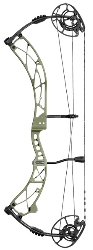
At launch in 2021 the APX offered an unusually broad palette for a value bow - six riser finishes: Realtree Timber, Realtree Edge, Realtree Excape, Molten Black, Tactical Sand, and OPS Green, with custom bowstring colors available on request. Over the production run retail availability narrowed to the two most popular options, Black and Realtree Edge, which is what most shops stock today. The finish itself is a durable factory coating over the machined aluminum, and on the solid colors the deep skeleton cuts of the riser read cleanly without a camo pattern breaking up the lines. The OPS Green solid, in particular, gives the bow a purposeful, understated look that photographs far more expensive than it is. There are no tribute or limited-run graphics here - this is a working hunter's finish set, chosen for the treestand and the truck bed, not the trophy shelf.Riser
The APX riser is machined from aluminum and heavily skeletonized, a lattice of cutouts that trims mass while keeping the long 33-inch chassis rigid - the bare bow lands at a 4.0-pound factory spec, closer to 4.2 to 4.4 pounds once a rest, sight, and stabilizer go on. Xpedition tools these risers to tight tolerances, and the machining quality holds up under close inspection - the pockets, holes, and radii are clean, with none of the roughness that sometimes betrays a budget build. Accessory mounting is conventional and universal: standard stabilizer bushings plus a double burger-button hole that lets you lock an arrow rest solidly into place. One geometry decision is worth knowing before you set the bow up - the cable rod comes off the riser at a fairly tight angle, which pulls the cables in close and tightens the clearance your fletching passes through. It's not a flaw so much as a setup detail, handled by orienting your cock vane outward and confirming rest clearance during tuning. What the aluminum chassis buys, more than anything, is confidence at full draw: a long, stiff riser is the foundation the APX's forgiving hold is built on.Grip
The grip is a slim, side-plate-style hunting grip molded to the riser's throat, low enough in the wrist to encourage a repeatable, low-torque hand position. It's a familiar shape rather than a statement - the sort of grip that feels unremarkable in the first ten shots and quietly right by the fiftieth, as your hand learns where it sits. There's no bulky rubber overmold or aggressive palm swell to fight; the narrow profile keeps the pressure point centered and consistent, which matters more for accuracy than any amount of cushioning. Owners who shoot the bow across a season tend to stop thinking about the grip entirely, which is the highest compliment a hunting grip earns. For shooters who prefer more fill or a warmer surface in cold weather, standard aftermarket side plates and grip wraps fit the riser without modification.Limbs
The APX runs split limbs seated in aluminum limb pockets, and the first thing experienced shooters notice is how slim the limbs and pockets are compared with the wide, beam-like limbs on many current bows. That narrow profile is a design choice, not a shortcut - the limbs are built to store energy efficiently for the bow's 340 fps rating while keeping mass down. Draw weight comes in 60- and 70-pound maximums, and each turns down between 10 and 15 pounds from peak across eight to ten turns of the limb bolts, enough to fine-tune to your setup but not the wide range of a grow-with-me platform. This is squarely an adult hunting draw-weight ladder, which is consistent with the bow's whole identity. Xpedition's aluminum-pocket, split-limb architecture has proven durable across the brand's lineup, and the tight machining of the pockets keeps the limbs seated and timed shot after shot.Eccentric System
The heart of the APX is its APX Cam, driven by a rotating module - a system that lets you set draw length anywhere from 26 to 30 inches in half-inch increments with nothing more than a couple of Allen wrenches, no bow press on the bench. That press-free adjustability at this price is genuinely useful for a shooter dialing in their own setup. The cam is tuned for speed: a 340 fps IBO rating that puts the APX right alongside far pricier bows on the spec sheet. Real chronograph numbers, as always, sit below the marketing figure and depend on your setup - one hands-on session clocked 268 fps at 60 pounds, 28 inches, and a 400-grain arrow, while a heavier 500-grain hunting arrow at 70 pounds and 30 inches clocked 272 fps, with lighter hunting shafts landing higher still. Let-off (the percentage the holding weight drops to at full draw) is 75 percent, lower than the 80-to-85 percent of many flagships, and it can be nudged slightly by repositioning the limb stops. Those limb stops are the other half of the story: they give the cam a hard, defined stop rather than a soft cable-stop slope, and that's what produces the bow's standout back wall. The result is a cam system that reads value on the price tag and performance in the hand.Draw Cycle/Shootability
Drawing the APX honestly depends on how you have it set up. Pulling the 70-pound bow to a 30-inch stop, I felt the cam load up and firm through the last few inches before it locked hard against the limb stops - it's a purposeful, athletic draw, not a lazy one, and that firmness is the tax you pay for a 340 fps cam with a defined wall. Set lighter and shorter, at 60 pounds and a shorter draw, the same bow rolls back noticeably smoother, which is why hands-on impressions of the draw cycle split along the lines of how each shooter had it configured. What everyone agrees on is the wall itself: it's rock solid, a hard stop you can put tension into without creep, and at 75 percent let-off it holds firmer than a high-let-off flagship - you feel the holding weight, but the trade is a wall that anchors your shot. The valley is short and definite rather than long and forgiving, which rewards staying engaged. Where the APX really earns its keep is after the shot: it sits dead in the hand with minimal vibration, and shot noise measured from about 92 to 98 decibels across hands-on tests - mid-pack for the tier, though one shooter found it a touch loud outdoors. When it went off, the bow simply sat in my hand - no jump, no buzz coming back through the grip. The release, in the end, behaves better than the pull suggests - work through the firm ramp, settle into that wall, and the shot comes off steady.Usage Scenarios
The APX is a whitetail and general big-game hunter's bow first. Its 340 fps rating and 60-to-70-pound draw put more than enough kinetic energy behind a broadhead for ethical shots on deer, hogs, and antelope at typical bowhunting ranges, and the long 33-inch axle-to-axle steadies the pin for the hunter who values a forgiving hold over a compact package. Picture the treestand shooter waiting out a long sit, or the western hunter taking a slightly longer poke across a cut - the long riser and tall brace height are exactly the geometry that rewards those shots. It suits the archer who already knows their draw length and wants a real hunting setup without a flagship's price, and it doubles comfortably as a backyard and 3D bow thanks to that stable platform and firm wall. What it is not is a grow-with-me family bow: the 26-to-30-inch draw range and 60/70-pound minimums mean it won't scale down to a young child or a very short-draw beginner. Buyers in that situation are better served by one of the wide-range adjustables. For the adult hunter it's built for, though, the APX covers the season from opening-day treestand to late-season ground blind without asking for a second bow.Versions
The APX is sold as a single platform with SKUs that differ only in draw weight and finish, all at one price. Draw weight is offered in 60- and 70-pound maximums, and finish is currently Black or Realtree Edge at retail (the 2021 launch palette ran to six riser colors). On pricing, the APX debuted in 2021 in the mid-price tier; the manufacturer's own store listed it at $849 in 2022, and over its production run Xpedition has walked that price down - it currently sells for $599.99 as of 2026, well below where it started and squarely in value-performance territory. Whichever weight and finish you choose, the bow shoots the same; the choice is simply your poundage and your camo.Xpedition APX vs Bowtech Amplify, Diamond Edge 320
| Bow | Xpedition APX | Bowtech Amplify | Diamond Edge 320 |
| Version | 2026 | 2026 | 2022 |
| Picture |  |  |  |
| Brace Height | 6.75 " | 6 " | 7.25 " |
| AtA Length | 33 " | 31.5 " | 32 " |
| Draw Length | 26 " - 30 " | 21 " - 30 " | 15 " - 31 " |
| Draw Weight | 50 lbs - 70 lbs | 8 lbs - 70 lbs | 7 lbs - 70 lbs |
| IBO Speed | 340 fps | 335 fps | 320 fps |
| Weight | 4.0 lbs | 4.0 lbs | 3.6 lbs |
| Let-Off | 75% | 85% | 85% |
| Where to buy Best prices online |
| ||
| compare more bows | |||
Set beside the two value benchmarks it's most often cross-shopped against, the APX stakes out a clear position. The Bowtech Amplify ($599 launch in 2021) is the ultra-adjustable one - a 335 fps, 31.5-inch bow that reaches from 8 to 70 pounds and 21 to 30 inches of draw at 85 percent let-off, a true one-bow-for-the-whole-family platform. The Diamond Edge 320 ($449 launch) plays the same adjustability game from the other end, a 320 fps, 32-inch bow spanning 7 to 70 pounds and 15 to 31 inches, also at 85 percent let-off. The APX gives up that enormous adjustment range entirely and spends the difference on performance: it's the fastest of the three at 340 fps, the longest at 33 inches axle-to-axle for the steadiest hold, and the only one with a firm limb-stop wall and a hunting-focused 75 percent let-off rather than the softer 85 percent high-let-off feel. The decision comes down to priorities: the Bowtech Amplify or Diamond Edge 320 for the buyer who needs one bow to grow across draw lengths and poundages - a household sharing it, or a new archer still changing - and the APX for the adult hunter who already knows their draw and wants speed, a long forgiving riser, and a flagship-style wall for the money.