
Alpine Denali Review
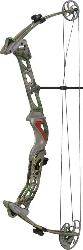

from $199
Pros
- Long 34-inch axle-to-axle and a tall 7-inch brace height make it genuinely forgiving - owners repeatedly credit it with tighter groups than the bows they moved up from
- Machined torque-free grip section and a one-piece rosewood grip drop the hand into the same low-torque spot shot after shot
- Parallel, highly reflexed Bi-Flex limbs plus the included Tundra VX dampers give a dead, low-shock shot uncommon in an economy single-cam of its era
- Simple Fast Trac single cam holds its tune and adjusts across 26-30 inches in the field, no bow press required
Cons
- Draw cycle is draw-length-dependent - smooth for longer-draw shooters, but some owners under roughly 28 inches find it firm; short-draw buyers should shoot one first or order the optional 65% let-off for an easier pull
- Moderate 307 fps IBO - real hunting-weight speed lands near 253 fps at 70 pounds and a 27-inch draw, plenty for whitetail ranges but short of what long-shot, flat-trajectory shooters want - they are better served by a faster bow
Editors' review
Here is a hunting bow built on target-bow bones. When Alpine launched the Denali for 2005 it wrapped a treestand hunter around a 34-inch riser and a 7-inch brace height - geometry most brands reserve for the spot line - and the result is a bow that forgives a rushed shot better than its price bracket has any right to. The trick is underneath: the Denali is the first of Alpine's Tundra Series, and its riser is not machined from one billet but assembled from individually machined components bolted into a single reflexed unit. That let a small, value-focused Idaho maker build a long parallel-limb riser without the material waste of billet or the warp of an extrusion. Speed is not the headline here - 307 fps IBO is honest, mid-pack for its day - so the pull is a steady hold, a low-torque grip, and a dead shot. This is the bow for the archer who counts arrows in the ten-ring, not feet-per-second on a box.
Finish
The hunting Denali and Denali Match Grade wear a single film-dipped camo, Realtree Hardwoods Green HD, applied across both the riser and the Bi-Flex limbs for an even, period-correct woodland pattern. There is no rainbow of finish options here the way a modern flagship offers - this is a mid-2000s bow from a value brand, and one well-executed hunting camo was the plan. The dip coverage is complete, wrapping the machined riser components and the limb faces alike, which matters on a riser assembled from several parts because it visually unifies the build. For 2006 Alpine broke the Denali out of camo entirely with the Denali Pro Competition, a target-dressed version offered in solid tournament colors including blue and orange. That split - woodland for the woods, bright solids for the shooting line - tells you how Alpine saw the platform: one chassis, two audiences.Riser
The Tundra Series riser is the story of this bow. Rather than machine a long parallel-limb riser from a solid aluminum billet - expensive, and wasteful of material - or extrude it and fight the twist that extrusions develop, Alpine machined individual components and bolted them into a finished riser unit. The payoff is a genuinely long, heavily reflexed riser at a working-man price. Geometry is aggressive: the reflex stores energy the 7-inch brace height would otherwise give away, and the grip section is machined to sit torque-free in the hand. A straight-mounted carbon cable guard keeps the guard flex low and consistent, and the 8.25-inch single-plane sight window gives a clean, square shelf for a rest and a long sight picture. In my experience a riser this long and this reflexed is what does the forgiving - it settles the pin and slows the wobble far more than any marketing feature does.Grip
The Denali uses a one-piece wrap-around rosewood grip, a warm, slim wooden hand that was still common on mid-2000s bows before rubberized and skeletonized grips took over. Wood does two things well here: it stays warm against bare fingers on a cold morning stand, and paired with the machined torque-free grip section it encourages the same repeatable, low-torque hand placement every draw. Drawing it, I found the narrow wood throat pushes the web of the hand into one natural pocket rather than letting you wander, which is exactly what you want on a bow whose whole pitch is forgiveness. Buyers who prefer a modern molded grip can swap in an aftermarket side-plate style, but most owners simply leave the rosewood alone - it is a large part of why the bow feels the way it does.Limbs
The Denali runs Bi-Flex composite limbs - split, parallel, and highly reflexed - seated in Alpine's Inter-Loc Limb Mounting System pockets. The parallel geometry is the functional heart of the low-shock shot: as the limbs recover they move in opposition, canceling much of the forward jump that a deflex-riser single-cam of the era would deliver into the hand. Draw weight comes in 60- and 70-pound peaks, covering most adult hunting setups. Adjustment is straightforward and press-free for draw-length changes within the cam's range, which suits the field-and-backyard owner who does his own tuning. Across Alpine's Tundra line these split composite limbs earned a reputation for holding up, and the film-dipped faces resist the scuffs that bare limbs pick up in a truck and a treestand.Eccentric System
At the center sits Alpine's Fast Trac Ball Bearing One Cam - a single cam turning on ball-bearing axles, which is the simplest reliable eccentric a hunter can own. IBO speed (the industry chronograph rating taken at 30 inches, 70 pounds, and a 350-grain arrow) is a stated 307 fps, an honest mid-pack number for 2005-2007 rather than a speed-race figure. Real-world numbers from an owner's chronograph on a 2006 Match Grade tell the practical story: about 270 fps with a 351.8-grain arrow, 253 fps with a heavier 402-grain shaft, both at 70 pounds and a 27-inch draw, and 235 fps when that same heavy arrow is pulled at 60 pounds. The single cam sets draw length across 26 to 30 inches in half-inch steps, and let-off is 80% standard with a 65% option - think of 80% let-off as holding roughly 14 pounds of a 70-pound peak at full draw, versus about 24 pounds at 65%, which target shooters sometimes prefer for a more active hold. A single cam like this trades a hair of the nock-travel precision a well-timed two-cam offers for the thing hunters actually value here: nothing to synchronize, and a tune that stays put.Draw Cycle/Shootability
This is where the Denali divides its owners, and honestly so. Pulled at a longer draw - 29 to 30 inches - the Fast Trac cam rolls up and over into an easy, gradual cycle that shooters describe as one of the bow's best traits. Bring the same cam down to a 27-inch draw and the ramp stacks up sooner; at least one long-time shooter near 27.5 inches found the pull firmer than nearly anything he had drawn in years. Neither impression is wrong - the cycle simply favors the longer draw. What everyone agrees on is the aim and the shot. The 34-inch riser and 7-inch brace hold the pin like a bow a category more expensive, and I keep coming back to how quietly it settles after the release - the parallel limbs and the factory Tundra VX dampers leave very little in the hand. It is not a speed bow's harsh crack; it is a low, dead thump. For a developing shooter or a hunter who wants the bow to cover a small timing error, that combination of steady hold and quiet finish is the whole appeal.Usage Scenarios
The Denali is at its best in a whitetail woods. Picture a treestand hunter with a 20-yard shooting lane and a heavy, quiet arrow: the long riser holds the pin dead while a buck feeds under the stand, and the low-shock release does not rock the stand or ring the aluminum. At moderate whitetail and hog ranges the roughly 250-270 fps of real speed is plenty of energy, and the forgiveness buys margin on the kind of half-drawn, heart-pounding shot that hunting actually produces. A ground-blind hunter gains from the same steady hold in a cramped, awkward sitting position. The Match Grade, with its integrated rest, sight, and stabilizer, suits the hunter who wants target-grade accuracy hardware without assembling it piece by piece, while the bright-colored Denali Pro Competition points at 3D and indoor spot shooters who value the long-riser forgiveness on a scored target. Where the Denali is not the answer is the long western shot - for elk at extended range where a flatter, faster arrow matters more than a placid hold, a speed bow serves better.Versions
The Denali shipped in three closely related forms on one chassis, all sharing the same riser, limbs, and Fast Trac cam. The base **Denali** is the hunting configuration in Realtree Hardwoods Green HD, and it came with Alpine's Tundra VX Dampening Package - a roughly $40 value - included free. The **Denali Match Grade** is the same bow built out target-ready, with an integrated Alpine Whisperflite fall-away rest, a Montana Black Gold Flash Point sight, and an MR2 stabilizer, so it arrives shootable out of the box; owners reported paying around $425 for a complete Match Grade new in 2006, in keeping with Alpine's economical, working-man positioning. For 2006 Alpine added the **Denali Pro Competition**, a dedicated target version dressed in solid tournament colors such as blue and orange rather than camo. There were no separate electronics or hand-specific SKUs - the choice was simply hunting camo, target-ready package, or bright-colored target model.Alpine Denali vs Bear Truth, Martin Bengal
| Bow | Alpine Denali | Bear Truth | Martin Bengal |
| Version | 2007 | 2007 | 2010 Mag |
| Picture |  |  |  |
| Brace Height | 7 " | 7 " | 7 " |
| AtA Length | 34 " | 33 " | 32.25 " |
| Draw Length | 26 " - 30 " | 23 " - 30 " | 25 " - 30 " |
| Draw Weight | 60 lbs - 70 lbs | 50 lbs - 70 lbs | 40 lbs - 70 lbs |
| IBO Speed | 307 fps | 310 fps - 314 fps | 315 fps - 320 fps |
| Weight | 4.2 lbs | 4.2 lbs | 3.5 lbs |
| Let-Off | 80% | 80% | 65% - 80% |
| Where to buy Best prices online | |||
| compare more bows | |||
Three forgiving, moderate-speed single-cam hunters from value-minded brands, and the choice is one of small preferences rather than class. The Bear Truth is the closest twin: a 33-inch, 7-inch-brace single cam rated 310 to 314 fps, and its real edge is a draw-length range that opens down to 23 inches, which pulls in shorter-draw and younger shooters the Denali's 26-inch floor leaves out. The Martin Bengal is a touch faster on paper at 315 to 320 fps in a slightly shorter 32.25-inch package, and its draw weight adjusts down to 40 pounds against the Denali's 60-pound hunting floor, giving families and lighter-poundage shooters more room. Against both, the Alpine Denali counters with the longest riser of the three at 34 inches and that heavily reflexed Tundra geometry - the most forgiving hold and the deadest shot of the group, at the cost of a couple feet-per-second and a higher draw-weight entry point. The decision comes down to priorities: the Bear Truth for the shooter who needs a short or growing draw length, the Martin Bengal for the buyer who wants lighter poundage and a hair more speed, and the Denali for the archer who will trade both away for the steadiest aim on the line.