
Alpine Frontier Review

from $100
Pros
- Approachable for a genuine first-timer - an owner bought his as a first bow and was hitting a target at 125 feet while still sighting it in
Cons
- Longer 35-inch axle-to-axle - more bow to maneuver in a tight ground blind or on run-and-gun public-land sets, so the mobile hunter should weigh whether the forgiving length suits how they hunt
Video
content from YouTube
Editors' review
Alpine built the Frontier around a promise most budget bows of the mid-2000s could not make: no cut-rate plastic. Where the sub-$300 shelf was full of cast risers and polymer cam-and-pocket assemblies, the Frontier's handle, its Advantage One Cam, and its limb pockets are all machined from aluminum - the same construction language Alpine used higher up its own line. Introduced in 2006 and carried through 2010, it was the value hunting rig in the catalog, a lightweight 3.5-pound single-cam bow (one cam and an idler wheel rather than two synchronized cams) that a first-time buyer could find on a mass-retail rack and take to the woods. It is not a speed bow and it is not a modern parallel-limb hunter; it is a metal-hardware entry bow with an honest 300 fps IBO rating (the industry-standard chronograph number measured at a fixed 30-inch, 70-pound, 350-grain setup) and a wide fit range. This review covers what that construction actually buys the buyer, who the bow fits, and where a shopper of its era would have cross-shopped it.
Finish
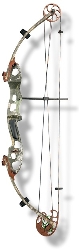
The Frontier's standard dress was Alpine's Next G-1 camo - the finish its 2008 and 2010 catalogs both list - while by 2010 Alpine's own product page showed the bow in Mossy Oak Break-Up, either pattern over accented brown anodized hardware that gave it a warmer, less clinical look than the black-and-silver budget norm. The camo is a film-dipped finish applied over the composite limbs and riser rather than a printed wrap, which wears better against brush and bowhanger rub. There is a single hunting-camo direction here rather than a menu of solids and patterns - this was a one-look bow aimed at the whitetail woods, not a target line with color options. The brown hardware accents are the small styling touch that dated it as a mid-2000s Alpine, and they are part of why owners describe the bow as sharper-looking than its price suggested.Riser
The riser is the Frontier's argument. It is a machined aluminum handle rather than a cast one, and Alpine carried that same machined approach into the cams and the limb pockets, so the load-bearing hardware on a budget bow is cut metal instead of the polymer parts common in the tier. Cable containment is handled by a straight-mounted carbon cable-guard rod, and the sight window is a 5.5-inch single-plane cut - enough room to run a standard fixed-pin hunting sight without crowding. Limbs attach through Alpine's Pivoting Limb Mounting System, marketed as the Challenger Series pockets, which let the limb seat and pivot in the pocket as draw weight changes. What stands out to me about the build is how much of it is cut metal - the pocket, the cam, and the handle are machined aluminum rather than molded filler, and that is the single thing that separated this bow from the rack around it. For a buyer whose alternative was a fully cast package bow, the machined chassis is the reason to look here.Grip
The standard grip is a two-piece ABS side-panel grip mounted directly to the machined riser - a straightforward, medium-profile hunting grip with no rubber overmold or heat-shrink. Buyers who stepped up to the Frontier Package got a wood panel grip in place of the ABS panels, a warmer feel in cold weather and the more traditional look that matched the brown hardware. Neither grip is a torque-inducing thick wrap; both keep the hand fairly centered on the riser. In my experience a simple side-panel grip like this is easy to shoot consistently precisely because there is so little to it - there is no fat rubber wedge pushing the hand off center - and a buyer who prefers a rubberized surface can add an aftermarket slip-on grip cheaply.Limbs
The Frontier uses Bi-Flex composite limbs 14.5 inches long, film-dipped to match the riser finish and seated in the pivoting Challenger Series pockets. Alpine sold the bow in 50, 60, and 70-pound peak-weight options, which is a genuinely useful span at this tier - the 50-pound build fits a smaller-framed or younger adult and the 70-pound build is a full whitetail-and-up hunting weight, so a household did not have to buy up a line to get real draw weight. Composite (rather than solid fiberglass) limbs keep the mass down and contribute to the 3.5-pound bare weight. The pivoting-pocket design is the same idea Alpine used across its catalog and had a clean reliability record on these single-cam bows. Draw weight adjusts through the limb bolts in the normal way; nothing here needs a bow press for weight changes within a build's range.Eccentric System
At the center of the bow is the Alpine Advantage One Cam, a single cam paired with a top idler wheel and running on bronze bearings. Draw length adjusts from 26 to 30 inches through rotating modules on the cam (draw length is how far back the string travels to full draw), so a buyer covers most adult draw lengths without swapping cams. Let-off is 80% standard with an optional 65% setting - let-off being the percentage of peak weight the bow sheds at full draw, so at 80% a 70-pound bow holds 14 pounds in the hand. The practical appeal of a single cam is what it does not ask of the owner: there are no two cams to keep in time, so the tune stays put and there is less to go wrong for someone new to bows. The rated speed is 300 fps IBO; no independent chronograph data exists for this discontinued bow, so that IBO figure - not a real-world number at a hunting arrow weight - is the honest speed reference. What I keep coming back to on a bow like this is that the single cam is the right engineering choice for the audience: it trades the last few feet per second of a dual-cam speed bow for simplicity a first-year archer can actually maintain.Draw Cycle/Shootability
A single-cam bow of this geometry draws in a predictable, rounded way rather than with the aggressive front-loaded ramp of a speed cam, and the 80% let-off drops the holding weight low enough that a new shooter can settle the pin without fighting the bow. The 35-inch axle-to-axle length and 7.25-inch brace height are the forgiveness story here: a longer riser and a taller brace make the bow slower to react to small hand and release errors, which is exactly what a developing archer needs while form is still coming together. Alpine set each Frontier up at the factory with its own string-dampening accessories and marketed the result as extremely quiet; the verifiable part of that claim is that the dampers are installed at the factory, so the bow arrives with vibration hardware already on it rather than as an upsell. The clearest real-world read on the bow comes from an owner who bought his as a first bow and was hitting a target at 125 feet while still sighting it in. By its geometry and cam, my read is that this is a bow built to be easy rather than exciting: it will not thrill a shooter chasing speed, but it lets a beginner build confidence fast, and that is the harder thing to design at the price.Usage Scenarios
The Frontier fits the new adult hunter on a tight budget more cleanly than almost anything else it shared a shelf with. Picture a first-season whitetail hunter who buys the bow off a sporting-goods rack in late summer, sets it up in the backyard through August, and is sighted-in and treestand-ready by opening weekend - the 300 IBO rating and 60 or 70-pound builds carry more than enough energy for whitetail and hogs at practical treestand ranges. In the 50-pound build it works as a lighter setup for a smaller-framed adult or a strong teenager moving up from a youth bow. It is a general woods-hunting and backyard-practice bow, comfortable for a shooter building form because the long axle-to-axle and tall brace are forgiving. Where it is the wrong tool is the run-and-gun mobile hunter squeezing into a tight ground blind or hanging light public-land sets - the 35-inch length is more bow to manage than a compact modern hunter - and the target or 3D shooter chasing tight scores will want a purpose-built rig. Inside its lane, though, it is a lot of durable metal hardware for a first serious bow.Versions
Two SKUs shipped under the Frontier name, and they are the same bow - the differences are what comes in the box, not how it shoots.Frontier (bow only) - the machined single-cam bow on its own, set up at the factory with Alpine's dampening accessories, in the ~$299 retail range during its run. The buyer supplies rest, sight, and quiver.Frontier Package - the complete hunting kit in the ~$400 range during its run: the bow plus a Match Grade dual ball-bearing fall-away rest, a 5-arrow Soft Loc quiver, a Pro Flex stabilizer, a Montana Black Gold fiber-optic sight, and an upgraded wood panel grip in place of the ABS panels. For a first-time buyer with nothing on the shelf, the package was the sensible way in.(Alpine did not publish an official MSRP for the Frontier; the figures above are the retail and owner-reported prices from its 2006-2010 run.)Alpine Frontier vs Diamond Razor Edge, Bear Truth
| Bow | Alpine Frontier | Diamond Razor Edge | Bear Truth |
| Version | 2010 | 2012 | 2007 |
| Picture |  |  |  |
| Brace Height | 7.25 " | 7 " | 7 " |
| AtA Length | 35 " | 31 " | 33 " |
| Draw Length | 26 " - 30 " | 19 " - 29 " | 23 " - 30 " |
| Draw Weight | 40 lbs - 70 lbs | 15 lbs - 60 lbs | 50 lbs - 70 lbs |
| IBO Speed | 300 fps | 308 fps | 310 fps - 314 fps |
| Weight | 3.5 lbs | 3.8 lbs | 4.2 lbs |
| Let-Off | 80% | 75% | 80% |
| Where to buy Best prices online | |||
| compare more bows | |||
In the mid-2000s budget single-cam hunting class, the Frontier's natural rivals were the Diamond Razor Edge and the Bear Truth - two cross-brand bows a value buyer of the era would have cross-shopped on the same rack. The Diamond Razor Edge, from Bowtech's value brand, was the adjustability champion of the group: an enormous 19-to-29-inch draw range and a 15-to-60-pound weight span made it the one-bow-fits-the-whole-family choice, and its shorter 31-inch axle-to-axle made it handier in tight quarters, though its top weight tops out below the Frontier's 70-pound build. The Bear Truth, a 2007 single-cam Bear hunter in the same entry package class, split the difference - a shorter 33-inch bow with a mature single-cam draw and Bear's broad accessory support. What the Frontier brings that neither fully matches is the fully machined aluminum riser, cams, and pockets - the Razor Edge and Truth lean harder on cost-engineered hardware to hit their price. The decision comes down to priorities: the Diamond Razor Edge for the household that needs the widest one-bow adjustment range, the Bear Truth for the buyer who wants the deepest dealer and accessory network, and the Frontier for the buyer who specifically wants metal hardware and a longer, more forgiving hunting geometry at the entry price.