
Alpine Micro Review
Pros
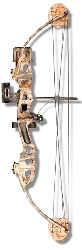
- Machined 6061 aluminum cams and limb pockets where budget youth bows usually run molded plastic - a genuine hunting-bow build in a small frame
- Hard-shooting two-cam Stalker II system rated 280 fps IBO, fast and hunting-legal for a youth-and-ladies bow
- Eight inches of draw-length range (21 to 28 inches) with the peak weight backing down to fit almost any kid or a short-draw woman
- Micro Elite Package arrives ready to shoot - drop-away rest, Bear Claw quiver, and Cobra three-pin fiber-optic sight - for around $300 at the time
Cons
- As a two-cam bow it needs both cams timed after break-in and after any draw-length change - plan on a shop setting the draw and re-timing it after the first 50 to 100 shots
- The 21-inch draw floor makes it a tween-to-adult fit rather than a small-child starter - families sizing a 5-to-8-year-old should look at a dedicated micro-youth bow instead
Video
content from YouTube
Editors' review
Most youth bows tell you where they cut the budget the moment you pick one up: molded plastic cams, injection-molded limb pockets, a hollow feel that says "starter toy." The Alpine Micro was built to do the opposite. Its cams are machined from 6061 aluminum, its limb cups are machined aluminum, and Alpine put a genuinely aggressive two-cam system on a bow sized for a kid or a short-draw woman - a youth bow assembled like a hunting bow. Made by Alpine Archery of Lewiston, Idaho, and sold from the early 2000s through 2010 before the Jim Shockey Lil Guff replaced it, the Micro rated 280 fps IBO, carried eight full inches of draw-length adjustment from 21 to 28 inches, and came in peak weights a shop could turn down to fit almost any young shooter. This is the bow for the parent who wants their kid's first real bow to be a real bow, and for the short-draw woman who is tired of being handed something built like a pool toy. It shoots hard enough to hunt with and is put together well enough to hand down to the next kid in line.
Finish
The standard Micro wore Alpine's Next G-1 camo over brown anodized hardware, finished with a film-dip process - the same dip-and-coat approach Alpine used across its adult hunting line, so the youth pricing did not buy a fragile coating. The look leans warm and understated rather than flashy: a classy riser profile, rich brown accents, and a full camo dip that holds up to being dragged in and out of a truck and leaned against tree bark by a ten-year-old. For shooters who wanted a target-room look instead of a treestand one, Alpine offered the Micro Target in a blue-and-red color scheme on the same hardware. The palette is deliberately short, which fits the bow's purpose - this is a one-or-two-color youth bow, not a flagship with a color book. What matters more than the number of options is that the finish is a durable dipped camo rather than a painted-on graphic that chips off the first season.Riser
The Micro's riser is a compact machined-aluminum handle scaled down for a short-draw shooter, and it carries the same no-shortcuts philosophy Alpine put in print for this bow - the company stated flatly that there are no plastic components on it. In the hand it reads as a small hunting riser rather than a youth toy, with enough mass in the right places to sit steady for a young archer still learning to hold on target. Weight adjustment runs through the limb bolts across roughly a ten-pound span, so a shop can dial the bow down from its stamped peak without swapping parts. The geometry is conventional - a straightforward cable guard and slide route the buss cables off to the side, exactly what a two-cam bow of this era used - and nothing about the layout demands special tools or a proprietary setup. It is a genuinely solid little riser, the kind of part that makes the bow feel worth more than it cost.Grip
Alpine fitted the Micro with a slim two-piece grip shaped low in the wrist, which is the right call for small and developing hands - a low-wrist grip lets a young shooter seat the web of the hand consistently without wrapping the fingers into a torque-inducing death grip. Sources differ on the exact material: Alpine's spec sheets list a composite (ABS) two-piece grip, while some Micro Elite packages left dealers wearing a wood panel grip, and Alpine sold a low-wrist rosewood Wood Panel Grip for its Silverado Series for archers who preferred the warmer feel of wood. Either way the shape is the same low-torque, narrow profile, and either way the surface stays comfortable in a cold-weather glove. For a bow whose whole job is teaching repeatable form to a beginner, a grip that encourages the same hand placement shot after shot matters more than the panel it is cut from, and the Micro's narrow low-wrist shape does that well.Limbs
The Micro runs split limbs in machined aluminum limb cups - the same machined pockets Alpine bragged about, not the molded plastic that shows up on most bows at this price. Alpine's Power Tuff limbs are 13 inches, sized to the compact frame, and they store energy efficiently enough to drive the bow to its 280 fps IBO rating despite the short draw. Peak weight came in 40- and 50-pound options in the later catalogs, with a lighter 30-pound option in the earlier run, and because the limb bolts back the bow down about ten pounds from peak, a single 50-pound Micro covers a wide practical span - a shop can set it soft for a first-timer and crank it up as the shooter grows. Adjusting draw weight is a routine limb-bolt turn with a hex wrench, no press required for the everyday changes. Split-limb geometry like this has a long track record across Alpine's lineup, and on a youth bow it keeps the mass low and the bow lively in a small archer's hands.Eccentric System
The heart of the Micro is Alpine's Stalker II - a two-cam system, one cam top and bottom, machined from 6061 aluminum and running on bronze bushings. It is a deliberately aggressive cam for a youth platform: the published rating is 280 fps IBO, taken at the bow's own 28-inch, 50-pound maximum rather than the 30-inch, 70-pound, 350-grain setup a full-size bow's IBO number uses, which is genuinely quick for a small bow and comfortably above what most youth-class bows of its day produced. Draw length spans 21 to 28 inches - a full eight inches - and changing it does not require a new cam or module: you reposition the cam on the base via a hidden hex screw, moving toward the plus mark to lengthen and the minus to shorten. The catch, and the thing to understand before buying, is that this is a two-cam bow, so any draw-length change has to be made on both cams and the two must be timed to roll over together. Let-off is 65 percent (the share of peak weight the cams shed at full draw), which means a 50-pound Micro holds around 17 pounds in the hand and a 40-pound setting holds about 14 - moderate by modern standards, enough relief for a young shooter without the long, loose valley of an 80-percent hunting cam. The payoff for the two-cam layout is speed and a straight-tracking nock; the tradeoff is that timing is a maintenance item rather than a set-and-forget.Draw Cycle/Shootability
Drawing the Micro, the first thing that registers is how little it behaves like a starter bow - the two-cam Stalker II builds to a defined peak and rolls over hard rather than mushing through a soft ramp, and the shot leaves with real authority for a bow this small. What I notice picking it up is that it does not feel hollow the way most youth bows do - the machined-aluminum cams and metal limb cups give it a density in the hand you register before you ever draw it. That aggression is the point: it is what lets a 50-pound Micro throw a hunting arrow fast enough to be legal on game, and it is what a dealer who sold plenty of them meant in calling it a hard-shooting little cam. The 65-percent let-off gives a shorter, firmer hold than the deep 80-percent valleys today's shooters expect, so the bow rewards a young archer who stays engaged and settles into the wall rather than one who lets the draw creep forward. In my experience a moderate let-off like this is actually a good teacher for a beginner - it builds the habit of holding through the shot instead of relaxing into a long valley. Because the peak backs down through the limb bolts, the same bow that a strong teenager shoots at 50 pounds can be set soft enough for a first-timer to draw cleanly, which is the quiet advantage of a real adjustable hunting-style cam over a fixed youth wheel. It is not a whisper-quiet flagship - this is a straightforward two-cam bow from the late 2000s - but for its size and price the shot is solid and the bow points and holds better than its weight suggests.Usage Scenarios
The Micro is, first and foremost, a first-real-bow for a young or short-draw hunter, and its 280 fps IBO and 50-pound peak give it the punch to back that up - a capable teenager set at 50 pounds has enough arrow speed and energy for whitetail at the close ranges most young hunters shoot. Picture a tween who starts the summer flinging arrows in the backyard at 30 pounds, grows into the bow over a season or two as a shop turns the limb bolts up, and sits their first treestand with the same rig set near its 50-pound peak - the Micro is built for exactly that arc. It doubles as a women's and ladies' hunting bow for adults whose draw falls in the 21-to-28-inch window and who want a genuine, hard-shooting setup rather than a scaled-down toy. It handles backyard practice, 3D club days, and small-frame target shooting comfortably, and its machined build makes it durable enough to pass down to the next sibling in line. What it is not is a bow for the youngest, smallest beginners - the 21-inch draw floor puts it a step above the toddler-to-tween starter bows - and its 28-inch ceiling means a long-draw adult will run out of bow. Inside its window, though, it covers the whole path from first arrow to first animal.Versions
The Micro was sold in three configurations under one design. The bow-only Micro sold new in the low-to-mid $200s in its era, dressed in Next G-1 camo with no accessories - the choice for a buyer who already owns a rest, sight, and quiver or wants to build the bow up themselves. The Micro Elite Package was the ready-to-shoot option at around $300 at the time, adding Alpine's own drop-away arrow rest, a three-arrow Bear Claw Soft Loc quiver that pops on and off and mounts straight or angled, and a Cobra composite three-pin fiber-optic sight - everything a young shooter needs to start putting arrows on target the day the bow comes home. The Micro Target was the same bow and hardware finished in a blue-and-red target color for shooters who wanted a range look rather than camo. All three share the identical chassis, cams, and shooting behavior; the choice among them is simply how much you want in the box and which finish you prefer.Alpine Micro vs Bear Apprentice, Diamond Infinite Edge
| Bow | Alpine Micro | Bear Apprentice | Diamond Infinite Edge |
| Version | 2010 | 2011 | 2015 |
| Picture |  |  |  |
| Brace Height | 6 " | 6 " | 7 " |
| AtA Length | 32 " | 27.5 " | 31 " |
| Draw Length | 21 " - 28 " | 15 " - 27 " | 13 " - 30 " |
| Draw Weight | 30 lbs - 50 lbs | 20 lbs - 50 lbs | 5 lbs - 70 lbs |
| IBO Speed | 280 fps | 265 fps | 310 fps |
| Weight | 3 lbs | 2.9 lbs | 3.1 lbs |
| Let-Off | 65% | 70% | 75% |
| Where to buy Best prices online |
| ||
| compare more bows | |||
The Micro's closest natural rival is the Bear Apprentice, another compact adjustable youth-to-adult bow in the same affordable tier. The Bear Apprentice reaches lower on both ends - a 15-to-27-inch draw range and a draw-weight floor down around 20 pounds let it start a genuinely small child that the Micro's 21-inch, 30-pound floor cannot - and like the Micro it changes draw length without a bow press. What it gives up is speed and build: the Apprentice rates 265 fps to the Micro's 280, and it gives up the Micro's headline feature, the all-machined 6061 aluminum cams and limb pockets. The wider-ranging alternative is the Diamond Infinite Edge, a dual-cam value bow whose enormous 13-to-30-inch draw range and 5-to-70-pound span make it the one-bow-for-the-whole-family choice, and its 310 fps IBO tops both. The Infinite Edge is the pick for a household that wants a single bow to carry a shooter from small child all the way to a full-power adult hunter. The decision comes down to priorities: the Bear Apprentice for the family starting a younger or smaller child, the Diamond Infinite Edge for the widest possible adjustment range in one bow, and the Alpine Micro for the buyer who specifically wants an all-machined-metal build and a harder-shooting cam in a compact youth-and-ladies frame.