
Browning Ambush Review


from $81
Pros
- Smooth, easy-pulling single cam - owners who came to it from faster bows kept it specifically because it draws easier
- Genuinely accurate and hunting-capable - owners report tight shooting and clean pass-throughs on whitetail inside 25 yards
- Strong budget value - an entry-tier bow when new that delivered real hunting performance for well under flagship money
Cons
- Modest top-end speed - owners are candid it is not a fast bow (230 fps with a heavy 450-grain arrow); fps chasers should look elsewhere, though the trade buys a smoother, quieter draw
- Available used only since Browning left archery - budget for a fresh string-and-cable set from a custom shop and check the cam and limbs before trusting an older example
Editors' review
One owner gave up a Jennings he loved for a Browning Ambush - not because it was faster, but because it drew smoother. That single owner story captures the whole bow. The Ambush is a mid-2000s, PSE-built, Browning-branded single-cam hunting bow that never chased the speed race, and that was the point. It is a long, stable, forgiving rig built around one cam, a machined-aluminum riser, and a price that sat well under the name-brand flagships of its day. It will not win a chronograph contest, and it was never meant to. What it offers instead is a bow that draws easily, holds steady, and puts a hunting arrow where you aim it - the exact profile a first-time buyer or a budget-minded whitetail hunter is actually looking for. Browning's archery line is gone now, so the Ambush survives on the used market, where it remains one of the quieter bargains in a deer-bow rack.
Finish
The Ambush shipped primarily in a hunting camo, and brown-toned examples also turn up on the used market. Because Browning's archery business was wound down in 2010 and its product pages went offline with it, the full factory finish palette and the exact pattern names can no longer be reconstructed from primary sources. What matters for a buyer today is condition rather than catalog color: the dip-pattern camo of this era holds up reasonably well but can show wear on the riser shelf and around the limb pockets after years in the field. On a bow this age, a few finish scuffs are cosmetic and have no bearing on how it shoots. Expect to judge each example on its own rather than on a published color chart.Riser
The Ambush is built on a machined-aluminum riser, the standard construction for a value hunting bow of its era and still the reason a twenty-year-old example can shoot straight today. The geometry is long by modern standards - a 36-inch axle-to-axle length that spreads the string angle and makes the bow forgiving of small aiming and release errors, which is a large part of why owners describe it as accurate rather than twitchy. There is no modern accessory plumbing here: no integrated rest mounting or Picatinny sight rail, just the conventional Berger-hole rest mounting and drilled-and-tapped sight holes every bow of the period used. In my experience that simplicity is a feature on a budget rig - there is less to go wrong and nothing proprietary to source parts for years after the fact. The riser carries Browning's branding, but these were PSE-built bows: PSE held the Browning archery license through this era and manufactured the line.Grip
The Ambush uses the conventional riser grip of its class and period rather than any named grip technology - there is no published grip system to describe, and owners did not single the grip out as a problem in the hands-on record. The profile is a middle-of-the-road hunting grip, neither aggressively thin nor bulky, which suits the bow's role as a first or general-purpose deer bow. Because the riser accepts standard mounting, a shooter who wants a different hand feel can fit an inexpensive slip-on or aftermarket grip, the same way they would on any bow of this generation. For most buyers the stock grip is simply unremarkable in the best sense - it gets out of the way and lets the long, stable riser do the work.Limbs
The Ambush runs Contour XP limbs, a solid-limb design that in practice has proven durable: owners report shooting the bow hard for years without limb trouble. The draw-weight range tops out in the 60-to-70-pound bracket most commonly, which is more than enough energy for whitetail and comparable game at normal bow ranges. Adjusting draw weight is the usual limb-bolt affair and stays well within what a home setup can handle. There is nothing exotic about the limb system, and that is exactly what keeps an aging budget bow reliable - a conventional solid limb on a long riser is a forgiving, low-drama combination. The reliability record is the quiet headline here: in a thin hands-on archive, the one thing nobody complained about was the limbs.Eccentric System
The heart of the Ambush is a single cam, and on the 2002 XB version that cam carried Browning's "Ignitor 3 One cam" branding. A single cam means there is no cam-timing to maintain between two wheels, which makes the bow simpler to tune, quieter, and smoother through the stroke - at the cost of the top-end speed a dual or hybrid cam would deliver. The Ignitor cam provides three inches of draw-length adjustment in half-inch increments, so a shooter can dial fit without a bow press. Let-off - the share of peak weight the bow sheds at full draw - is 75 percent on the XB, while the earlier "Ambush 80" version was built to 80 percent let-off, the figure its name advertises. Browning rated the XB at 280 fps IBO (the industry chronograph standard of 30-inch draw, 70 pounds, and a light test arrow), and owners recalled the earlier 80 being rated a touch higher. Those are marketing-setup numbers; the real-world figure is the honest one. A long-term owner clocked 230 fps with a 450-grain hunting arrow - exactly where a ~280-IBO single cam lands once you load a heavy broadhead-weight shaft at a real hunting draw. That is not fast by modern standards, and it does not need to be: 230 fps of a heavy arrow punched cleanly through a whitetail doe at 25 yards. In my experience the bows people actually keep in this tier are the smooth ones, not the fast ones, and the Ambush sits squarely in the keep column.Draw Cycle/Shootability
Draw feel is where the Ambush earns its reputation. The whole reason an owner traded a bow he loved for this one was that the Ambush pulled noticeably smoother, and that theme runs through every hands-on account of it. Pulling a single cam of this vintage, I expect a gentle front-end ramp and a forgiving valley rather than an aggressive speed-cam hump, and nothing in the owner record contradicts that - the bow comes back easily and settles without a fight. The single cam also keeps the shot quiet and low in hand shock relative to the two-cam speed bows of the same years, another reason it reads as pleasant to shoot rather than punchy. Combined with the long 36-inch riser, the result is a bow that holds steady on target and is easy to shoot accurately, which owners consistently describe as its strongest trait. The honest limitation is the flip side of that smoothness: this is a relaxed, moderate-speed draw, so a shooter coming off a modern flagship will feel the lower energy. For a first bow, a budget bow, or a deer hunter who values a calm shot over a fast one, the trade lands firmly in the bow's favor.Usage Scenarios
The Ambush is a whitetail bow first and foremost, and it is at its best inside 25 to 30 yards from a treestand or a ground blind, where its accuracy matters more than its arrow speed. A new hunter can buy a used one cheaply, add a basic sight and rest, and have a capable, low-maintenance deer rig that will not punish a developing release the way a short, fast bow would. It makes a sensible backup bow for an experienced hunter who wants something reliable in the truck without tying up flagship money. In the 60-to-70-pound range it carries enough energy for whitetail, hogs, and similar game at ethical bow distances. Where it runs out of room is the long-range or big-western-game end of the spectrum - the moderate speed means a shooter chasing flat trajectory past 40 yards or hunting elk at distance is better served by a faster modern bow. Picture a father setting up his teenager's first real hunting bow on a Saturday afternoon: a used Ambush, a fresh string, a $30 sight, and the kid is shooting tight groups in the backyard by Sunday and ready for opening weekend. That is the scenario this bow was built for, and it still fills it.Versions
Two configurations appear under the Ambush name, best understood as generations of one bow rather than separate models:- **Ambush 80** - the earlier version; the "80" refers to its 80 percent let-off. Single cam, 36-inch axle-to-axle, a high-20-inch draw length, 60-70 pound peak. Owners recall it selling around the $200 bare-bow mark when new.- **Ambush XB** - the 2002 refinement, built around the Ignitor 3 One cam with 75 percent let-off, a machined-aluminum riser, Contour XP limbs, and a Dyna 97 string on 450-Plus cables.Both share the same long-riser, single-cam, moderate-speed character; the practical differences come down to let-off percentage and the specific cam. A camo-finished "Ambush Pro" title shows up occasionally in the used market, but it could not be confirmed as a distinct factory variant and is most likely a seller's description of a camo example.Browning Ambush vs Bear Code, PSE Brute
| Bow | Browning Ambush | Bear Code | PSE Brute |
| Version | 2002 XB | 2007 | 2013 X |
| Picture |  | 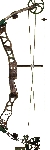 |  |
| Brace Height | 7.75 " | 7.38 " | 7.25 " |
| AtA Length | 36 " | 34 " | 31 " |
| Draw Length | 27 " - 29 " | 24 " - 31 " | 25 " - 30 " |
| Draw Weight | 60 lbs - 70 lbs | 50 lbs - 70 lbs | 40 lbs - 70 lbs |
| IBO Speed | 280 fps | 306 fps - 310 fps | 312 fps - 320 fps |
| Weight | 3.9 lbs | 4.4 lbs | 4.7 lbs |
| Let-Off | 75% | 75% | 75% |
| Where to buy Best prices online | |||
| compare more bows | |||
All three are mid-to-late-2000s value hunting bows, so the choice is about character rather than tier. The Browning Ambush is the longest and most forgiving of the group at 36 inches axle-to-axle, and the slowest, trading fps for a smooth single-cam draw and a steady hold. The Bear Code is the closest philosophical cousin - a 34-inch single cam rated 306-310 fps IBO that Bear built around forgiveness and reliability, with quad limbs and factory vibration damping; it is a touch faster than the Ambush while chasing the same calm, accurate-deer-bow goal, and it is the pick for a buyer who wants that same philosophy with a little more speed and a recognizable brand behind it. The PSE Brute is the most compact and fastest of the three at 31 inches and 312-320 fps IBO, and it is a particularly telling comparison because PSE is the company that built the Browning bows under license - the Brute is essentially PSE's own take on the same value-hunter brief, aimed at a shooter who wants a shorter, snappier bow. The decision comes down to priorities: the Ambush for the shooter who wants the longest, smoothest, most forgiving draw at the lowest cost, the Bear Code for the same forgiveness with a bit more speed and brand support, and the PSE Brute for a buyer who wants a more compact, faster bow from the maker behind all three.