
Hoyt Havoc Review
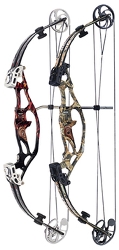

from $179.99
Pros
- Forgiving, easy-tuning hunter - owners across the early-2000s consistently describe a bow that settles fast and holds a mark
- Quiet on the shot with little hand shock, helped by the bridged TEC riser routing vibration behind the grip
- Smooth draw across Hoyt's cam menu, finishing on the Cam & 1/2 hybrid with a wide, unhurried valley
- Genuinely affordable used today - a Hoyt-built hunter that shooters kept and hunted with for years
Cons
- Some owners find the Cam & 1/2 back wall a touch spongy - a firm hook-and-lean into the wall tightens it, and cam timing/module setup accounts for most of the difference
- Long discontinued, so strings, cables and modules come from custom string shops rather than a dealer shelf - budget a fresh string set when buying one used
Video
content from YouTube
Editors' review
Somewhere around 2002 the Hoyt Havoc quietly grew a suffix and became the HavocTec, and that single syllable is the whole story of this bow. "Tec" is Hoyt's TEC riser (Total Engineering Concept) - a bridged, truss-like aluminum riser that stiffens the handle and, by Hoyt's design intent, lets shot vibration travel behind the shooting hand instead of into it. Dropped onto what had been a straightforward mid-price hunter, it turned the Havoc into one of the calmer, more forgiving bows in Hoyt's early-2000s hunting line - not the fastest, not the flashiest, but the one owners tended to keep. Across four model years (2000-2003) it was offered with several different limbs and most of Hoyt's cam menu of the era, so no two Havocs are quite identical on paper. What they share is a personality: quiet, stable, easy to tune, and comfortable to hold at full draw. Two decades on, it survives as a used-market bow with a real following. This review covers the platform as a whole - where the numbers move between versions, they are called out by year and configuration.
Finish
The Havoc shipped in the camo patterns that defined turn-of-the-century bowhunting - the Realtree and Mossy Oak schemes of the day baked onto the riser and limbs, with solid-color builds turning up on the target-oriented XT2000 configurations. Hoyt also offered a HighGrade finish tier on the HavocTec, a dressed-up cosmetic option for buyers who wanted the bow to look the part. Because these were dip-and-cure finishes from the early 2000s, condition today is entirely down to how the individual bow was stored and carried; a safe-queen example still looks sharp, while a hard-hunted one will show the honest wear of a working bow. There is no modern Cerakote or hydro-dip durability claim to make here, and pretending otherwise would be dishonest - this is period finish technology. For a used buyer the finish is a cosmetic and condition question, not a performance one, and a worn pattern has no bearing on how the bow shoots.Riser
The riser is the reason this bow has two names. The early Havoc (2000-2001) used a conventional machined-aluminum handle; the 2002 HavocTec adopted Hoyt's TEC riser, a bridged design whose extensive cutouts and truss-style geometry chase stiffness and low weight at the same time. The engineering goal is a handle that resists twist and flex on the shot and pushes residual vibration rearward, behind the hand, rather than letting it buzz into the grip - the same design language Hoyt would carry through its lineup for years afterward. In practice that is what owners describe: a stable, planted feel at full draw and a shot that finishes without much hand buzz. The riser sweeps back mildly to set a brace height (the string-to-grip distance that governs forgiveness) of around 7.5 inches on the early bows. It is a straightforward, robust aluminum chassis with no exotic materials and no carbon; the value was always in the geometry and the bow's genuinely light weight, not the price tag. What actually changes the bow's axle-to-axle footprint (ATA, the tip-to-tip cam distance) is the limb fitted to it, which is covered below.Grip
Hoyt fitted the Havoc with the slim, mid-height grip typical of its hunting bows in this era - a narrow throat that seats the hand consistently and keeps torque low without forcing an exaggerated wrist angle. It is a functional, unfussy grip rather than a modular, swappable system, and shooters used to a modern interchangeable grip should expect a fixed profile here. In my experience with Hoyt handles of this generation, the payoff of the narrow throat is repeatability: the hand falls into the same spot draw after draw, which is a quiet contributor to the forgiveness owners praise. Anyone who finds the bare aluminum cold or thin can wrap it or add a slip-on grip, exactly as many owners did back then, with no effect on tune.Limbs
The limb is the Havoc's most consequential choice, because Hoyt offered the riser with several limb options and each one changes the bow's dimensions. In 2000 you could order it with the XT2000 split limb - a 15-inch Magnum limb, later shortened to 14 inches on the HavocTec - the PFX (Powerflex) limb, or the longer Intruder limb; the 2001-2002 bows added the ZR200 limb. That limb choice sets the axle-to-axle length: roughly 33.25 inches with the XT2000, 34 with the PFX and a long 35 with the Intruder in 2000, tightening to around 31 inches on the 2003 HavocTec - so two Havocs can look quite different depending on how they were speced. Draw weight comes in the familiar hunting peaks of 50, 60, 70 and 80 pounds on the 2000 bows, with the later HavocTec reaching down to lighter 40-class options, all adjusted down at the limb bolts to cover a light whitetail setup or a heavy elk-capable draw on the same riser. What surprises for a bow of this vintage is how little it weighs - Hoyt built it light, around 3.5 pounds bare, so it carries easily through a full day in the woods rather than hanging on your arm. The limb-and-pocket architecture is proven, a design Hoyt used widely and one that has held up across two decades of hunting use, judging by how many are still being shot.Eccentric System
Cams are where the Havoc's four-year span shows the most variety, because Hoyt offered it across most of its cam menu rather than a single fixed system. Early Havocs could be ordered with Command, Redline, Master, Saber or Versa cams and wheels; the 2002 HavocTec added the AccuWheel single cam and the Excel; and by 2003 the HavocTec XT2000 was built around the Cam & 1/2 - Hoyt's slaved two-cam system that would go on to define the brand for years. The Cam & 1/2 is the one worth understanding, because it is both the newest and the smoothest: two rotating modules of different size, slaved to a single harness so the cams fire together for straight, level nock travel, with the smaller module carrying a rubber damper to hush the cable as it bottoms out. Draw length adjusts in half-inch steps by rotating those modules, and the platform as a whole spans a wide 21 to 33 inches of draw across its various configurations, though any single bow covers a narrower slice. Speed is honest-mid for its day: the earlier XT2000 Havoc was rated around 312 fps IBO (the industry chronograph standard at 30 inches, 70 pounds, and a 350-grain arrow), while the HavocTec sits closer to 300-305 fps IBO - low-300s numbers that were competitive in 2002 and remain perfectly adequate for whitetail-range hunting. Let-off (the percentage of peak weight the holding weight drops to at full draw) is adjustable between roughly 60 and 75 percent depending on cam and module, giving the shooter a choice between a firmer hold and a more relaxed one.Draw Cycle/Shootability
Draw the Cam & 1/2 HavocTec and the character that made owners loyal shows up immediately: the cam builds to peak weight without a harsh spike, rolls over the top, and drops into a valley that is wide and unhurried rather than grabby. That forgiving valley is the single trait owners mention most - it tolerates a little creep and a little variation in anchor without trying to jerk the bow out of your hand, which is exactly what a hunter wants when a shot stretches long. The back wall is solid, though I found - and some owners echo this - that it can read slightly soft on the Cam & 1/2 compared to a modern limb-stop wall; leaning firmly into it and confirming cam timing brings it back to a clean stop. Where the bow genuinely surprises is the shot itself. For a twenty-plus-year-old aluminum hunter it is quiet, and there is little of the hand shock you might expect from the era - the TEC riser doing its job of shepherding vibration behind the grip. Owners routinely describe it as a bow they could shoot all afternoon without the hand fatigue a buzzier bow produces. It is not silent by 2026 flagship standards, and a speed-obsessed shooter will feel its age, but as a shooting experience it is calm, planted, and confidence-building - the profile of a bow you learn to shoot well rather than fight.Usage Scenarios
The Havoc's natural home is exactly where it started: whitetail hunting from a treestand or ground blind, at the ordinary 20-to-40-yard distances where its low-300s speed and forgiving hold are all anyone needs. Picture a bowhunter who wants into the woods on a real budget - the Havoc is the bow a mentor hands down, or the one picked up used for a couple hundred dollars that turns out to shoot far above its price. Its 40-to-70-pound range (80 on the Magnum-limb builds) makes it capable well past whitetail - a properly set-up XT2000 has the stored energy for elk-sized game at sensible ranges. The wide draw range and forgiving valley also make it a forgiving bow to learn on, which is why it suits the shooter still tightening up their form as much as the seasoned hunter who just wants something dependable. The target-finished XT2000 configurations lean it toward backyard and 3D practice, where the stable riser and smooth draw reward a deliberate shot. What it is not is a competition speed bow or a modern minimalist - anyone chasing maximum fps or a sub-30-inch compact hunting rig is shopping the wrong decade. As a proven, affordable working hunter, though, it still earns its keep.Versions
The Havoc was never a single SKU - it was a platform that evolved in name and hardware across four model years, and buyers today should know which one they are looking at:- 2000-2001 Havoc: the original conventional-riser bow. In 2000 it came with Redline, Command or Mastercam cams on a choice of XT2000, PFX (Powerflex) or Intruder limbs - ATA about 33.25 inches (XT2000), 34 (PFX) or 35 (Intruder), brace near 7.5 inches, draw weight 50-80 pounds. In 2001 the cam menu shifted to Command, Saber and Versa on the XT2000 and ZR200 limbs.- 2002 HavocTec (XT2000 and ZR200 limbs; plus an XT2000 Custom): the platform's defining year, when the TEC riser arrived and the bow gained its "Tec" name. Cam menu spanned the AccuWheel single cam, Command, Excel and Versa; the XT2000 build tightened to roughly 31-32 inch ATA and a 6.75-7.75 inch brace.- 2003 HavocTec XT2000: built around the Cam & 1/2 hybrid, brace 7.25-7.9 inches, ATA near 31 inches, draw 24-30 inches - the smoothest-drawing and most collectible configuration of the run.A HighGrade cosmetic finish tier was available on the HavocTec. Because there is no meaningful modern MSRP to quote on a discontinued platform, the practical version question is condition and cam type, not price sticker.Hoyt Havoc vs Mathews MQ32, Bowtech Patriot
| Bow | Hoyt Havoc | Mathews MQ32 | Bowtech Patriot |
| Version | 2000 XT 2000 (Mastercam) | 2005 VFT | |
| Picture | 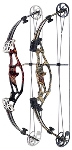 | 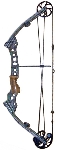 |  |
| Brace Height | 7.5 " | 8.5 " | 6.875 " |
| AtA Length | 33.25 " | 32 " | 33.375 " |
| Draw Length | 22 " - 30 " | 24 " - 30 " | 25 " - 30 " |
| Draw Weight | 40 lbs - 80 lbs | 40 lbs - 70 lbs | 40 lbs - 70 lbs |
| IBO Speed | 312 fps | 303 fps | 318 fps - 326 fps |
| Weight | 3.5 lbs | 3.25 lbs | 4.063 lbs |
| Let-Off | 65% | 80% or 70% | 65% - 80% |
| Where to buy Best prices online | |||
| compare more bows | |||
In its own era the Havoc squared off against exactly two kinds of bow, and both are still on the used market. The Mathews MQ32 was the single-cam benchmark of the moment - a 32-inch bow with a very tall 8.5-inch brace height and a 303 fps IBO rating, trading speed for a long, stable, exceptionally forgiving platform. Against it the Havoc/HavocTec is a touch faster in its XT2000 form and offers more cam variety, while the Mathews MQ32 answers with that towering brace height and the simplicity of a proven solo cam - the pick for a shooter who prioritizes forgiveness and shot-to-shot consistency above all. The Bowtech Patriot is the closer spec twin: a 33-35 inch single-cam hunter with a 6.875-7.875 inch brace and a 312-340 fps IBO rating, faster than the Havoc and one of the bows that pushed the whole category toward more speed. Where the Bowtech Patriot leans aggressive, the HavocTec leans calm - quieter and softer-shooting thanks to the TEC riser, at the cost of a few fps. The decision comes down to priorities: the Mathews MQ32 for the shooter who wants maximum brace-height forgiveness, the Bowtech Patriot for the one chasing period speed, and the Havoc for the shooter who wants the quietest, most vibration-controlled hold of the three from a proven Hoyt chassis.