
Hoyt Kobalt Review


from $300
Pros
- Enormous 18-28 inch draw and 7-45 lb weight range grows with a child from first backyard lessons to a real hunting setup on one bow
- Draw length changes with two screws and a module twist, no bow press, so parents or a pro shop can resize it at home as the archer grows
- Tech Riser stiffens the frame against the hand torque new archers put in, so off-center grip pressure costs fewer points and groups tighten
- Light 2.8 lb bare weight keeps it steady on aim for small shooters who tire quickly holding a heavier bow
- Thin, flat-backed grip indexes the hand the same way on every draw, building repeatable form from the very first arrow
Cons
- Offered in right-hand only, so left-handed young archers will need a different bow; confirm hand before ordering
- Tops out at 28 inch draw and 45 lb, so a fast-growing teen nearing full adult size will eventually graduate to a full-length hunting bow; a ceiling by design, not a fault
Video
content from YouTube
Editors' review
Most youth bows are built down to a price and feel like it the moment a kid drops the string. The Kobalt is the opposite bet: Hoyt took the riser architecture, grip philosophy and durability testing from its adult hunting line and shrank the mission to fit a seven-year-old. Introduced in 2022 as Hoyt's successor to the discontinued Ruckus and carried unchanged into 2026, it answers one question better than almost anything in its class: how do you buy a single bow that survives a child's entire growth curve? The answer is a 10-inch draw-length window and a 38-pound weight span that a parent can dial with hand tools, no press required. Along the way it teaches form instead of fighting it, because the same torque-resisting Tech Riser that steadies a veteran's shot steadies a beginner's far more. The Kobalt name itself is not new, Hoyt sold an unrelated adult Cam & 1/2 Plus Kobalt from 2008 to 2010, but today's bow shares only the badge, rebuilt from the ground up as a youth platform. This is not a toy that gets outgrown in a season; it is a first real bow.
Finish
Hoyt offers the Kobalt in a wide finish selection that runs from tactical solids to full camo, so a kid picks the one that feels like theirs. Solid options include Blackout, a Bourbon/Buckskin tan and the muted Wilderness and Tombstone tones, while camo shoppers get Mossy Oak and Realtree APX patterns. Two signature editions carry extra personality: the Cameron Hanes Keep Hammering build pairs a Blackout riser with red strings and custom limb decals, and the Bone Collector editions (Blackout or Realtree) run green strings with their own limb graphics. The coatings are the same anodize-and-dip finishes Hoyt uses across its line, chosen to shrug off the drops and dings a young archer's bow inevitably takes. Because every finish ships at the same price and spec, the choice is pure personality rather than a performance trade-off.Riser
The heart of the bow is what Hoyt calls the Tech Riser, a design carried over from the full Hoyt lineup where a reinforcing bar sits behind the grip and stiffens the riser against torque. That geometry matters far more on a youth bow than a marketing line suggests: new archers reflexively torque the grip because their hand position is still forming, and a riser that resists that twist turns a sloppy grip into a forgivable one. In my experience watching beginners shoot, the single biggest score-killer is hand torque, and this is the rare youth bow engineered specifically against it. The riser also builds in a Hoyt quiver mount and a standard stabilizer bushing, so a young hunter can hang a light quiver and a short stabilizer without adapters. Standard accessory bushings mean the sight, rest and peep a shop installs are the same hardware that lives on an adult bow, not proprietary youth parts that get thrown away later. It is a genuinely rigid platform that owners repeatedly describe as feeling built to last rather than disposable.Grip
The Kobalt uses the same thin, flat-backed grip philosophy Hoyt runs across its hunting bows, and on a youth bow that pays off twice. The narrow profile fits a small hand, and the flat spot across the back gives a repeatable reference so the hand lands in the same place every single draw. That consistency is the whole point: teach a child where the grip sits once, and their form stops drifting shot to shot. Shops that set beginners up on this bow report that simply coaching proper grip and hand placement tightens groups noticeably, before a single accessory change. Because the grip is a standard Hoyt profile rather than a molded youth block, the hand a kid learns on is the hand they will already know when they step up to a full-size Hoyt years later. It is a small piece of hardware doing quiet, long-term work.Limbs
The Kobalt's limbs are built around adjustability, spanning a 7 to 45 pound draw-weight range off the limb bolts. Draw weight changes the familiar way, turning the limb bolt clockwise to add poundage and counterclockwise to shed it, so a parent moves the bow across its whole range with a single Allen wrench. That span is the feature: most bows step in fixed 10-pound module brackets, but the Kobalt's continuous range lets a new shooter start at a genuinely light 20 pounds, groove their form, and add weight only as coordination and strength catch up. Bottoming out near 7 pounds means even a very small child can hold and aim it, while the 45-pound top end is real hunting weight for a young teen. The limbs feed a bow rated to pass Hoyt's 1,500-cycle dry-fire torture test, the same durability bar the brand holds its adult models to, which matters when the owner is a kid who will eventually dry-fire it by accident.Eccentric System
The Kobalt runs a dedicated youth cam tuned for this platform rather than a scaled-down hunting cam, and its defining trick is press-free draw-length adjustment. To change draw length, you back out a pair of module screws, turn it to the setting printed on the mod, and snug it back down; the whole 18 to 28 inch range is covered without a bow press or a trip to the shop. That is the mechanism that lets one bow follow a child for years, and it is why the Kobalt earns its keep where fixed-draw youth bows get replaced annually. Hoyt does not publish an IBO speed or a let-off figure for the Kobalt, and no independent chronograph data exists for it, which is honest to its purpose: this is a learning-and-growing bow, not a speed bow, and arrow velocity is beside the point at 7 to 45 pounds. What the cam is engineered to deliver instead is an easy, controllable draw a beginner can manage and a hold they can settle into. Draw weight lives on the limb bolts, draw length lives on the module, and both are owner-adjustable, which is exactly the right division of labor for a bow that has to grow.Draw Cycle/Shootability
Handing a bow this light to a small child changes the first lesson entirely; at 2.8 pounds bare it does not sag off the target the way a heavier adult bow does in young arms, and that alone buys a beginner more good repetitions before fatigue sets in. Drawing it, the front end is undemanding by design, because a 20-pound starting weight and a youth-specific cam were never meant to test anyone's back. The real shootability story is forgiveness: the Tech Riser's torque resistance means the inevitable beginner grip errors translate into smaller misses than they would on a whippier youth frame, so a new archer sees tighter groups sooner and stays encouraged. What I keep coming back to is that this bow is engineered to flatter developing form rather than expose it. It shoots quietly and without drama at these weights, and because the grip references the hand identically every draw, the shot process becomes repeatable fast. For a young shooter, confidence is the whole game, and the Kobalt is tuned to build it.Usage Scenarios
The Kobalt's natural home is the household planning years ahead rather than one season. Picture a seven-year-old starting at 15 to 20 pounds in the backyard this spring, grooving form on a bow light enough to hold steady, then the same bow climbing to 40-plus pounds by the time they are a young teen ready for their first whitetail from a ground blind or box stand. It fits the beginning-archer program at a club, where the huge weight range means one bow covers a wide age spread of new shooters. It suits the short-draw or smaller-framed young adult who is not yet at full draw and wants a real, forgiving bow rather than a stopgap. And it makes a strong first hunting rig for a youth hunter chasing deer and hogs at moderate range, where 45 pounds is legal and effective in many states. Where it is not aimed: a fully-grown adult with a 29-plus inch draw or anyone chasing elk-class energy has outgrown it, and that is exactly the point at which its owner steps up to an adult Hoyt.Versions
The Kobalt is sold as a single bow model in several buying options, all sharing identical specifications and a $449 launch MSRP for the bow. The bow-only purchase lets a shop or parent bolt on their own accessories through the standard bushings. A ready-to-hunt package built around the bow adds the essentials a beginner needs on day one, commonly a Fuse four-arrow quiver, a Pro-Fire three-pin sight and a Whisker Biscuit arrow rest, so the archer can shoot immediately. Hoyt also offers a custom FUSE package for buyers who want to hand-pick the accessory kit. Beyond packaging, the only differences across the lineup are finish and signature editions (Blackout, Bourbon, Wilderness, Tombstone, Mossy Oak, Realtree APX, plus the Bone Collector and Cameron Hanes Keep Hammering editions), which are cosmetic and priced alike. The bow is offered in right-hand configuration only. A note on the name: Hoyt first sold a Kobalt from 2008 to 2010, but that was an entirely different bow, an adult hunting model of 20 to 60 pounds built on XT500 limbs and the Cam & 1/2 Plus single-cam system with a 290 fps IBO rating. The 2022 youth Kobalt reviewed here revives the name after a twelve-year gap and shares nothing with it beyond the badge; the two are separate bows a generation apart.Hoyt Kobalt vs Bear Cruzer G3, Diamond Infinite Edge Pro
| Bow | Hoyt Kobalt | Bear Cruzer G3 | Diamond Infinite Edge Pro |
| Version | 2026 | 2024 RTH | 2026 Legacy |
| Picture |  | 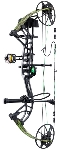 |  |
| Brace Height | 6.875 " | 6.5 " | 7 " |
| AtA Length | 29.25 " | 30 " | 31 " |
| Draw Length | 18 " - 28 " | 14 " - 30 " | 13 " - 31 " |
| Draw Weight | 7 lbs - 45 lbs | 10 lbs - 70 lbs | 5 lbs - 65 lbs |
| IBO Speed | fps | 315 fps | 300 fps |
| Weight | 2.8 lbs | lbs | 3.3 lbs |
| Let-Off | 75% | 80% | |
| Where to buy Best prices online | |||
| compare more bows | |||
The obvious cross-shops for the Kobalt are the two long-running adjustable growth bows, the Bear Cruzer G3 and the Diamond Infinite Edge Pro, and the comparison clarifies who each is really for. Both competitors are adult-capable value packages: the Bear Cruzer G3 spans a 14-30 inch draw and a 10-70 pound weight range with a 315 fps IBO rating, and the Diamond Infinite Edge Pro covers 13-31 inches and 5-70 pounds at a 310 fps IBO, with the Diamond commonly found as a ready-to-hunt kit under $400. They reach adult hunting weight and speed that the Kobalt, capped at 45 pounds and 28 inches, deliberately does not. The Kobalt trades that top-end for a genuinely youth-first design: lighter at 2.8 pounds versus the Diamond's 3.2, more compact at 29.25 inches axle-to-axle, and built on the torque-resisting Tech Riser and standard Hoyt grip rather than a value chassis, at a higher $449 price. The decision comes down to priorities. A family that wants one bow to eventually pull full 70-pound adult hunting weight, at the lowest price, is better served by the Bear Cruzer G3 or the Diamond Infinite Edge Pro. A parent who wants the lightest, most forgiving, best-built platform specifically for a young archer's learning years, and who accepts that the child will step up to a full-size bow later, is buying the Kobalt on purpose.