
Hoyt LazerTec Review


from $274.98
Pros
- Smooth, easy Cam & 1/2 draw cycle that builds to peak and rolls over the wall without a fight, staying manageable even at a 70-pound draw
- Dead-quiet, soft shot with no felt hand shock, thanks to the RizerShox and AlphaShox dampers that settle the bow before you notice the arrow is gone
- Planted, steady balance on aim that makes an average shooter look better than the price tag suggests
- Value that outshoots its cost, delivering the shooting manners of a far pricier bow in an affordable mid-tier package
Cons
- As a discontinued 2006 model it comes used, so budget a fresh string and cable set and a quick cam-timing check at a pro shop before you hunt it
Editors' review
Hoyt built the LazerTec for the shooter who wanted the Hoyt shooting experience without the flagship price, and in 2006, its 75th-anniversary year, that is exactly what it delivered. On the same Cam & 1/2 system and vibration-damping hardware that carried the UltraElite and ProElite, the LazerTec rides GTX split limbs on a machined-aluminum riser at a mid-tier price the flagships never touched. What owners remember about it a decade and a half later is not a number on a chart but a feeling: a draw that rolls to the wall without a fight, a shot that lands dead-quiet with no shock in the hand, and a bow that holds steady enough to make an average shooter look better. At 341/2 inches axle-to-axle (the distance between the two cam axles) and a 71/4-inch brace height, it is a forgiving, easy-shooting hunting rig rather than a speed bow, and its 295 fps IBO (the industry-standard chronograph rating at a fixed 70-pound, 30-inch, 350-grain setup) sits below its faster stablemates by design. This is the Hoyt that made "affordable" and "shoots like more" belong in the same sentence.
Finish
The LazerTec arrived in Hoyt's 75th-anniversary year, and its defining finish was the commemorative 1931-2006 anniversary graphics that marked the milestone across the line. Beyond the anniversary treatment, Hoyt offered the bow in the hunting camo and solid target colors standard for its 2006 catalog, so a buyer could set it up as a woods rig or a bare-riser target bow. Hoyt did not publish a per-model finish palette for the LazerTec, and a clean list has not survived, so treat specific camo-pattern claims with caution when shopping a used example. What has held up is the coating itself: the era's dipped camo and anodized risers wear well, and most surviving bows show their age in string wear and accessory scuffs rather than finish failure. For a collector, the anniversary graphics are the detail that separates a 2006 LazerTec from an ordinary mid-2000s hunting bow.Riser
The LazerTec's riser is machined aluminum, and owners who have stripped one down describe a milled riser rather than a cast one, carrying the 3D-ribbing pattern Hoyt used to stiffen its mid-line risers without adding mass. The most consequential piece of hardware on it is RizerShox, a riser-mounted damper that soaks up post-shot energy before it reaches the grip, and it is a big part of why the bow shoots as quietly as it does. The geometry is a conventional, forgiving hunting layout rather than an aggressive speed platform: the long axle-to-axle riser-and-limb package gives the bow a stable feel on aim that shorter bows trade away for maneuverability. Cable management runs off an 81/2-inch cable guard bar, keeping the string clear of the vanes without crowding the shot. In the hand the whole assembly feels planted and deliberate, a riser built to hold still rather than to be whipped around a tight ground blind.Grip
Owners consistently single out how the LazerTec feels in the hand, and much of that comes down to a comfortable, low-profile grip that lets the bow sit into the web of the palm without forcing torque into the shot. It is the Hoyt hunting grip of its era, a slim and straightforward shape rather than a heavily contoured target grip, and it suits shooters who want a repeatable hand position more than an aggressively engineered one. Because the shape is neutral, it works across a range of hand sizes and takes an aftermarket or side-plate swap easily if a buyer wants to fine-tune the fit. Paired with the bow's planted balance, the grip is a meaningful reason owners describe the LazerTec as steadier on aim than its price suggests. If you have shot any mid-2000s Hoyt, the hand feel here will be immediately familiar.Limbs
The LazerTec rides GTX split limbs, a 3/4-inch split-limb design that sits a step below the past-parallel limb technology of Hoyt's flagships but delivers the durability split limbs are known for. Draw weight spans a broad 40-to-80-pound range in the standard configuration, sold in the usual 10-pound peak increments (a 50-60 and a 60-70 were the common hunting builds), with a lighter 30-to-80-pound limb option in the catalog for shooters who wanted to start softer. That range makes the bow genuinely flexible: the same riser and limbs will set a new shooter up at a comfortable 50-pound peak and still deliver a full 70-pound hunting draw when they are ready. Adjustment is by the limb bolts in the standard fashion, with no bow press required to move within a limb's range. Across Hoyt's mid-2000s lineup this split-limb design earned a reputation for staying put, and owners report the LazerTec holding tune and timing over years of use, part of why it is still praised as a reliable buy on the used market.Eccentric System
The heart of the LazerTec is Hoyt's Cam & 1/2 system, a two-cam setup that pairs a power cam with a control cam to combine the tunability of a twin-cam bow with a smoother pull than the aggressive speed cams of the day. Let-off is adjustable between 65 and 75 percent (the share of peak weight the bow sheds at full draw), so a shooter can dial a longer, more relaxed hold or a firmer, more efficient one depending on preference. Draw length is set by modules across a wide 23-to-31.5-inch span, which is unusually accommodating, reaching down far enough for short-draw shooters and growing teenagers that many competitors of the era simply could not fit. On paper the bow rates 295 fps IBO, the slowest of its usual cross-shop set and deliberately so, because the LazerTec was tuned for shootability over raw speed. In the real world, one owner clocked 257 fps at a 27-inch draw with a 361-grain arrow, a realistic, hunting-honest number for a mid-weight setup and fast enough for whitetail and hogs at practical ranges. What every owner comes back to is the draw itself: the Cam & 1/2 builds to peak and rolls over cleanly into a defined valley, without the harsh front-end spike a speed cam demands. It is the kind of cam system that flatters a shooter rather than punishing a mediocre release.Draw Cycle/Shootability
Draw the LazerTec and the first thing you notice is how little it asks of you: the weight builds gradually, crests without a hitch, and drops into a valley that holds the string comfortably at full draw. Coming off aggressive modern speed bows, I found the roll-over genuinely relaxing, a cam that lets you settle the pin instead of fighting the wall. The back wall is present but not brutally rigid, matching the bow's forgiving character. Where the LazerTec earns its lasting reputation is the shot: it is quiet and soft, with the RizerShox and AlphaShox dampers pulling vibration out before it reaches your hand. Owners describe a dead-in-the-hand feeling with no shock, and that holds up, because the bow finishes the shot and simply sits there, arrow already in the target. That quietness is a real hunting asset from a treestand, where a loud bow can duck a deer at 25 yards. Balance is the other half of the story, and at 341/2 inches axle-to-axle the bow hangs steady on aim, so I kept noticing how little it wanted to torque or drift as the pin settled. For an affordable mid-2000s bow, the overall shooting experience is remarkably composed: smooth to draw, quiet to shoot, and easy to hold.Usage Scenarios
The LazerTec fits the hunter who values a quiet, forgiving bow over a fast one. Picture a whitetail hunter easing to full draw on a buck at 20 yards in the last light of an October evening: the Cam & 1/2 lets him reach anchor without a jerk that flags the deer, and the dampened shot is quiet enough that the arrow lands before the bow settles. At practical bowhunting ranges it carries plenty of energy for deer, hogs, and antelope with a well-matched arrow. Its wide 23-to-31.5-inch draw range makes it a natural family or first-serious-bow choice: a teenager can shoot it at a 25-inch draw and 50 pounds, then grow into a 29-inch, 70-pound setup on the same bow without a new purchase. Target and 3D shooters who prize a steady hold over a hot arrow will find the long, planted riser and adjustable let-off well suited to a relaxed spot session. Where it is not the tool is the run-and-gun western hunter chasing every last fps, or the treestand hunter squeezed into a tight box blind who needs a compact sub-32-inch bow, because the LazerTec is a longer, more deliberate rig by design. For a used-market buyer today, it is one of the more forgiving ways to get a genuine Hoyt shooting experience on a modest budget.Hoyt LazerTec vs Trykon, Tomkat
| Bow | Hoyt LazerTec | Hoyt Trykon | Bowtech Tomkat |
| Version | 2006 Hoyt GTX | 2007 | 2008 |
| Picture |  | 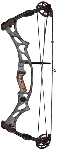 | 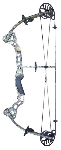 |
| Brace Height | 7.25 " | 7 " | 8.5 " |
| AtA Length | 34.5 " | 33 " | 31.75 " |
| Draw Length | 23 " - 31.5 " | 25 " - 31 " | 27 " - 31 " |
| Draw Weight | 30 lbs - 80 lbs | 40 lbs - 80 lbs | 40 lbs - 70 lbs |
| IBO Speed | 295 fps | 316 fps | 299 fps - 315 fps |
| Weight | 4.3 lbs | lbs | 3.8 lbs |
| Let-Off | 65% or 75% | 65% or 80% | 65% - 80% |
| Where to buy Best prices online | |||
| compare more bows | |||
Within Hoyt's own 2006 line, the natural cross-shop is the Hoyt Trykon, and the two make the trade-off clear. The Trykon is the faster, more compact bow, rated 316 fps IBO on a 33-inch axle-to-axle frame with a 7-inch brace, while the LazerTec trades that speed for a longer, steadier 341/2-inch platform and a slightly more forgiving 71/4-inch brace. A shooter who wants the quickest arrow and a shorter bow to carry leans Trykon; a shooter who wants the smoothest draw and the quietest, most planted shot leans LazerTec. The cross-brand alternative is the Bowtech Tomkat, the value single-cam bow of the same era. The Bowtech Tomkat counters with the longest brace height of the three at 8.625 inches, which makes it the most forgiving of the trio and the friendliest to a newer shooter's form, on a single-cam system that is dead simple to maintain. But the Tomkat's draw range starts at 27 inches, where the LazerTec reaches down to 23, so for short-draw shooters and growing teens the Hoyt fits a wider audience. On feel, the LazerTec's Cam & 1/2 splits the difference, smoother than the punchy speed cams and more efficient than a pure single cam. The decision comes down to priorities: the Hoyt Trykon for speed and a compact carry, the Bowtech Tomkat for maximum brace-height forgiveness and single-cam simplicity, and the LazerTec for the smoothest, quietest all-around shooting manners of the three.