
Hoyt Pro Comp Elite Review
Pros
- One riser, two target cams: the GTX for a smoother pull and a 65% or 75% let-off choice, or the Spiral X for more speed
- Adjustable Air Shox limb dampers slide, re-angle, or come off entirely with a set screw - tuning you do by hand, not by press
- Wide shoot-through riser window clears fletching whether the arrow tunes a touch inside or outside center
- Settles and holds on the spot with a tight, planted aim that rewards a disciplined shooter
- Selectable 65%/75% let-off on the GTX cam suits both long practice ends and a firm back-tension release
Cons
- The set screw on the adjustable Air Shox needs a firm bite - snug it down hard or it can creep up under the shot
- A short-valley target cam demands honest follow-through - break form and the miss is bigger, so stay in the shot to the wall
Video
content from YouTube
Editors' review
Before the Podium X Elite carried Hoyt's target flag, this was the bow winning the podiums - the Pro Comp Elite was Hoyt's 2013-2014 freestyle platform, and world-class archers shot it on the international line. It is a target tool through and through, built on the long XT2000 limb system and aimed at the spot, field, and 3D archer who chooses a bow on how steady it holds, not on a speed number. The defining decision is the cam: the Pro Comp Elite ships with a choice of two on the same riser - the smoother GTX Cam and a half with a selectable let-off, or the faster Spiral X. Add adjustable Air Shox limb dampers you can set by hand and a wide shoot-through window that ends fletching-clearance headaches, and you have a bow designed to be fitted to the archer rather than shot as-issued. It launched at a flagship target price, and it reads like one from the first draw.
Finish
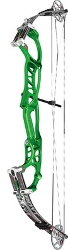
Hoyt dressed the Pro Comp Elite in a target palette rather than hunting camo - the finishes a spot shooter wants under range light. The standard target colors ran blue fusion, red fusion, green, orange, cobalt blue, and jet black, with a custom paint and powder-coat program adding custom red, custom blue, custom black, pearl white, and pink on request. Even the Air Shox dampers could be ordered in matching custom colors, a small touch that lets a competitor build a coordinated rig. These are clean, high-visibility finishes with no woodland pattern anywhere in the range - this is a bow dressed for the line, not the treestand. The coating carries the constant handling a competition bow sees between ends, and the same finish spans both cam options, so a GTX or a Spiral X build looks identical on the rack.Riser
The riser is Hoyt's target geometry mated to the long XT2000 limbs, a deflex design built to sit dead-still at full draw rather than swing quickly. Two features do the real work. The first is the shoot-through window: it is cut wider than a standard Hoyt riser, and in practice that extra room clears the fletching regardless of whether the arrow tunes a little inside or a little outside center - a genuine convenience that removes a common source of contact and noise. The second is the limb-mounted, adjustable Air Shox dampers. Where most bows fix their dampers in place, here a set screw lets you slide each Air Shox along its rod, change its angle, or remove it entirely, so you set damping the way you set a rest. The riser carries the lower rear stabilizer mount target archers use to hang a back bar low, and it does without a string stop - a target rig at this draw and let-off does not need one. It is a chassis that treats setup as an adjustable, repeatable process.Grip
The grip is Hoyt's target grip of the era, a narrow, low-torque profile meant to give the bow hand a repeatable, dead-center seat. It sits where Hoyt placed it before the later Podium X Elite moved the grip location rearward - a useful thing to know if you are cross-shopping the two, because the hand position and the way a stabilizer balances differ subtly between them. In my experience with a target grip like this, the payoff is a relaxed, consistent hand: the narrower the throat and the lower the wrist, the less rotational torque sneaks into the shot before the arrow leaves. It is a grip you learn once and then stop thinking about, which on a competition bow is exactly the goal.Limbs
The Pro Comp Elite runs Hoyt's XT2000 target limbs in the Pro Lock X-Lite Pocket, a wide, parallel split-limb system with a long track record across Hoyt's target line. Peak weight comes in the familiar competition brackets - 30-40, 40-50, 50-60, and 60-70 pounds - so an archer can settle into a comfortable holding weight for a long practice session without over-bowing. The wide limb stance is what gives the bow its steady, planted feel at anchor, spreading the load so the sight picture stays calm end after end. The adjustable Air Shox dampers live on these limbs, and shooters setting the bow up noted the pockets and limbs hold their tune across the range sessions that define how a target bow actually gets used. Draw-weight changes are standard limb-bolt work, with the reminder that the Air Shox position wants a small reset whenever you change poundage.Eccentric System
The cam is where the buyer makes the real decision, because the Pro Comp Elite offers two on the same riser. The GTX Cam and a half is the hybrid target cam: it carries a selectable let-off of either 65% or 75% - the percentage of peak weight your holding weight drops to at full draw - adjusts draw length through modules, and is rated 305 fps IBO (the industry-standard chronograph figure at a fixed 30-inch, 70-pound, 350-grain setup). The Spiral X Cam and a half is the faster, firmer option, fixed at 65% let-off and rated 315 fps, and it is the cam the competitive archers in this platform's heyday tended to run. Ten fps separates them on paper, but the real difference is character: the GTX pulls smoother and lets you dial the higher let-off for a relaxed hold, while the Spiral X trades a little of that ease for speed and a more defined wall. Both adjust across a wide draw range - spanning 24.5 to 32 inches depending on cam and module - and both keep the same riser, limbs, grip, and adjustable Air Shox, so the choice is purely how you want the bow to draw and hold.Draw Cycle/Shootability
Drawing this bow, the target-cam character comes through clearly: it is smooth and deliberate rather than quick, and it settles onto the spot and stays there. What I keep coming back to on this platform is how the aim planted itself - the bow holds tight and settles on target faster than a livelier hunting cam would, which is the whole reason a spot archer picks a bow like this. That steadiness asks something back. Drawing and shooting it, I found it rewards an honest follow-through and punishes a lazy one: stay in the shot all the way to the wall and it pounds the middle, but let the hand relax early and the miss opens up wider than a more forgiving bow would allow. That is a characteristic, not a flaw, for the audience this bow is built for. The Spiral X sits into a firm, defined back wall a back-tension shooter can lean on; the GTX at 75% let-off is the friendlier draw for a long day on the line. It is not a dead-in-the-hand hunting bow and never pretended to be - it is a transparent target rig that gives honest feedback and turns clean form into tight groups.Usage Scenarios
This is a competition bow first. Picture a spot archer on a Tuesday-night indoor league running the GTX at 75% let-off for a relaxed, repeatable end, or a field archer working a marked course who wants a long, stable 37-inch bow that settles on the pin. It suits the FITA and target archer who values a calm sight picture and a bow that tunes at the practice bale - the adjustable Air Shox and wide shoot-through window are aimed squarely at that shooter. The 60-70 pound bracket covers an outdoor archer pushing a heavier arrow into the wind, while the 30-40 and 40-50 options keep a full practice round comfortable. With a draw range reaching to 32 inches, it fits most adult competitors, and a shooter whose draw runs longer still should look at the longer Pro Comp Elite XL. It is not a hunting bow - the geometry, let-off options, and length are built for the target line, not the treestand - and that focus is exactly what its audience is buying.Versions
The Pro Comp Elite is one model offered with a choice of cam system rather than separate packages - the riser, XT2000 limbs, grip, and adjustable Air Shox are identical, and the cam is the only variable:- Pro Comp Elite GTX - GTX Cam and a half, selectable 65% or 75% let-off, rated 305 fps, brace height near 8 inches. The smoother, more flexible choice.- Pro Comp Elite Spiral X - Spiral X Cam and a half, 65% let-off, rated 315 fps, brace height 7.625 inches. The faster, firmer competition choice.Both were offered across the 30-70 pound peak-weight brackets and in right- or left-hand, and both ran unchanged as a carryover through 2013 and 2014. At launch the bow sat in flagship target territory - around $1,349 for the base black finish, with the custom paint and powder-coat colors adding to that. Choosing between the cams is a question of whether you value the GTX's let-off flexibility and smoother pull or the Spiral X's extra speed and firmer wall.Hoyt Pro Comp Elite vs Bowtech Specialist, PSE Supra
| Bow | Hoyt Pro Comp Elite | Bowtech Specialist | PSE Supra |
| Version | 2014 GTX cam | 2014 | 2018 EXT |
| Picture |  |  |  |
| Brace Height | 8.125 " | 7.5 " | 7 " |
| AtA Length | 37.875 " | 37.5 " | 37 " |
| Draw Length | 24.5 " - 31 " | 26 " - 30.5 " | 25 " - 30.5 " |
| Draw Weight | 30 lbs - 70 lbs | 50 lbs - 60 lbs | 30 lbs - 60 lbs |
| IBO Speed | 305 fps | 330 fps | 317 fps - 325 fps |
| Weight | 4.8 lbs | 4.1 lbs | 4.7 lbs |
| Let-Off | 65% or 75% | 65%, 75% | 65% & 75% |
| Where to buy Best prices online |
| ||
| compare more bows | |||
In the 37-inch competition-target class, the Pro Comp Elite lines up against the Bowtech Specialist and the PSE Supra, two bows a spot or field archer would genuinely cross-shop. The Bowtech Specialist sits at 37.5 inches axle-to-axle with a 7.5-inch brace and a binary cam rated 330 fps - a slightly faster, binary-cam target bow many shooters find easy to keep in time, where the Pro Comp Elite's edge is its by-hand-adjustable Air Shox damping and the two-cam let-off flexibility. The PSE Supra, at 37 inches with a 7-inch brace and a 317-325 fps range, is the lighter-braced, speed-leaning option of the three and a long-running fixture on competition lines. Against both, the Pro Comp Elite's distinguishing traits are the choice between a 65/75% GTX cam and a faster Spiral X on one riser, plus a wide shoot-through window and dampers you set without a press. The decision comes down to priorities: the Pro Comp Elite for the archer who wants a cam choice and by-hand tuning, the Bowtech Specialist for binary-cam simplicity, the PSE Supra for a proven speed-target platform. Within Hoyt's own line, a longer-draw shooter should step up to the Pro Comp Elite XL, and an archer wanting the shorter, later refresh should look at the Pro Comp Elite FX.