
Hoyt Trykon Jr Review
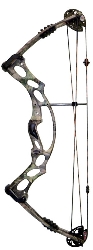

from $75
Pros
- One cam covers 17 to 25 inches of draw in inch steps, so the same bow follows a child through years of growth instead of being outgrown in a season
- Machined-aluminum Hoyt riser and dedicated youth limbs - a real Hoyt build at 2.7 pounds, not a plastic toy-grade youth bow
- 65% let-off keeps the holding weight low enough that a small archer can settle and aim rather than fight the bow
- A documented upgrade path - Hoyt built the Jr to trade up to the Trykon Sport once a kid grows past its 40-pound ceiling
- Light and short at roughly 30 inches axle-to-axle, easy for small hands and arms to hold up and steer
Cons
- Draw-weight floor was 20 pounds in 2007 and 2008, which is stout for a very young beginner - buyers of a first bow for a small child should hunt down a 2009 or 2010 unit, whose cam family drops the floor to 10 pounds
- As a discontinued 2007-2010 model it is a used-market buy today - worth a quick string and cam-module check before handing it to a kid, since fresh strings and the right module are inexpensive
Video
content from YouTube
Editors' review
Most youth bows are bought to be thrown away - a toy-grade rig a kid outgrows in a season, then it goes in the garage. The Hoyt Trykon Jr was built to do the opposite. Its Versa Cam & 1/2 gives 17 to 25 inches of draw length on a single cam, adjusted through nine module positions in inch steps, so one bow tracks a growing archer across years rather than months. Pair that with a draw-weight span that reaches from a beginner-friendly floor up to a real 40 pounds and you get a bow a child can start on and keep - right up to the point where Hoyt intended them to trade up to the Trykon Sport. And it is a genuine Hoyt underneath: a machined-aluminum riser and dedicated youth limbs at a 2.7-pound mass weight, the same build philosophy as the adult Trykon family, scaled down. This is the bow for the parent who wants to buy once and let a young archer grow into it, not the parent buying a plastic starter every birthday.
Finish
Hoyt shipped the Trykon Jr in the standard camo dress of its era, matching the finish process used across the adult Trykon line rather than a cheaper coating reserved for the youth model. The dip-and-coat finish is the same durable treatment Hoyt applies to its hunting bows, which matters more on a youth bow than it might seem - a kid's bow gets dropped, leaned against fences, and dragged through more abuse than an adult's, and a fragile coating would show it fast. Because this is a discontinued model bought used, the exact finish a buyer finds depends on the year and the individual bow; the catalog spec sheet for the Jr does not print a color book the way the flagship bows do. What carries across every unit is that the finish is real Hoyt-grade, not a corner cut to hit the youth price. For a growing archer who will not baby the bow, that durability is the point.Riser
The Trykon Jr uses a machined-aluminum riser, not a cast or molded one - the same construction approach as the adult Trykon, sized down for a youth platform. That is the single most important thing to understand about this bow: it is a real Hoyt, not a toy wearing a Hoyt logo. A machined riser gives the frame rigidity and a solid, dead-in-the-hand feel that a child can actually learn good form on, because the bow holds still and repeats. The geometry is compact, contributing to the roughly 30-inch axle-to-axle length that keeps the whole bow light and maneuverable for small arms. Hoyt routes a 7.5-inch cable guard bar off the riser and hangs the youth-scaled limb pockets (pocket #30) on a short, stiff frame. The result is a riser that behaves like the grown-up Trykon it is derived from, which is exactly what lets a young shooter carry the form they build on this bow straight up into an adult rig later.Grip
The grip is scaled for a child's hand, narrower and shorter in the throat than an adult Hoyt grip so a young archer can wrap it without the bow rolling. Grip consistency is one of the quiet fundamentals of accuracy - the hand has to land in the same spot every draw - and a youth-sized throat makes that far easier for small hands to find repeatably. Handing a bow like this to a young shooter, the first thing I check is whether the grip forces the hand into a torqued, uncomfortable position that teaches bad habits, and the Trykon Jr's low-profile shape lets a small hand settle in naturally instead. It is not a plush, oversized grip; it is a functional, low-torque shape sized for the intended archer. For a parent, the takeaway is simple: the grip is built for the kid who will actually shoot it, not adapted down from an adult mold.Limbs
The Trykon Jr rides on dedicated YZ50 youth limbs, a design specific to Hoyt's youth family rather than a de-tuned adult limb. The draw-weight range is where these limbs tell their story: the bow was rated 20 to 40 pounds in 2007 and 2008, then Hoyt extended the floor down to 10 pounds for the 2009 and 2010 configuration, widening the usable span for smaller and younger beginners. That 40-pound ceiling is a genuine number, not a toy figure - enough for a capable teenager to hunt small game or shoot 3D with authority, which is a large part of why the bow can follow a child for years. Adjusting draw weight is done at the limb bolts (a 2.5-inch bolt length) in the conventional Hoyt manner, so a parent or pro shop can walk the weight up as the child gets stronger without special tooling. Split youth limbs on a machined riser also keep the mass down to that 2.7-pound figure, which is the difference between a small archer holding steady on target and shaking after ten arrows.Eccentric System
The Versa Cam & 1/2 is the heart of what makes this a buy-once youth bow. It is Hoyt's youth-family take on the Cam & 1/2 hybrid system, and its signature trick is a module-indexed base cam: nine positions labeled A through I let the draw length step from 17 to 25 inches in one-inch increments, giving a full nine inches of adjustment on a single cam without swapping cams or buying a new bow. For context on why that range is unusual, most youth bows cover a much narrower span before a child outgrows them - nine inches of draw adjustment is enough to carry an archer from roughly grade school into their teens on one rig. The let-off is 65 percent (let-off is the percentage the holding weight drops to at full draw), which is a deliberate youth-appropriate figure: it keeps enough holding weight for the archer to feel the wall and learn to hold, without the aggressive, short valley of a high-speed adult cam that a beginner would fight. The catalog IBO speed is 255 fps, measured at the bow's 40-pound peak and a 25-inch draw - modest by adult standards and exactly right for a youth platform, where controllability matters far more than raw speed. No independent chronograph data exists for a bow this age, so 255 fps stands as the honest catalog figure. The whole cam system is engineered so that a young shooter's draw grows with a module change rather than a new purchase.Draw Cycle/Shootability
Drawing the Trykon Jr, the story is control, not speed. The 65 percent let-off and the youth-tuned cam produce a draw a child can actually manage - the weight builds gently to peak and drops to a holding weight low enough that a small archer can settle the pin instead of trembling against the bow. That is the whole point of a youth let-off: a beginner who can hold at full draw is a beginner who can aim, and aiming is where good form is built. The valley is forgiving rather than punishingly short, which suits a young shooter who has not yet learned to stay hard on the back wall. At 2.7 pounds the bow is light enough for small arms to hold up through a full session without the fatigue-driven flinch that a heavy adult bow induces in a kid. The shot itself is quiet and low-key for the class, without the whip-crack of a high-poundage adult bow - a calmer report keeps a young shooter from developing a flinch. In my experience the bows that turn kids into archers are the ones that let them succeed early, and the Trykon Jr is tuned squarely for that: controllable weight, a manageable valley, and a light frame that rewards a young shooter for holding steady.Usage Scenarios
The core scenario writes itself: a parent buys one Trykon Jr for an eight- or ten-year-old just getting into archery, sets the module low and the draw weight light, and that same bow follows the kid through years of backyard shooting, 4-H or JOAD range nights, and eventually into 3D and small-game hunting as the draw climbs toward 25 inches and 40 pounds. That growth span is the reason to choose this bow over a disposable starter. A capable teenager at the top of the range has a genuine 40-pound hunting bow for whitetail-country small game, turkeys, and 3D courses, not a toy. When the child finally grows past the Jr's ceiling - a longer draw than 25 inches or a need for more than 40 pounds - Hoyt built in the next step, marketing the upgrade from the Trykon Jr to the Trykon Sport, so the family stays in the same lineup with familiar feel and form. The secondary buyer is a very short-draw, small-frame adult on a tight used-market budget who needs a 17-to-25-inch draw and can live with 40 pounds. What the Jr cannot do is serve a full-grown, long-draw adult or take big game at extended range - that is not its job, and pretending otherwise would misfit the buyer.Versions
The Trykon Jr was sold as a single youth model, not a package family, and its one meaningful variation across the run is the draw-weight floor. In 2007 and 2008 the bow was configured 20 to 40 pounds; for 2009 and 2010 Hoyt widened the configuration to 10 to 40 pounds, dropping the floor so smaller and younger beginners could start lighter. Everything else - the Versa Cam & 1/2, the 65 percent let-off, the YZ50 limbs, the 17-to-25-inch draw range, the roughly 30-inch axle-to-axle frame and 2.7-pound mass - carried unchanged across all four model years. For a used buyer that makes the year worth checking: a parent shopping a first bow for a very young or small child should specifically look for a 2009 or 2010 unit to get the 10-pound floor, while the earlier 20-pound bows suit an older or stronger beginner just as well. No launch MSRP was printed in Hoyt's catalogs for this model, so pricing today is entirely used-market. Within the family, the Trykon Jr is the youth entry that feeds up into the compact Trykon Sport, which Hoyt positioned as the deliberate next bow once a young archer outgrows the Jr.Hoyt Trykon Jr vs Diamond Nuclear Ice, Mission Menace
| Bow | Hoyt Trykon Jr | Diamond Nuclear Ice | Mission Menace |
| Version | 2010 | 2010 | 2014 |
| Picture |  |  |  |
| Brace Height | 6.5 " | 6 " | 7.25 " |
| AtA Length | 29.5 " | 22.75 " | 31 " |
| Draw Length | 17 " - 25 " | 14 " - 24 " | 17 " - 30 " |
| Draw Weight | 10 lbs - 40 lbs | 10 lbs - 29 lbs | 16 lbs - 52 lbs |
| IBO Speed | 255 fps | 187 fps - 195 fps | fps |
| Weight | 2.7 lbs | 2.8 lbs | 2.95 lbs |
| Let-Off | 65% | 70% | 70% |
| Where to buy Best prices online |
| ||
| compare more bows | |||
Two other bows answer the same question - how do you buy one bow a kid will not outgrow in a season - and they bracket the Trykon Jr from opposite ends. The Diamond Nuclear Ice is the pure small-youth pole: a 22.75-inch axle-to-axle, 6-inch-brace micro-bow with a 14-to-24-inch draw range and a 10-to-29-pound draw weight, built for the very youngest archers and topping out around 195 fps. It starts a smaller child than the Trykon Jr can and is lighter and more compact, but it also runs out of room sooner - its 29-pound ceiling and shorter frame mean it graduates a growing kid faster. The Mission Menace comes from the other direction: a 31-inch axle-to-axle, 7.25-inch-brace bow with a huge 17-to-30-inch draw range and a 16-to-52-pound draw weight, engineered by Mathews' value brand to span a child clear into adulthood on one chassis. The Menace covers more top-end than the Trykon Jr - a longer draw and 52 pounds versus the Jr's 40 - so it can serve a kid all the way to a full adult hunting setup, where the Trykon Jr instead hands off to the Trykon Sport at its ceiling. The Trykon Jr sits between them: more growth range and a real machined-riser Hoyt build compared to the Nuclear Ice, less raw top-end than the Menace but part of a lineup with a defined upgrade path. The decision comes down to the archer's age and how you want the growth handled: the Diamond Nuclear Ice for the smallest beginner who needs the lightest starting point, the Mission Menace for the buyer who wants one bow to span child-to-adult without ever switching models, and the Trykon Jr for the parent who wants a genuine machined-riser Hoyt that grows for years and then trades up to a Trykon Sport.