
Hoyt Ventum Pro 30 Review
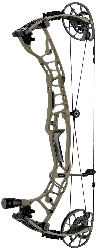

from $850
Pros
- Same shooting engine as the carbon RX-7 - identical HBX Pro cam, VitalPoint grip, In-Line system and 342 IBO - built in aluminum for several hundred dollars less
- Dead in the hand - owners consistently report no felt vibration, the riser settling instantly after the shot
- Quiet shot signature, measured at 80-81 dB on a meter, putting it among the hushed bows of Hoyt's 2022 line
- VitalPoint grip is tacky and thin, locks the hand in a repeatable spot, and stays warm where the old hard plastic grip went cold
- Let-off switches between 80% and 85% with one screw inside each module, so the same bow stays legal in states that cap it at 80%
Cons
- Back wall carries a touch of the familiar Hoyt softness rather than a concrete stop - release-aimers who want a hard wall can firm it up by setting let-off to 80%, though most hunters find it comfortable as-is
- A half-pound heavier and quicker to chill than the carbon RX-7 twin - a grip wrap or gloves handles the cold, and it is the trade for paying several hundred dollars less
Video
content from YouTube
Editors' review
Carbon costs more. The Ventum Pro 30 is the bow that asks whether you actually need it. For 2022 Hoyt built its first 100-percent-carbon riser and hung it on the REDWRX Carbon RX-7 - and then built the exact same bow in machined aluminum, called it the Ventum Pro 30, and priced it a third lower. Same all-new HBX Pro cam, same VitalPoint grip, same integrated In-Line accessory system, same 342 fps rating, same hunting finishes, same Short Stop stabilizer in the box. What changes is the riser material, a half-pound of mass, and several hundred dollars. Owners who shot the two back to back kept landing on the same verdict: the aluminum bow gives up cold-weather warmth and a few ounces, not the shooting experience. Wrap that platform in a compact 30-inch axle-to-axle frame (the distance between the cam axles, the measure of how short the bow is), and you have Hoyt's value flagship - the archer's bow that delivers the carbon-flagship engine without the carbon-flagship invoice.
Finish
The Ventum Pro 30 launched in Hoyt's 2022 hunting palette, the same slate offered on the carbon RX-7: solid Black Out, Buckskin, and Wilderness alongside the camo patterns Realtree Edge, Kuiu Verde 2.0, and Gore OptiFade in both Elevated II and Subalpine. The catalog's color spread for the Ventum Pro leans on Wilderness and Buckskin, the earthy tones that suit a Western or open-country hunter glassing across a canyon. For buyers who follow those names, Hoyt also offered Signature Series treatments - a Bone Collector build and a Cameron Hanes build - carrying their respective graphics. The coating is the same durable textured finish across the range, only the pattern changing, and because the riser is aluminum rather than carbon it wraps a solid surface that takes the pattern crisply. Black Out remains the timeless pick for the hunter who plans to hang their own accessories and wants the riser to disappear behind them, while the OptiFade and Kuiu builds target the spot-and-stalk hunter who needs to vanish against sage and rock. That breadth runs wider than most aluminum hunting bows of the era carried.Riser
The Ventum Pro 30 is built on a machined aluminum riser, and the headline change for 2022 sits in how accessories attach to it. The In-Line Picatinny sight rail - the same accessory mounting standard used on AR-platform firearms - is now machined directly into the front of the riser rather than bolted on as a separate bracket, so the sight mounts in-line and front-of-center with nothing hanging off the side. In my experience that integration is the kind of detail you stop noticing precisely because it works: the sight sits where it should, the weight stays centered, and there is one less bracket to torque loose. A QAD Integrate dovetail on the back docks a compatible rest tight and rigid to the riser, an optimized quiver-mount location keeps a loaded quiver from canting the bow, and two Shock Pod damper locations let you tune where vibration gets killed. The riser carries weight-reduction cutouts that hold a 30-inch aluminum hunter to 4.45 pounds bare, though hands-on scales read closer to five pounds once a rest, sight, and quiver are hung - heavier than the carbon RX-7 by design, since aluminum is the denser material. For the hunter who shoots with a quiver on, pulling that mass in tight against the riser is the real-world payoff: the bow balances closer to how it feels bare.Grip
The Ventum Pro 30 wears Hoyt's VitalPoint grip, new for 2022 and a genuine departure from the hard plastic grips Hoyt ran for years. It is a rubberized, slightly tacky Versaflex material with a flatter back angle, engineered to reduce input from the palm and center the hand in a repeatable spot. Owners who had cooled on Hoyt's old grip came around on this one: the tack keeps the hand from squirming under recoil, the flatter profile fills the palm without forcing torque, and the rubber simply does not go cold and slick the way the old hard grip did on a frosty morning. It also runs noticeably thinner than Hoyt grips of the past, which shooters with smaller hands or a preference for a slim throat tend to prefer. There is no left-right windage adjustment as on Hoyt's target side-plate grips, but for the field that direct, repeatable hand position is the more consistent choice. Most owners leave it exactly as it ships; the occasional shooter who wants the bare riser shelf can pull the panels, but the consensus is that the VitalPoint is finally a Hoyt grip you keep on the bow.Limbs
The Ventum Pro 30 runs Hoyt's split, past-parallel limbs in machined pockets - the proven interface behind the brand's flagship hunters and a big reason these bows tune predictably and hold tune across seasons. Past-parallel geometry angles the limb tips away from each other so their recoil forces largely cancel at the shot, part of why the bow finishes quiet and settles dead in the hand. Draw weight spans the full hunting range, available in peak weights from 40 to 80 pounds in five- to ten-pound increments, so a smaller-framed hunter can sit at the bottom while a backcountry hunter chasing kinetic energy runs the 80-pound top end. Any individual bow ships configured to a module covering a 10-to-15-pound window around its peak, so it is worth confirming the peak weight you want when ordering rather than expecting one bow to span the entire range. One note for the shopper comparing spec sheets: Hoyt's own website briefly listed a 30-to-80-pound range while the catalog spec block reads 40 to 80, and the catalog is the number to trust. The limbs, pockets, and cams are covered by Hoyt's limited lifetime warranty to the original owner.Eccentric System
The HBX Pro Cam is the engine the Ventum Pro 30 shares with the carbon RX-7, and it is Hoyt's second-generation binary cam - a refinement of the all-new HBX that debuted the year before. It is a three-track binary design, meaning the two cams are kept in time by control cables running cam-to-cam with no top yoke to stretch, which keeps a tuned bow tuned longer and lets you shim the cam left or right to tune rather than twisting yokes. For 2022 Hoyt reshaped the cam for an improved vibration profile, easier tuning, and a better center shot and full-draw sight picture; one practical consequence is that the new HBX Pro modules do not interchange with the prior year's HBX, so a shop sets you up with the correct generation. One cam covers the lineup through two module sizes across the 25-to-30-inch draw range with no speed penalty at any setting. The cam carries a 342 fps IBO rating (IBO being the industry-standard chronograph rating taken at 30 inches, 70 pounds, and a 350-grain arrow), and real measurements track close to it: at a 30-inch draw and 70 pounds, a 350-grain arrow ran 337 to 339 fps, a 450-grain shaft 300 fps, and a heavier hunting arrow 274 fps, while a 420-grain arrow at 29 inches and 74.7 pounds clocked 294 - right on the same curve the carbon RX-7 posts, since the two share this exact cam. Let-off is shooter-selectable between 80% and 85% (let-off being the share of peak weight your holding weight drops to at full draw) by sliding a peg inside each module - a one-screw change, no press, that lets a Western hunter drop to the 80% many states require without buying new modules.Draw Cycle/Shootability
Drawing the Ventum Pro 30 back, the front end loads a touch firm before it eases - and there is a reason worth understanding. On the compact 30-inch frame the cam is working at the steeper end of its range, so the initial pull feels slightly more aggressive than it would on the longer Ventum Pro 33; drawing one whose top module sits right at your exact draw length exaggerates that, which is why fitting the bow at a shop matters here. It is never a harsh draw, though: the weight builds, then the cam levels and smooths and rolls into the wall rather than dumping hard over the top. Where the Ventum Pro shows its character is the back wall, which carries a touch of the familiar Hoyt softness rather than a concrete stop - a tension-release shooter chasing a hard wall will feel that give, and the fix is simple, since setting the let-off to 80% firms it up. The shot itself is the strong suit. Owners describe zero hand shock, the riser absorbing the energy and going still the instant the arrow leaves, and the sound is genuinely quiet - a meter put it at 80 to 81 decibels, among the hushed bows of the 2022 field. What I keep coming back to is how dead the bow sits after release: there is a single soft note and then nothing, no buzz traveling up the grip, which is exactly what lets you stay locked on a close deer instead of flinching through the shot. Get the draw-length module dialed at a shop and this is a bow you can hold comfortably through a long, cold sit.Usage Scenarios
The Ventum Pro 30 is built for the serious bowhunter who wants flagship feel without flagship spend, and its compact 30-inch frame is the through-line. Picture a Western elk hunter packing into high country: the 80-pound top module drives a heavy shaft with enough kinetic energy to reach the far lung at the end of a long stalk, and the one-screw drop to 80% let-off keeps the bow legal in the states that cap it there. Drop into a tight whitetail treestand and the short axle-to-axle threads between branches a longer bow would fight, while the dead-quiet, no-buzz shot keeps a deer from jumping the string from twenty feet up. For the spot-and-stalk mule deer hunter ranging across a canyon, the flat speed of a mid-weight arrow tightens pin gaps and the centered In-Line balance holds the sight steady at full draw. The 40-to-80-pound span and 25-to-30-inch draw range let one platform fit a smaller-framed hunter at the bottom or a powerlifter at the top. It can moonlight as a 3D bow for shooters who like a fast arrow, though a target archer who wants a longer riser and a deeper parking valley will be happier on a dedicated target platform - and a hunter who needs 31 inches of draw, or simply wants a longer, steadier-aiming bar, should look to the longer Ventum Pro 33 built on this same engine.Versions
The Ventum Pro 30 is the compact, standard 30-inch, 6-inch-brace model, and it was a single-year flagship: it debuted for 2022 at a $1,249 launch MSRP and was succeeded for 2023 by the renamed, lightly revised VTM 31 rather than carried over. There are no package SKUs to choose between - buyers configure the bow through peak draw weight (40 to 80 pounds in five- to ten-pound increments), draw-length module, hand, and finish, and every Ventum Pro ships with the Short Stop stabilizer in the box. The real decisions sit outside the SKU sheet. First, aluminum versus carbon: the Ventum Pro 30 and the REDWRX Carbon RX-7 are the same bow - same 342 fps HBX Pro cam, same In-Line system, same VitalPoint grip and finishes - separated only by riser material, a half-pound, and several hundred dollars, with the carbon adding cold-weather warmth in the hand and the lighter 3.9-pound mass. Second, length: the longer Ventum Pro 33 puts this same engine in a 33-inch frame with a taller brace and a draw range reaching 31 inches, for the hunter who wants more forgiveness and a steadier hold. The Ventum Pro 30 is the compact, faster, lighter-aiming one of that pair.Hoyt Ventum Pro 30 vs Hoyt REDWRX Carbon RX-7, Mathews V3X 29
| Bow | Hoyt Ventum Pro 30 | Hoyt REDWRX Carbon RX-7 | Mathews V3X 29 |
| Version | 2022 | 2023 | 2023 |
| Picture |  |  |  |
| Brace Height | 6 " | 6.25 " | 6 " |
| AtA Length | 30 " | 30 " | 29 " |
| Draw Length | 25 " - 30 " | 25 " - 30 " | 25.5 " - 30 " |
| Draw Weight | 40 lbs - 80 lbs | 40 lbs - 80 lbs | 50 lbs - 75 lbs |
| IBO Speed | 342 fps | 342 fps | 340 fps |
| Weight | 4.45 lbs | 3.9 lbs | 4.47 lbs |
| Let-Off | 80% or 85% | 80% or 85% | 80 or 85% |
| Where to buy Best prices online | |||
| compare more bows | |||
A Ventum Pro 30 buyer is really cross-shopping two bows. The first is its own carbon twin, the Hoyt REDWRX Carbon RX-7: identical on paper through the 30-inch axle-to-axle, the 342 fps IBO, the HBX Pro cam, the VitalPoint grip, and the 40-to-80-pound draw range, separated only by the RX-7's first-ever 100-percent-carbon riser, its slightly deeper 6.25-inch brace, its lighter 3.9-pound mass, and its $1,849 launch price - $600 over the aluminum Ventum Pro. What the carbon buys is warmth in cold hands and a half-pound off the pack weight; what it does not buy is a different shooting engine, since the cam, grip, and accessory system are the same. The cross-brand rival is the Mathews V3X 29, a 29-inch, 6-inch-brace, 340 fps aluminum compact at 4.47 pounds with the same 80/85% let-off but a narrower 50-to-75-pound draw-weight range, launched at $1,199 - $50 under the Ventum Pro. The Mathews answers with its renowned dead-in-hand silence and a Switchweight-module system that lets a shop change peak weight in five-pound jumps; the Ventum Pro counters with a wider 40-pound draw-weight floor, the integrated In-Line accessory system, and a grip owners increasingly prefer to leave on. The decision comes down to priorities: the Hoyt Ventum Pro 30 for the hunter who wants the carbon-flagship engine in aluminum for a few hundred less, the Hoyt REDWRX Carbon RX-7 for the buyer who wants carbon's warmth and feathered weight and will pay for it, and the Mathews V3X 29 for the shooter who prizes Mathews silence and module-based weight changes over the Hoyt's draw-weight range.