
Hoyt Highline Review
Pros
- Long 36.5-inch axle-to-axle holds rock-steady at full draw - owners with long draws call it one of the most forgiving rigs they have shot
- Reaches a true 34-inch draw most bows cannot, so a big-wingspan shooter finally anchors without a cramped, steep string angle
- HBX Pro cam draws easy and rolls over smoothly - owners describe it as a very smooth, easy-pulling bow even at long draw settings
- Dead in the hand and very quiet - owners report zero hand shock and one of the quietest shots they have heard in a while
- Comes loaded with no corners cut - full In-Line Picatinny mounting and an included Short Stop stabilizer right out of the box
Cons
- Built around long draw, so at the short end of its range it gives up speed - shooters under about 31 inches will be faster and happier on a shorter bow
- Big and heavy at 4.9 pounds bare and close to 5.7 on the scale with the stabilizer - long-draw shooters handle it fine, treestand minimalists may want to heft one first
- Drawing right at the 32 to 32.5-inch module boundary loses a little speed on the longer module - pick the cam module deliberately at a shop to land on the faster side
Video
content from YouTube
Editors' review
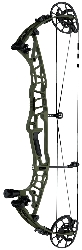
Most compound bows quietly give up on the long-draw bowhunter somewhere past 30 inches, and the archer with a 33-inch draw spends his life forcing short bows to fit - fighting a steep string angle, a pinched anchor, and a peep that never sits right. The Hoyt Highline is the bow built to end that compromise. It is a long, deliberately oversized hunting rig: a 36.5-inch axle-to-axle aluminum platform that reaches a genuine 34 inches of draw, where most hunting flagships stop at 31 or 32. Built on Hoyt's Ventum riser and running the HBX Pro cam, it is not chasing the speed charts - it is chasing a steady hold and a clean anchor for the tall hunter the rest of the market under-serves. Hoyt loaded it with the full In-Line accessory system, the VitalPoint grip, and an included Short Stop stabilizer, and priced it below the carbon flagships as their value long-draw option. The result is a bow that does one job extremely well: it lets a long-draw shooter finally hold dead-steady on a far target without his equipment fighting him.
Finish
The Highline ships in a palette aimed squarely at the Western and timber hunter who lives in open country. Three solids anchor the lineup - Black Out, Wilderness, and Buckskin - alongside a deep slate of camo: Realtree Edge, Kuiu Verde 2.0, and Sitka's Gore OptiFade in both Subalpine and Elevated II, with First Lite Cerca and Mossy Oak Bottomland appearing at some dealers across the model's run. Hoyt also offered Cameron Hanes and Michael Waddell Signature Series treatments for buyers who follow those names. Black Out stays the most timeless pick for a hunter who plans to load his own accessories and wants the riser to disappear behind them, while the OptiFade and Kuiu builds target the spot-and-stalk hunter glassing canyons at first light. That breadth is wider than most single-purpose long-draw bows bother to carry, and because the Highline was a four-year carryover the exact patterns rotated slightly season to season while the riser, cam, and limbs stayed the same underneath.Riser
The Highline is built on Hoyt's machined-aluminum Ventum riser platform, stretched long to put real distance between the axles - and that length is the whole point. A 36.5-inch axle-to-axle frame is what holds the pin still: the longer the riser, the more stable and forgiving the bow sits at full draw, which is exactly what a hunter wants when a mule deer takes its time across a canyon. Settle into anchor and you feel that length doing its job - in my hands the float tightened and the pin wanted to stay put rather than wander. The riser carries Hoyt's full In-Line accessory system, the same hardware the carbon flagships got that year - a Picatinny rail (the same accessory mounting standard used on AR-platform firearms) machined into the front for the sight, an Integrated rest mount that docks a compatible rest tight to the riser, a lowered forward-facing stabilizer location, and a lower SL sidebar mount. Pulling the sight and rest in-line and front-of-center is what keeps a long, accessorized hunting bow balanced instead of nose-heavy. Owners setting one up out of the box note that Hoyt cut no corners here - every mounting feature the premium bows carried made it onto the Highline. Two shock pod locations sit near the limb pockets to soak up residual riser vibration after the shot, part of why this bow finishes so quiet.Grip
The Highline wears Hoyt's VitalPoint grip, molded directly to the riser from a non-slip material with a flattened angle. The design intent, per Hoyt, is to center hand pressure in the meat of the palm instead of loading the bottom edge, which reduces torque at full draw - and on a long, forgiving bow that matters, because a steady riser only stays steady if the hand isn't twisting it. The practical payoff is a repeatable hand position the shooter settles into without thinking about it, the kind of low-torque hold that keeps a long-draw bow pointing where the eye is looking. The non-slip texture is also a cold-weather story: it stays grippy and never goes ice-slick against bare fingers through a long, freezing sit on a Western ridge. There is no left-right windage adjustment as on Hoyt's target side-plate grips, but for a hunting bow the fixed, direct-to-riser connection is the cleaner, more consistent choice, and most owners leave it exactly as it ships.Limbs
The Highline runs Hoyt's split limbs seated in machined limb pockets, the proven interface that anchors the brand's hunting lineup and a big part of why these bows tune predictably and hold tune across seasons. Draw weight is offered in overlapping module brackets that cover a 40 to 70-pound peak span, so a mid-frame hunter can sit at 50 or 60 pounds while a stronger shooter runs the 65 or 70-pound top end. That is a sensible hunting range rather than an extreme one - the Highline's argument was never maximum poundage, it was draw length and a steady hold, and the smooth HBX Pro draw is part of why owners move up to the 70-pound option without dreading the pull. Hoyt's limited lifetime warranty covers the limbs, pockets, and eccentrics to the original owner, reflecting the company's confidence in a limb-and-pocket system it has refined across the Ventum line for years.Eccentric System
The HBX Pro is a three-track binary cam - the same wheel top and bottom, tied together so the system stays in time - and on the Highline it is tuned for reach rather than raw speed. One cam size covers the full 29 to 34-inch draw range through two module options: Mod 2 spans 29 to 32 inches and Mod 3 spans 32.5 to 34 inches, so the long-draw shooter the bow was built for finally finds his exact length instead of topping out a size short. The cam carries a 345 fps IBO rating (IBO being the industry-standard chronograph rating taken at 30 inches, 70 pounds, and a 350-grain arrow), but that number describes a long-draw bow shot short: on a chronograph at 30 inches, 70 pounds, and a 350-grain arrow, a Highline ran in the low 290s - slow, because 30 inches is the very bottom of its cam. Stretch it out to the 33-inch draw it was engineered around and the same cam comes alive with a much longer power stroke driving the arrow. Let-off is shooter-selectable between 80% and 85% (let-off being the share of peak weight your holding weight drops to at full draw) by sliding a screw in each cam's module with an Allen key - an easy change that lets a hinge or back-tension shooter pick the valley behind the wall. Tuning is done by shifting cam shims to walk the arrow's tail straight, the same load-shift idea as Mathews' top-hat system, so a clean paper tear rarely means moving the rest far off center. One honest note from setup: drawing right at the 32 to 32.5-inch seam between the two modules costs a little speed on the longer module, so a shooter on that boundary should choose his module deliberately.Draw Cycle/Shootability
What owners remember after shooting the Highline is how civilized a big long-draw bow can feel. The HBX Pro draws easy - owners coming off other bows describe it as very smooth, pulling cleanly to the wall without a hard hump on the way - and stretched out to a long draw, what I noticed is how the long power stroke stays comfortable rather than building into a fight. The valley is the hunting sweet spot, deep enough to settle into and hold without the bow creeping forward, which is exactly what a long-draw hunter wants when a buck takes its time stepping into the lane and he has to hold at anchor. Where the bow really earns its keep is the shot: owners report zero hand shock and call it one of the quietest bows they have shot in a while, the riser sitting dead and hushed with only a touch of reverb that fades fast. That dead, quiet finish is the payoff of the long riser, the shock pods, and the included Short Stop stabilizer working together. Best of all is the hold: drop into anchor and the 36.5-inch frame parks the pin, and in my hands it simply sat there, the kind of steady, forgiving sight picture that flatters a long-draw shooter's accuracy at distance. It is a big bow, and I felt that mass on the walk in, but the moment I came to full draw the weight turned into stability - and that trade is the entire reason this bow exists.Usage Scenarios
The Highline is built for one archer above all: the long-draw bowhunter, the 32, 33, or 34-inch shooter the rest of the market crams onto bows a size too short. Picture a Western spot-and-stalk hunter glassing mule deer across a canyon - at his 33-inch draw the long 36.5-inch frame parks the pin dead-steady, the string angle stays open and comfortable at anchor instead of pinching, and the flat, forgiving hold lets him hold through the wind and break a clean shot at distance. Drop him into a treestand and the long axle-to-axle and quiet, low-shock shot keep a close whitetail from jumping the string, though the bow's length is more at home in open country than in a tight ground blind. A 70-pound build with a heavy hunting shaft carries plenty of kinetic energy for whitetail, mule deer, and black bear at sensible ranges. It can moonlight as a 3D or backyard target bow for a long-draw shooter who likes a long, stable riser and a steady hold. The one hunter it does not fit is the short-draw shooter: under about 31 inches the Highline is slow and oversized, and that archer is genuinely better served by a shorter, faster bow.Versions
The Hoyt Highline is a single hunting model produced as a four-year carryover - debuting in 2022 and running unchanged through 2023, 2024, and 2025 before Hoyt dropped it from the 2026 lineup. Every model year shares identical specifications: the same 36.5-inch axle-to-axle aluminum riser, the same HBX Pro cam, the same 345 fps IBO rating and 7.875-inch brace height, with only the finish palette rotating season to season. Because of that, the meaningful choice for a buyer is not the model year but the configuration: the cam module (Mod 2 for a 29 to 32-inch draw, or Mod 3 for 32.5 to 34 inches), the peak draw-weight module across the 40 to 70-pound span, hand, and finish. There were no separate package SKUs - the Highline shipped as one bow with the Short Stop stabilizer included, and it listed in the roughly $1,399 to $1,459 range at major retailers like Lancaster Archery, positioned as Hoyt's value long-draw option below the carbon flagships. A shopper buying one today on the used or clearance market is looking at a discontinued-but-identical bow regardless of which of the four years it left the factory.Hoyt Highline vs Mathews V3X 33, PSE EVO NXT 33
| Bow | Hoyt Highline | Mathews V3X 33 | PSE EVO NXT 33 |
| Version | 2025 | 2023 | 2020 |
| Picture |  |  |  |
| Brace Height | 7.875 " | 6.5 " | 7 " |
| AtA Length | 36.5 " | 33 " | 33 " |
| Draw Length | 29 " - 34 " | 27 " - 31.5 " | 26.5 " - 32 " |
| Draw Weight | 40 lbs - 70 lbs | 50 lbs - 75 lbs | 40 lbs - 80 lbs |
| IBO Speed | 345 fps | 336 fps | 314 fps - 322 fps |
| Weight | 4.9 lbs | 4.67 lbs | 4.5 lbs |
| Let-Off | 80% or 85% | 80 or 85% | 80% - 90% |
| Where to buy Best prices online |
| ||
| compare more bows | |||
A long-axle hunting bow shopper usually cross-shops the other big-frame flagships, and two come up most. The Mathews V3X 33 is the premium benchmark for a stable long-axle hold: a 33-inch, 6.5-inch-brace, 336 fps bow at 4.67 pounds with the same 80/85% let-off, built on Mathews' bridge-lock aluminum chassis, and it launched at $1,299. The PSE EVO NXT 33 plays the value-flagship card - a 33-inch, 7-inch-brace bow rated 314 to 322 fps at 4.5 pounds, with the widest 40 to 80-pound draw-weight span and an 80 to 90% let-off range, launched at $1,099. Against both, the Highline's case is reach and forgiveness, not price: it is the only one of the three that holds a genuine 36.5-inch axle-to-axle and the only one that reaches a true 34-inch draw, where the V3X 33 stops at 31.5 inches and the EVO NXT 33 at 32. For the long-draw hunter that gap is the whole decision - neither rival physically fits him. The trade is that both rivals undercut the Highline on price and run shorter and a touch quicker for a normal-draw shooter, with the Mathews V3X 33 adding the brand's renowned silence and the PSE EVO NXT 33 the lowest entry cost and widest poundage range. The decision comes down to draw length and priorities: the Hoyt Highline for the 32-to-34-inch shooter who needs the reach and the steadiest long hold, the Mathews V3X 33 for the normal-draw hunter who wants a quiet long-axle flagship, and the PSE EVO NXT 33 for the buyer chasing the most adjustability for the least money.