
Hoyt Vantage Pro Review
Pros
- Long 41-inch riser that owners consistently call more forgiving than the Shoot-Through Vantage Elite
- Machined-aluminum integrated grip lets you set a repeatable, low-torque hand and lean into a push-pull hold
- Two cam paths on one chassis - smoother Cam & 1/2 Plus for tuning and the aggressive Spiral X for a harder wall and speed, with a third option (the GTX Cam) added for 2011
- Groups tight essentially out of the box after basic tuning, with owners reporting competitive target scores
- Stealth Shot on the 2010 build quiets the string and trims residual shot vibration
Cons
- A specialized long-riser target bow, not a hunting-first platform - short-range treestand hunters are outside its audience
- The integrated grip is fixed and personal - some shooters settle into the Vantage Elite grip faster, so it is worth shooting both in hand first
- Spiral X is draw-length sensitive and prefers to be over-rolled slightly long; Cam & 1/2 Plus is the friendlier choice if you want an easier setup
Editors' review
Born from competition - that was Hoyt's own line for the Vantage Pro, and for once the marketing points at the right question. On paper the Vantage Pro launched in 2009 as a near-twin of the Vantage Elite beside it: identical 41-inch axle-to-axle, identical 301 and 308 fps IBO ratings across its two launch cams, identical 8-inch and 7.75-inch brace heights, identical 4.8-pound mass, identical XT2000 limbs. Hoyt kept it in the target line for three model years, through 2011, and its final year added a third cam to the menu. So the interesting part of this bow is not a spec - it is a fork. The Elite is Hoyt's Shoot-Through Technology riser; the Pro is the standard long riser paired with the machined-aluminum integrated grip that was already winning tournaments on Hoyt's Elite Series. This is a bow for the target and field archer who wants Vantage-platform stability without the Shoot-Through architecture, and who cares more about how the riser holds and how the grip sits than about a number on a spec sheet.
Finish
Hoyt built the Vantage Pro as a target bow first, and the 2010 palette reflects it: Blue Fusion, Red Fusion, Orange, Cobalt Blue, Jet Black, and Pearl White - colors made to look right on a shooting line rather than in the timber. A camo package was also offered for buyers who wanted to take the platform into the field, which is why Abbey Archery carried both a target and a camo SKU. The anodized target finishes are durable and hold up to the handling a competition bow sees across a full season of practice and tournaments. This is not a finish selection about concealment; it is about a bow you are proud to put on a stand between ends. For a competition-oriented compound, that spread of bright anodized options is generous.Riser
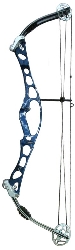
The riser is the whole story of the Vantage Pro. Where the Vantage Elite runs Hoyt's Shoot-Through Technology, the Pro uses a standard long riser - a conventional, stiff, target-length chassis with no string slot - and that single decision is what separates the two bows. In practice owners describe the Pro's long riser as more forgiving than the Elite's, which is the opposite of what a spec-only glance would suggest, since the two share the same 41-inch axle-to-axle number. The riser is machined aluminum and carries the TEC bridge structure Hoyt used across its target line; in 2010 it moved to the lighter TEC-Lite form. It is a long, deliberately stable platform, and some owners report fitting longer XT3000 limbs to stretch the geometry toward roughly 44.5 inches for still more stability. What I keep coming back to with this bow is that the riser is not a compromise chassis borrowed from a hunting model; it was drawn for the line, and it holds like it.Grip
The grip is the Vantage Pro's second signature, and it is the same machined-aluminum integrated grip Hoyt put on its Elite Series tournament bows - not the removable Pro-Fit wood grip, which Hoyt explicitly did not offer on this model. Integrated into the riser, it establishes a fixed, repeatable hand position with very little torque, and shooters report the bow rewards a clean push-pull execution and simply sits still while you hold. In my experience a fixed metal grip like this is polarizing by design: it is superb once your hand learns it, because there is nothing to shift or rotate, but it gives you nothing to customize if the shape does not suit you. That is exactly what owners say - some settle in immediately and love it, while others found they could hold the Vantage Elite better. The takeaway is simple and consultative: this grip is a strength if it fits your hand, so put your hand on one before you commit.Limbs
The Vantage Pro runs Hoyt's proven XT2000 limbs - five-layer laminated, split-limb - the same limb set that carried much of Hoyt's target line in this era. At launch in 2009 the draw-weight range was 40 to 80 pounds; for 2010 it shifted down to 30 to 70 pounds - Hoyt dropped the 70-to-80-pound module and added a 30-to-40-pound option for shooters who did not need heavy poundage. Each module adjusts roughly ten pounds down from its peak, so a shooter tunes weight without a full limb change. The XT2000 limb has a long, well-documented reliability record across Hoyt's catalog, which matters on a bow built to fire thousands of arrows a season on a practice line. Because the limbs set the axle-to-axle, some owners report moving up to longer XT3000 limbs to push the Vantage Pro toward a longer, even more forgiving geometry near 44.5 inches.Eccentric System
Hoyt offered the Vantage Pro with a choice of cam systems aimed at two different archers, and the menu grew over its run. The Cam & 1/2 Plus - on the bow every year of its life - is rated at 301 fps IBO and is the smoother, more adjustable path: a friendlier draw with selectable let-off, and the easier system to tune and live with. The Spiral X Cam & 1/2 was the sportier alternative from the start, rated at 308 fps IBO - the aggressive option, a hard-pulling draw stacking into a super-hard back wall on a 7.75-inch brace, with the speed target archers chase. For 2011, the bow's final model year, Hoyt added a third choice, the GTX Cam: rated at 305 fps IBO on a slightly longer 41 5/8-inch axle-to-axle, it is the smoother, more modern speed cam that spread across Hoyt's 2011 target line. The trade-off with Spiral X is real - it is sensitive to draw length and, as owners note, the timing marks want to be over-rolled a hair to the long side, so it is not a set-and-forget cam for a newer tuner. Real-world numbers land where you would expect for a below-IBO setup: one owner clocked a Cam & 1/2 Plus rig at 286 fps with a 317-grain arrow at 57 pounds, and Spiral-X shooters reported the mid-to-upper 280s at a 28-inch draw with five-grain-per-pound arrows. Neither cam is a hunting-first compromise; both are drawn for accuracy at distance. Drawing the Spiral X, I found the wall to be exactly as advertised - a firm, definite stop you can pull into and trust - while the Cam & 1/2 Plus feels noticeably kinder through the middle of the stroke. For most target and field shooters the Cam & 1/2 Plus is the sensible default; the speed-minded want the Spiral X, or - on a 2011 bow - the smoother GTX Cam.Draw Cycle/Shootability
The Vantage Pro shoots like the long target bow it is: it settles, it holds, and it stays put. On the Cam & 1/2 Plus the draw is smooth and predictable, building without a harsh hump and easing into a defined valley - the kind of cycle you can repeat identically for a full round without fatigue changing your form. On the Spiral X the ramp is more aggressive and the payoff is that super-hard wall, which many spot shooters prefer because it gives a fixed reference to pull against. Owners describe the bow as one that groups tight after only basic tuning - nock height, center shot, a stabilizer - and then simply lets you execute; one competitor cited a 654 with the Pro, and clean-X runs come up repeatedly in owner talk. In my experience the standout is the hold: the long riser and the fixed integrated grip together make the bow feel planted at full draw, so the shot is about your release, not about fighting the bow. On the 2010 build, Stealth Shot takes the edge off the string and trims residual vibration, so the shot finishes quiet and dead in the hand. This is a bow that rewards a shooter with a repeatable, disciplined process, and it gives that shooter very little to blame.Usage Scenarios
The Vantage Pro is a target and field bow, full stop. Picture a spot shooter at an indoor league on a Tuesday night, holding a 41-inch bow rock-steady on a 40-centimeter face and stacking Xs - that is the home range for this bow. Picture a field archer walking a 3D or field course, valuing the long riser's forgiveness on unmarked yardage where a steady hold covers a small ranging error. It suits the archer transitioning up from a shorter hunting-style compound into a dedicated tournament rig, and it suits the established competitor who wants Vantage-platform stability without the Shoot-Through riser. With the camo package and a Cam & 1/2 Plus setup it can absolutely be hunted, but that is not why you buy it - a 41-inch axle-to-axle target bow is long for a treestand, and short-range hunting is not its calling. Choose it for the shooting line, the field course, and the pursuit of a clean, repeatable, high-scoring shot at distance.Hoyt Vantage Pro vs Bowtech Specialist, PSE Supra Focus
| Bow | Hoyt Vantage Pro | Bowtech Specialist | PSE Supra Focus |
| Version | 2011 (GTX Cam) | 2014 | 2021 SE |
| Picture |  |  |  |
| Brace Height | 8 " | 7.5 " | 7 " |
| AtA Length | 41.625 " | 37.5 " | 37 " |
| Draw Length | 25.5 " - 32 " | 26 " - 30.5 " | 26 " - 31.5 " |
| Draw Weight | 30 lbs - 70 lbs | 50 lbs - 60 lbs | 40 lbs - 60 lbs |
| IBO Speed | 305 fps | 330 fps | 318 fps - 326 fps |
| Weight | 4.8 lbs | 4.1 lbs | 4.7 lbs |
| Let-Off | 65% or 75% | 65%, 75% | 65% - 75% |
| Where to buy Best prices online |
|
| |
| compare more bows | |||
For an archer cross-shopping dedicated target and field compounds, the Bowtech Specialist and the PSE Supra Focus are the two natural alternatives to the Vantage Pro. The Bowtech Specialist is a shorter, faster-feeling target platform built around Bowtech's shooter-comfort and vibration-damping approach - it appeals to the competitor who wants a slightly more compact, forgiving-yet-quick bow and who values Bowtech's dead-in-hand shot signature. The PSE Supra Focus comes at target archery from PSE's speed-and-innovation angle, aimed at the shooter who wants an aggressive, fast target rig and is comfortable tuning for it. The Vantage Pro sits between those temperaments: a long 41-inch riser tuned for forgiveness and a rock-steady hold, with a choice between the smooth Cam & 1/2 Plus and the hard-walled, faster Spiral X so the archer picks their own draw character. It also carries the machined-aluminum integrated grip that came off Hoyt's tournament-winning Elite Series, which is a genuine draw for shooters who already trust that hand feel. The decision comes down to priorities: the Bowtech Specialist for the archer who wants a more compact, damping-focused target bow, the PSE Supra Focus for the one chasing PSE-style target speed, and the Hoyt Vantage Pro for the shooter who puts a long, forgiving riser and a fixed tournament grip above all else.