
Bear Adapt 2 Review

from $455.68
Pros
- Smooth draw cycle - clean rollover and a settled back wall, especially on the Single Cam variant
- Quiet shot in the 82-88 dB band on the DHC Hybrid; the Single Cam runs louder
- Real-world chronograph close to published IBO - 294 fps Single Cam, 310 fps DHC Hybrid at 29"/70#/350gr
- Bear Paw rubber grip - low-torque hold, warm in cold weather, same grip Bear puts on flagships
- RTH packages arrive range-ready - Trophy Ridge accessories pre-mounted, tunable to a bullet hole
Cons
- Some users have noted slight compliance in the DHC Hybrid cable-stop back wall - the Single Cam variant offers an optional limb-stop for a firmer wall
- Some owners have reported the RTH factory peep failing early - any $10 aftermarket peep drops right in
- Some users have reported post-shot vibration on the Single Cam variant - aftermarket dampeners help, or the DHC Hybrid ships with full dampening
Video
content from YouTube
Editors' review
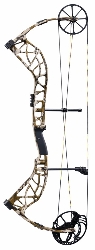
The Adapt 2 platform answers a question most buyers don't realize they're asking: how much of the cost of a flagship bow is the cam? Two bows share the riser, the grip, the IMS rest dovetail, the Picatinny sight rail, the roller cable slide, the KillerWave limb dampeners, and the Bear Paw rubber grip. They share a 31-inch axle-to-axle frame and a 6.5-inch brace height. They differ on a single component - the cam - and that one swap drives a 16 fps real-world speed delta, a three-inch shift in draw-length range, and a $100 to $150 price gap across SKU tiers. The Single Cam variant carries the original Adapt 2 name, launched August 2024, and stays in the 2026 lineup unchanged. The DHC Hybrid variant - Adapt 2 HP - joined the family a year later, August 2025, and the platform now sells in parallel as two versions a buyer chooses between rather than as a model with a successor. This review covers both as one Adapt 2 platform; the Versions section below lists every SKU with launch MSRP.
Finish
Available finishes split by version and package tier rather than running as a single palette across the platform. The Single Cam Adapt 2 ships Bow Only in two solid hunting patterns - Mossy Oak Bottomland and Throwback Green - adds True Timber Strata for the RTH package, and stays on the same two solids for the RTH+ tier. The DHC Hybrid Adapt 2 HP carries the same two solids on Bow Only, expands to four options on RTH (Bottomland, Throwback Green, Strata, and the newer Emerge 2.0), and offers three on RTH+ (Bottomland, Throwback Green, Emerge 2.0). Emerge 2.0 is the most recent Bear camo introduced in 2025 and does not appear on the Single Cam lineup. Two-tone limb options are not currently advertised on either version; this is a solid-pattern platform rather than a finish-customization-first one. The coating reads as a durable factory hydro-dipped pattern over the aluminum riser, consistent with what ships across Bear's hunting lineup at this tier.Riser
Both versions share an aluminum cage-style riser cut with the same geometry, which means the accessory ecosystem, the cable management, and the visual identity carry across the platform. The Integrate Mounting System (IMS) dovetail at the rear of the riser accepts IMS-compatible Trophy Ridge rests - the included Whisker Biscuit V on the RTH packages slides in and self-levels without tools, a setup that takes minutes rather than the half-hour of a traditional Berger-hole install. The Picatinny rail up front (the same accessory mounting standard used on AR-platform firearms) handles sight mounting, so a swap from the included multi-pin to a slider sight does not require re-drilling. The roller cable slide replaces the plastic slider used on lower-tier Bear models like the Legit Maxx - less friction at the cables during the draw, less perceived effort late in the cycle. In my experience the IMS rest install on a fresh RTH package cuts setup time in half compared to a traditional rest, which matters when the buyer's plan is Saturday purchase, Sunday range, Wednesday treestand. Cable guard and limb pocket detailing match across the two versions; at the rack, you would have to look at the cam to tell a Single Cam and a DHC Hybrid apart.Grip
The Bear Paw rubber grip ships on both versions, removable for shooters who prefer to draw against the bare riser. The profile is flatter at the back than a traditional grip, with contoured cuts that encourage a low-torque hand position - the kind of grip that rewards consistent placement and forgives small variations. The rubber coating earns its place on cold-weather hunts; the same surface that feels neutral at 70 degrees feels warm to the hand in late November sub-freezing temperatures, and the difference is not subtle after two hours in a treestand. The same grip ships across Bear's mid-tier and higher lineup, including the Persist 33 flagship - a strong indication of where Bear sees the platform's cost ceiling, because this is not the place they save money. For shooters who prefer a custom grip - rubber wrap, aftermarket wood, a particular hand-fit - the removable design means you do not pay for hardware you intend to replace. In my experience the Bear Paw is one of the underrated value points on this platform; on a flagship, this same grip is sold as part of the flagship's premium feel.Limbs
Split limbs in matching pockets across both versions; the same draw-weight modules ship on both bows. Two module options cover the buyer's draw-weight choice: a 45-60 lb module and a 55-70 lb module. A bow press is required to swap between modules - this is not a tool-free in-the-field adjustment. The 45-60 lb option handles youth-into-young-adult progression and lighter-poundage adult target shooting; the 55-70 lb option handles full hunting weights with margin to spare. Both versions cap at 80% let-off (the percentage of peak weight the holding weight drops to at full draw), which on the heavier 70 lb module means 14 pounds of holding weight at full draw - the difference between holding 14 pounds and 21 pounds matters more on a long sit than the math suggests. The limb pocket geometry and the in-limb KillerWave dampening hardware are identical across the two cam variants; the platform's speed difference does not come from the limbs.Eccentric System
This is where the two versions diverge. The Single Cam Adapt 2 carries a single power cam on the bottom limb paired with an idler wheel on top - the string and one cable wrap the cam, the second cable goes to the idler. Less timing sensitivity (only one cam to stay in sync), longer string life, and an easier press-free maintenance cycle are the structural advantages. The trade-off shows up on the chronograph: 320 fps IBO published, with chronograph testing averaging 294 fps at a 29-inch draw, 70 lb peak, and a 350 grain arrow - typical hunting-weight numbers. The Single Cam also ships with an optional limb-stop accessory in the box, which converts the standard cable-stop back wall into a firmer limb-contact wall: flagship-firm without the flagship spend. The Adapt 2 HP swaps to the DHC Hybrid Cam (top and bottom cam working in concert), bumps IBO to 330 fps, and chronograph testing on identical setup produces 310 fps at the same 29-inch draw, 70 lb peak, and 350 grain arrow - a 16 fps real-world delta on the same chassis. The HP's back wall is cable-stop only and carries some compliance: think of it as a wall with a hint of give rather than a hard stop. Split-yoke tuning is available on both versions for lateral-tear correction; the hybrid gains tuning headroom from the dual-cam geometry, the Single Cam holds the smoother draw character. Both cams adjust draw length in half-inch increments via rotating modules - no press required for the module step itself, though full timing-spec corrections still benefit from one.Draw Cycle/Shootability
The Single Cam draws as the platform's smoothest option - a gradual ramp to peak weight, a clean rollover, and a deliberate settle into the back wall. Pulling the 70 lb module at a 29-inch setting, perceived weight feels closer to 60 lbs at peak; the single-cam geometry plus the 80 percent let-off pull 14 lbs of holding weight off the hand and produce a draw cycle that does not fatigue across a long range session. The DHC Hybrid draws a little more aggressively but not punishingly - the cam roll is shorter, the peak builds faster, then releases into a deeper valley than the spec sheet suggests. In my experience the hybrid valley reads more like 85 percent let-off than the published 80; there is room to relax at full draw that the cam's draw-stop dwell allows, which matters during a long hold on a moving deer. The shot finish on the Single Cam leans on KillerWave limb dampeners for noise control, and the one independent decibel reading came in louder than the HP. The HP's Complete Dampening System adds in-riser dampeners and a string stop on top of the limb dampeners, holding noise in the 82 to 88 dB band depending on arrow weight; releasing the bow, I was surprised at how contained the hand-shock pattern stayed for a sub-$700 hunting setup. Both versions reward a deliberate release. For the shooter graduating from a $400 RTH package, either version reads as a genuine step up; for the shooter coming from a $1,500 flagship, the difference is felt mostly in the back-wall character and the post-shot quiet.Usage Scenarios
Whitetail hunting with the Single Cam fits the patient still-hunter or the treestand sitter - the smoother draw means a cold-stiffened arm can reach full weight without a hitch that alerts a deer at 18 yards. The DHC Hybrid favors the hunter who wants headline speed for moderate-distance shots and accepts a slightly stiffer cam character to get it. Picture an opening-week Saturday: a buyer walks into a pro shop, picks an RTH package (Trophy Ridge accessories pre-mounted, tuned to a bullet hole), sights in by lunch, and is in a stand by Wednesday's pre-dawn for the late-October rut window. The 24-inch minimum draw on the Single Cam fits households where a parent and a teenager share a bow across seasons - at 14 the kid starts at the 45 lb module's lower end, at 18 the same chassis takes them to the 70 lb module's full weight for elk-capable hunting. The HP's 27-inch minimum starts higher and tops out at 32 inches, which fits the tall adult shooter (six-two and up) who has historically had to grind through a flagship to find that range. Both versions handle 3D club nights and backyard practice - neither is target-bow-tuned but both group well enough at 30 to 50 yards to serve as the hunting season's practice tool.Versions
The Adapt 2 platform ships in seven SKUs across two cam variants. Launch prices listed below; bow itself (riser, limbs, grip, draw cycle, accuracy) is identical within each cam variant - only package contents and color and hand availability differ.Single Cam Adapt 2 - Bow Only at $499.99 launch MSRP, right-hand only, two solid finishes (Bottomland, Throwback Green), no accessories.Single Cam Adapt 2 RTH at $599.99 launch MSRP, left or right hand, three finishes - Trophy Ridge Integrated 4-Pin sight, IMS Whisker Biscuit V rest, 5-arrow quiver, stabilizer with sling, peep and D-loop, 3-month OnX Elite membership.Single Cam Adapt 2 RTH+ at $799.99 launch MSRP, left or right hand, two finishes - Trophy Ridge SWFT Duo two-pin slider sight, 5-arrow VRSA Light quick-disconnect quiver, Hitman quick-disconnect stabilizer in place of the RTH's basic kit.DHC Hybrid Adapt 2 HP - Bow Only at $599.99 launch MSRP, right-hand only, two solid finishes, no accessories.DHC Hybrid Adapt 2 HP RTH at $679.99 launch MSRP, left or right hand, four finishes including the newer Emerge 2.0 - Trophy Ridge Fatal 4-Pin sight, Whisker Biscuit V rest, Snubnose 6-inch stabilizer, 5-Spot quiver, peep and sling.DHC Hybrid Adapt 2 HP RTH+ at $949.99 launch MSRP, left or right hand, three finishes - Trophy Ridge SWFT Duo slider sight, Hitman stabilizer with quick-disconnect, VRSA Light quick-disconnect quiver.DHC Hybrid Adapt 2 HP RTH+ Sync at $969.99 launch MSRP, right-hand only, 55-70 lb module only, two finishes - RTH+ contents with the Trophy Ridge Sync MD drop-away rest replacing the Whisker Biscuit V (drop-away vs full containment; cleaner fletching, supports faster arrows).Bear Adapt 2 vs Diamond Provider, PSE Stinger Max
| Bow | Bear Adapt 2 | Diamond Provider | PSE Stinger MAX |
| Version | 2026 | 2018 | 2021 |
| Picture |  |  |  |
| Brace Height | 6.5 " | 7.5 " | 7 " |
| AtA Length | 31 " | 31 " | 30 " |
| Draw Length | 24 " - 31 " | 25.5 " - 31 " | 21.5 " - 30 " |
| Draw Weight | 45 lbs - 70 lbs | 20 lbs - 70 lbs | 45 lbs - 70 lbs |
| IBO Speed | 320 fps | 310 fps | 304 fps - 312 fps |
| Weight | 4.3 lbs | 3.3 lbs | 3.8 lbs |
| Let-Off | 80% | 80% | 80% |
| Where to buy Best prices online | |||
| compare more bows | |||
Three single-cam hunting bows sit at the under-$500 launch tier: the Bear Adapt 2 standard, the Diamond Provider, and the PSE Stinger MAX. The Diamond Provider opens at $499 launch MSRP - exact price match to the Bear Adapt 2 - with a 7.5-inch brace height (a full inch more forgiving than the Adapt 2's 6.5-inch brace) and a 20 lb draw-weight minimum that pulls the youth and family use case down further than the Adapt 2's 45 lb floor. Diamond Provider runs 310 fps IBO on a single cam derived from Bowtech engineering at Diamond pricing - comparable smoothness, higher forgiveness on form errors, slightly lower headline speed. The PSE Stinger Max comes in at $449 launch MSRP - fifty dollars under the Adapt 2 - with a 7-inch brace, 304 to 312 fps IBO depending on setup, and a 21.5-inch minimum draw length that fits the smaller-framed shooter the Adapt 2 cannot reach. The PSE Stinger Max also leans into PSE's typical aggressive industrial styling rather than Bear's hunting-traditional look. The decision comes down to priorities: the Bear Adapt 2 for the buyer who wants the IMS and Picatinny accessory ecosystem and the option to step up to the DHC Hybrid HP variant on the same chassis, the Diamond Provider for the buyer who prioritizes a forgiving brace height and the widest draw-weight floor for a family-share setup, the PSE Stinger Max for the buyer who wants the smallest draw-length accommodation at the lowest entry price.