
Bear Adapt Review


from $220
Pros
- Quiet, dead-in-hand shot - a hunting-weight arrow reads under 96 dB with only a faint puff of post-shot vibration that never travels into the riser
- Rare back-wall choice for a single cam - an ovalized limb stop delivers a rock-solid wall, or run it inward to shoot closer to 75 percent let-off for a firmer hold
- Genuinely tunable without a bow press - three exposed screws handle the cable stop, module and limb stop, and the single cam sidesteps the timing dance of a two-cam bow
- Fits a whole household - a 24 to 31 inch draw span plus two 15-pound weight modules covers a short-draw teenager and a 70-pound adult on one bow
- Bear Paw grip debuts here - an over-molded rubber grip that stays warm in the cold, sits low and repeatable in the palm, and pops off with two Allen screws
Cons
- Heavier than the sheet says - Bear lists 3.9 pounds but it weighs about 4.4 out of the box; pulling the grip and limb dampeners drops it back toward 4.2 for shooters chasing a lighter carry
- Some shooters will feel a slight hump at the back of the draw - the price of pulling 320 fps from a single cam; running the ovalized limb stop inward softens the hold if you accept a hair less draw length
Video
content from YouTube
Editors' review
The Adapt is the bow where a lot of today's Bear started. Launched in July 2022 as the first Hunting Public collaboration, it introduced the Bear Paw grip that now ships across half of Bear's lineup, and it proved a value single cam could give a shooter a real back-wall choice instead of the one spongy wall the category was known for. Aaron, Greg, Zack, Jake, Hayden and Ted of The Hunting Public built the bow they wanted for their own seasons: a smooth, quiet, forgiving single cam that fits almost any body and takes any North American game, at a price under $500. It is a 32-inch axle-to-axle hunter with a 6.5-inch brace and an honest 320 fps IBO rating (the industry-standard chronograph number at a fixed 30-inch, 70-pound, 350-grain setup) - never a speed demon, and never trying to be. What it chases instead is comfort, quiet, and adjustability, and it lands all three. Discontinued when the Adapt 2 arrived in 2024, it remains one of the easiest single cams to live with that Bear has built.
Finish
The bow-only Adapt shipped in a single deliberate look: Throwback Tan, a desert-tan riser paired with classic Fred Bear camo limbs - an old-school nod rather than a modern digital pattern, and a genuinely distinctive one on a rack full of gray-and-green hunters. The Ready-to-Hunt packages opened the palette up with TrueTimber Strata, Veil Whitetail, and a solid olive alongside the Throwback Tan, so a buyer who wanted a full modern camo instead of the heritage look had it. When the Adapt Plus arrived in 2024 it added Mossy Oak Bottomland to the top-tier package. The soft-coat finish on the riser and limbs is the same treatment Bear runs across its current lineup. If there is a wish-list item, it is more solid riser colors - the tan look is polarizing, and a darker brown or a matched olive riser would have widened the appeal.Riser
The Adapt rides on a cast aluminum riser with aluminum limb pockets - not a machined billet chassis, which is exactly right for the price, and Bear spent the savings where a shooter feels it. The cutouts are clean, the geometry pushes the axle-to-axle out to a forgiving 32 inches, and the string angle at full draw is pleasantly acute for a bow this size. Rest and sight mounting is traditional here: standard double rest holes and a Berger-style stabilizer hole, not the Integrated Mounting System (IMS) dovetail or Picatinny rail that Bear would later put on the Adapt 2, so any conventional drop-away rest and any threaded sight bolt straight on. A rear string stop hangs off the back of the riser to catch shot energy. What stands out is how quiet and inert the riser is after the shot - drawing and firing it, the vibration is a single small puff that dies instantly instead of ringing through the handle, and that stillness is a big part of why the bow feels more expensive than it is.Grip
The Bear Paw grip made its debut on the Adapt, and it is one of the underrated reasons to shoot this bow. It is an over-molded soft-coat rubber grip, warm to the hand on a cold pre-dawn sit and shaped low so the hand sits deep and repeatable rather than perched high where torque creeps in. In my experience it settles into the same spot shot after shot, which is exactly what a hunter wants when the shot count is one. Two Allen screws pull it off, and the riser is machined underneath to serve as its own grip - so shooters who prefer to shoot straight off the bare riser, as many target archers do, have that option without any aftermarket part. Bear called it their most comfortable and ergonomic grip to date at launch, and the design earned that billing: it went on to ship across the Alaskan, Resurgence, Legit, Species EV and eventually the Adapt 2. For a bow at this price to introduce a grip the flagship line later adopted tells you where Bear put its attention.Limbs
The Adapt uses split limbs seated in aluminum pockets, and the real story is the draw-weight strategy. Rather than one narrow band, Bear offers two 15-pound modules - 45 to 60 pounds and 55 to 70 pounds - so a shooter can dial in a genuinely light setup or a full 70-pound hunting weight from the same bow. That 15-pound spread is unusually generous for a mid-price hunter; most competitors give you a 10-pound window, and the extra room means a shooter can start softer while building form and climb into full weight later without buying new limbs. Combined with the 24 to 31 inch draw-length range, the limb options are what let a single Adapt fit a whole family across years. The limbs carry the KillerWave dampeners in the pockets, which is a meaningful part of the bow's dead-in-hand character, and the same limb-and-pocket architecture appears across Bear's broader lineup.Eccentric System
At the heart of the Adapt is a single cam paired with an idler wheel - the choice The Hunting Public made on purpose. A single cam trades the top-end speed of a two-cam bow for a smoother pull, longer string life, and freedom from cam-timing headaches, and the Adapt leans fully into that. Its 320 fps IBO rating sits a touch above Bear's Species-family single cams (around 310 fps) but the Adapt is honest about not being a speed bow. Real chronograph work at 70 pounds and a 29-inch draw shows what a hunter actually gets: 294 fps with a light 350-grain arrow, 278 fps at a more typical 400 grains, 266 fps at 450, and 253 fps with a heavy 500-grain shaft - plenty of kinetic energy for any North American animal. Push into 680-grain heavy-FOC territory and it still throws 219 fps. The standout feature is the back wall. Most single cams give you one slightly spongy wall and that is that; the Adapt gives you a choice. An ovalized limb stop can be run all the way out, where it touches at the same instant as the cable stop for a rock-solid wall at a full 80 percent let-off, or run inward to firm the hold up closer to 75 percent let-off with a touch less draw - a genuine tuning latitude that the Adapt's own single-cam siblings never got. Adjustment is refreshingly simple: three exposed screws, no hunting for fasteners hidden behind the limb, and often no press at all.Draw Cycle/Shootability
Drawing the Adapt, the front half is linear and easy - no early spike, just a steady climb to peak. Toward the back there is a slight hump before the valley, and that is the deliberate cost of pulling 320 fps out of a single cam; you feel it, but it is far from harsh. Where it settles is the good part. Roll over the peak and the bow drops into a generous valley - none of the grabby, snap-forward feel of the old single cams, no tendency to rip your arm forward if you creep. With the limb stop activated the wall is a wall, firm and repeatable, and I found running it inward for a shorter, harder hold made the bow reward strong back tension the way a target archer wants. At 80 percent let-off you can feel that you are holding a real percentage of peak weight, but there is enough valley to relax and aim. The shot itself is the headline: quiet, with a measured reading under 96 dB on a hunting arrow and one of the quietest signatures a shop will put on the meter in this class, followed by that single small puff of vibration that is gone before the arrow lands. Between the smoothness, the quiet, and the forgiving 32-inch geometry, it is an easy bow to shoot well from the first arrow.Usage Scenarios
The Adapt is a whitetail and general big-game hunter first. Set at 400 grains and 70 pounds it carries plenty of energy for deer, hogs and black bear at normal treestand and ground-blind ranges, and the quiet shot is exactly what you want when a deer is standing at fifteen yards inside a treeline. The 32-inch axle-to-axle length and acute string angle make it forgiving on longer poke shots from a blind, while still being manageable from a saddle or a crouch - Bear specifically pitched it for those awkward, unpredictable hunting positions. It doubles as a summer 3D and backyard target bow: run the limb stop inward for the firmer 75-percent hold and it rewards a deliberate, back-tension shot process on the range. It is an ideal one-bow-fits-the-family buy - start a teenager at the bottom of the 45-to-60 module and a 24-inch draw, then let the same bow grow with them to a 70-pound, 31-inch adult hunting rig. What it is not is a long-range speed weapon; a shooter chasing flat trajectory at 60-plus yards or the fastest arrow on the range will want a two-cam bow, and that is a fit question, not a flaw.Versions
The Adapt was sold in three configurations under one chassis:- Adapt Bow Only - $459.99 launch MSRP (2023). Just the bow (cast riser, single cam, Bear Paw grip, limb stop and cable stop), for shooters bringing their own accessories. Shipped in Throwback Tan.- Adapt RTH - $559.99 launch MSRP (MAP $529.99). Adds a Trophy Ridge 4-pin sight, Whisker Biscuit V rest, 5-arrow quiver, stabilizer and sling, plus a peep and D-loop - a complete hunt-ready package. Offered in TrueTimber Strata, Throwback Tan, Veil Whitetail and solid olive.- Adapt Plus (Adapt+) - 2024 top-tier package. Upgrades the RTH kit with a Trophy Ridge Hotwire sight and a Hitman stabilizer, adds a roller cable slide for an even smoother draw, and comes in Mossy Oak Bottomland.The bow shoots identically across all three - the differences are the accessory kit, the roller cable slide on the Plus, and the color. Buyers cross-shopping the current lineup should note the Adapt 2 is the direct successor: it moved to a 31-inch chassis, added the IMS rest dovetail and a Picatinny sight rail, and made the roller cable slide standard.Bear Adapt vs Diamond Provider, PSE Stinger Max
| Bow | Bear Adapt | Diamond Provider | PSE Stinger MAX |
| Version | 2024 RTH | 2018 | 2021 |
| Picture | 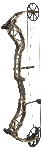 |  |  |
| Brace Height | 6.5 " | 7.5 " | 7 " |
| AtA Length | 32 " | 31 " | 30 " |
| Draw Length | 24 " - 31 " | 25.5 " - 31 " | 21.5 " - 30 " |
| Draw Weight | 45 lbs - 70 lbs | 20 lbs - 70 lbs | 45 lbs - 70 lbs |
| IBO Speed | 320 fps | 310 fps | 304 fps - 312 fps |
| Weight | 4.4 lbs | 3.3 lbs | 3.8 lbs |
| Let-Off | 80% | 80% | 80% |
| Where to buy Best prices online | |||
| compare more bows | |||
All three are single-cam hunting bows built for the value-minded buyer, and they separate on the details. The Diamond Provider, at $499 MSRP, is the most family-flexible of the group - its 20-pound draw-weight floor and forgiving 7.5-inch brace height make it the pick for a household that wants one bow to reach from a young beginner all the way to a full adult hunting weight, where the Adapt's 45-pound floor sets a higher entry point. The PSE Stinger MAX, at $449, is the budget-friendliest and fits smaller-framed shooters with its 21.5-inch draw minimum, though its 30-inch axle-to-axle length gives up some of the forgiveness the Adapt's longer 32-inch riser provides. The Adapt sits in the middle on price but leads the trio on two things a hunter feels: its adjustable limb-stop back wall - neither competitor offers the rock-solid-or-softer wall choice - and its quiet, dead-in-hand shot. The decision comes down to priorities: the Diamond Provider for the widest family-share range, the PSE Stinger Max for the lowest price and shortest-draw shooter, and the Adapt for the shooter who wants the tunable wall and the quietest release of the three.