
Bear Brave Review
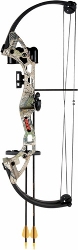

from $52.49
Pros
- Genuine scaled-down compound build - solid, light in the hand, and well assembled rather than a plastic toy
- Holds up to real use - owners report hundreds of backyard arrows with no meaningful wear
- Full-capture Whisker Biscuit rest and an adjustable 1-pin sight are included, so a beginner learns proper form from the first shot
- Finger-friendly setup that needs no D-loop or release, making it an easy bridge from a first recurve to a compound
- Low entry cost - a genuinely low-risk way to find out whether a child takes to compound archery
Cons
- The draw length is fixed, not adjustable - the 13.5-19.5 inch figure on the box is the cam's continuous window, not a range you dial in, so it will not grow with the child; for that, choose an adjustable youth compound instead
- The included two-arrow quiver is flimsy and also carries the sight bracket, so it has to stay on - most owners simply set arrows aside for backyard target sessions
Video
content from YouTube
Editors' review
The number on the box does most of the damage: "draw length 13.5 to 19.5 inches" reads like an adjustable bow, and it is not one. The Bear Brave's draw does not adjust at all - that range is simply the continuous window in which its single youth cam delivers full let-off (the percentage of peak weight the bow lets you hold at full draw), and understanding that one line is the whole key to buying this bow correctly. What the Brave actually is: a genuine compound bow scaled down for a first-time archer eight to twelve years old, built with a real cam-and-string system rather than the stretchy toy mechanism of a department-store set. It ships with a full-capture Whisker Biscuit rest and an adjustable single-pin sight, it costs less than a hundred dollars, and it is put together well enough to survive a summer of backyard shooting. For the parent whose kid has outgrown a foam bow and is ready to learn how a compound actually works, that is exactly the point.
Finish
The Brave carries a broader color range than most bows at its price. Four solid finishes cover the basics - Black, Green, Orange, and Purple - and a Camouflage option adds a woodland look for the young hunter-in-training. Above those sit five Fred Bear tribute finishes - Shadow, Electric, Fire, Twilight, and Tan - that borrow the retro palettes from Bear's heritage line and give a kid a bow that looks like something off dad's rack rather than a toy aisle. The composite riser and limbs take the color in the mold, so there is no decal to peel after a season of being dropped in the grass. The lineup has shifted over the years - older runs leaned on pink and fluorescent tones - but the current selection spans ten finishes, which is a wide choice for a first bow.Riser
The Brave is built on a molded composite riser rather than machined aluminum, which is the right call for this bow: it keeps the mass low so a small archer can hold it up, and it keeps the price where it needs to be. In the hand the whole bow feels light and genuinely well put together - the kind of solidity that reassures a parent it will survive being dropped, leaned against a fence, and left out overnight. The 26-inch axle-to-axle length (the tip-to-tip measurement across the cams) keeps the bow compact and easy for short arms to manage. The Whisker Biscuit rest mounts to the shelf and, being a full-capture bristle rest, holds the arrow in place from every angle so a beginner cannot knock it off before the shot. The Brave is offered in right hand only, which is the one thing a left-dominant family needs to check before buying.Grip
The grip is molded straight into the composite riser - narrow, simple, and sized for a child's hand rather than an adult's. There is nothing to adjust and nothing to torque, which suits the audience: a young archer is learning to build a consistent hand position, not fine-tuning grip angle. The string carries a set of finger guides that act as reference points for where small fingers sit above and below the arrow, so the bow encourages a repeatable draw from the start. Because it is designed to be shot with fingers rather than a mechanical release, the grip and string work together to keep the whole motion close to what a kid already knows from a beginner recurve.Limbs
The limbs are durable composite, matched to the riser, and they are the part of the bow that sets how heavy it draws. Peak draw weight builds continuously up to about 25 pounds, and the limb bolts give you some room to back that off with a tool for a smaller or younger shooter - no bow press required, which matters for a parent working on the kitchen table. That range is deliberately gentle: enough to launch an arrow into a backyard target with authority, light enough that an eight-year-old can come to full draw without straining. The composite limb design has a long track record across Bear's youth line, and hands-on owners consistently report the Brave shrugging off hundreds of shots without cracking, splintering, or losing tune.Eccentric System
The heart of the Brave - and the source of all the confusion - is its single youth cam. It is a true compound eccentric with a real back wall and 65-percent let-off, meaning at full draw the archer holds only about a third of peak weight, which is what lets a small shooter settle and aim instead of shaking against the full poundage. The one thing it does not do is adjust draw length. The 13.5-to-19.5-inch figure printed on the packaging is the continuous window over which the cam delivers full let-off for a two-to-three-inch stretch at the archer's natural draw - it is not a range you dial in, and there is no module or rotating cam to lengthen as the child grows. This is the single most important fact about the bow, and it is why some parents feel misled by the box: the Brave fits a kid whose draw falls inside that window today, and a child who grows past it has simply outgrown the bow. Speed is not a metric anyone measures on a 25-pound youth cam, and it should not be part of the buying decision here; the cam's job is smooth, forgiving, repeatable draw, and it does that. One firm rule applies as with any compound: never dry-fire it.Draw Cycle/Shootability
Drawing the Brave is deliberately easy. The front end ramps up gently, peak weight arrives without a hard hump, and the 65-percent let-off drops the holding weight enough that a young archer can hang at full draw long enough to line up the pin. Shooting it with fingers rather than a release, I found the motion stays close to what a kid already learned on a first recurve - the same pull, the same anchor, just with a wall to stop against and a sight to guide the aim, which is exactly the bridge a beginner needs. The full-capture Whisker Biscuit takes arrow-falloff out of the equation, so a new shooter can concentrate on anchor and release instead of babysitting the arrow. It is a quiet, low-energy shot by nature of the light poundage, with none of the hand shock conversation that surrounds adult bows. The Brave will not hold a kid inside a tight group across a room on day one - a child transitioning from a trad bow needs time to find where the eye and the anchor belong - but the platform is forgiving enough that the groups tighten fast with practice. That forgiveness is exactly what I look for in a first bow: it lets a kid build the shooting motion instead of fighting the equipment.Usage Scenarios
The Brave lives in the backyard and at the range. It is a learning bow: stumps, foam block targets, paper plates on a bale, and the first taste of a 3D animal target at close range. It is genuinely capable at that job - an eight-year-old with no problem coming to draw can put arrows into a target with real authority - but it is not a hunting weapon, and honesty matters here: at a light youth poundage the arrows bury only partway into a dense foam target at ten yards, nowhere near enough for game. Picture the real scene it fits: a kid who has spent a couple of summers plinking with a beginner recurve while the family camps, who is finally ready to understand how a compound works, unboxing a Brave for a birthday and shooting it in the yard that same afternoon. The suggested eight-to-twelve age band is realistic - a five-year-old generally cannot pull it to draw, while a typical eight-year-old manages it easily. Buy it for the mechanics of compound shooting and the fun of it, not for the deer woods.Versions
The Brave is sold as one model in a single spec, differentiated only by finish. Solid colors - Black, Green, Orange, and Purple - carry a launch MSRP of $79.99, while the Camouflage finish and the five Fred Bear tribute finishes (Shadow, Electric, Fire, Twilight, and Tan) run $89.99. Every version is the identical bow underneath: 26-inch axle-to-axle, up to 25-pound continuous draw weight, 65-percent let-off, right hand only, and the same Whisker Biscuit rest, adjustable 1-pin sight, and two Safetyglass arrows in the box. Street pricing typically lands around $60 at the larger retailers. There is no package ladder to weigh and no left-hand option to hunt for - the only decision is which color a kid wants to carry.Bear Brave vs Diamond Atomic, PSE Mini Burner
| Bow | Bear Brave | Diamond Atomic | PSE Mini Burner |
| Version | 2025 | 2026 | 2025 |
| Picture |  |  |  |
| Brace Height | 5.5 " | 6 " | 6.625 " |
| AtA Length | 26 " | 24 " | 26 " |
| Draw Length | 13.5 " - 19.5 " | 12 " - 24 " | 16 " - 26.5 " |
| Draw Weight | 15 lbs - 25 lbs | 6 lbs - 29 lbs | 30 lbs - 40 lbs |
| IBO Speed | N/A fps | 191 fps | 267 fps |
| Weight | N/A lbs | 1.9 lbs | 2.5 lbs |
| Let-Off | 65% | 70% | 65% |
| Where to buy Best prices online | |||
| compare more bows | |||
The Brave's real competition is the group of youth compounds that do the one thing it deliberately does not - grow with the child. The Diamond Atomic is the closest cross-shop: it adjusts from a 12-inch to a 24-inch draw and across a 6-to-29-pound weight range on a single bow, so a parent buys once and lengthens the draw as the kid grows, at the cost of a higher price and a bow that needs tuning to keep in sync. The PSE Mini Burner reaches further up the age ladder - a 16-to-26.5-inch draw and heavier peak weights into the range where an older kid or teen could actually start hunting - which makes it the better pick for a bigger child, but overkill for a first-timer who is still learning to anchor. The Brave answers a narrower question with less money and zero setup: it fits an eight-to-twelve-year-old right now, works out of the box, and asks nothing of a parent who does not want to press or tune a bow. The decision comes down to priorities: the Brave for the lowest-cost, no-fuss first compound for a kid in its window, the Diamond Atomic for a grow-with-them bow that spans several years, and the PSE Mini Burner for an older or bigger child ready for more draw and more power.