
Bear Element Review


from $110
Pros
- Owners consistently rate it a strong-shooting bow for the money - Bear's value single cam that punches at its price
- Long service life: multiple owners report a decade-plus of hunting, some still on the original factory string
- Quiet, smooth-drawing single cam that owners describe as easy and dead in the hand at the shot
- Wide 24-31 inch modular draw range adjusts in tool-simple one-inch steps, no bow press needed for the module changes
Cons
- A 2006-2007 value single cam, not a modern speed platform - hunters set on flagship fps should cross-shop a current bow instead
- Available used only now, so condition varies - budget a fresh set of strings and a quick pre-hunt tune, especially on well-worn examples
Video
content from YouTube
Editors' review
The Bear Element answers a simple question: how cheap can a genuinely reliable hunting single cam get without turning into a toy. Bear built it in 2006 and 2007 as its value flagship, then rolled the same design forward into the 2008 Showdown, so the Element is the first expression of a chassis Bear clearly trusted. Nearly twenty years on, the interesting part is not the spec sheet but the ownership record: buyers are still hunting these, some on the string they bought them with. It is a 32-inch axle-to-axle, 7.75-inch brace-height hunter with a machined-aluminum riser and a compression-molded quad limb, wrapped in Realtree green hardwoods camo. It was never a speed bow and it was never meant to be. What it offered was Bear durability and a forgiving, quiet draw at a price a first-time or budget-minded whitetail hunter could actually reach. That is still exactly who it fits today on the used market.
Finish
The Element shipped in a single finish: Realtree Hardwoods HD Green, the green-forward hardwoods camo Bear ran across its mid-2000s hunting line (the 2007 catalog abbreviates the same pattern as Realtree Green HD). There was no solid-color or target option - this was a hunting bow sold one way. The camo is a dipped film over the machined-aluminum riser and the compression-molded limbs, and it has aged well in practice; owners hunting these bows for ten-plus seasons rarely mention finish wear as a complaint. A small visual signature is the string: Bear ran a two-tone green-and-brown BCY Dynaflight 97 Tech Twist set, which reads as a period detail against the green camo. For a buyer today, the practical note is simply that every Element looks the same from ten feet - there is no rare finish to hunt for, which keeps the used market simple.Riser
The riser is machined from 6061-T6 aircraft aluminum rather than cast, which is the single most important reason these bows have held up. A machined riser resists the slow dimensional drift that plagues cheaper cast-aluminum hunting bows of the era, and it is why a well-kept, two-decade-old Element can still hold tune. Bear ran a moderate reflex geometry to set the 32-inch axle-to-axle length - long enough to stay forgiving and steady on aim, short enough to swing in a treestand. Cable containment is handled by a straight carbon guard rod with a Teflon slide, a simple, low-maintenance arrangement with nothing to wear out and no roller module to service. There are no modern mounting rails here - this predates integrated rest systems - so a rest attaches through the standard Berger hole the way it always has. It is a plain, honest riser, and plain is exactly what has let it last.Grip
The Element wears Bear's two-piece wood grip, a signature the brand carried through its traditional and mid-2000s compound lines. Wood grips run warm in cold weather in a way that molded rubber and bare aluminum do not, which matters on a November treestand where a cold grip telegraphs straight into your hand. The profile is a medium, slightly rounded hunting shape that encourages a relaxed, low-torque hand rather than a locked grab. Owners tend to leave it alone, which is the quiet compliment a grip earns when it simply works. If a shooter does want to change it, the two-piece design comes off with a couple of screws, and a period aftermarket or a wrap is a straightforward swap. For most buyers, the wood grip is part of the bow's appeal, not something to fix.Limbs
The Element uses Bear's compression-molded quad limbs in a parallel-leaning configuration, seated in pivoting limb pockets with vibration dampening. Bear marketed these as among the most reliable limbs in the business, and while that is the brand's own claim, the field record backs the spirit of it - limb failure almost never comes up in owner accounts of these bows. The parallel geometry sends the limb tips' recoil against each other at the shot rather than back into the hand, which is a large part of why the Element shoots as calm as it does. Draw weight is offered in 50, 60, and 70-pound peaks, covering everyone from a lighter-drawing new hunter to a full 70-pound whitetail-and-beyond setup. The pivoting pockets let the limbs self-align as draw weight changes, which keeps the bow shooting straight through the adjustment range. This is the part of the bow that has aged the best, and it is the reason a used Element is worth considering rather than avoiding.Eccentric System
The Element runs a single cam - one cam on the bottom limb, an idler wheel up top - which was Bear's deliberate choice for a value hunting bow. A single cam has no top-and-bottom timing to drift out of sync, so it stays tuned with far less fuss than a two-cam bow of the same era, which is a real advantage for a buyer who does not own a press. The cam carries a fixed draw stop that produces a defined, repeatable wall to pull into. Let-off is 75% (the share of peak weight the bow sheds at full draw, so a 70-pound Element holds around 17-18 pounds), a moderate figure that keeps the bow feeling honest rather than dumping hard into a long dead valley. Catalog IBO speed (the industry chronograph rating at a fixed reference setup) is listed at 300-304 fps, but read the fine print: Bear rated the Element at 27 inches and 50 pounds with a 250-grain arrow, a lighter reference than the usual 30-inch, 70-pound, 350-grain IBO standard. A real 70-pound Element throwing a hunting-weight arrow lands well below that 300 headline, which is exactly what you expect from a value single cam and no mark against it. Draw length adjusts across 24-31 inches through one-inch modules, and owners confirm the module steps are a tool-only job with no press required - a genuinely wide fit range for a bow at this price.Draw Cycle/Shootability
Drawing an Element is an unhurried, old-school single-cam experience: the weight ramps up steadily, rolls over the top without a sharp hump, and settles onto the draw stop's firm wall. In my experience with these Bear single cams the stop is solid enough to anchor into confidently - you pull to the wall, it holds, and there is no soft creep inviting you off your anchor. The 75% let-off gives a valley that is present but not cavernous, so the bow rewards a shooter who stays engaged rather than one who relaxes fully into the wall. Where the Element genuinely surprises is the shot: owners repeatedly describe it as quiet and smooth, one long-time owner noting essentially zero hand vibration across years of hunting, and that calm signature is the parallel limb geometry doing its job. It is not a flagship-silent bow by 2020s standards, but for a mid-2000s value single cam it shoots notably dead in the hand. What stays with me about bows like this is how little they ask of the shooter - no timing anxiety, no harsh recoil, just a steady pull and a soft shot. That forgiveness, more than any number, is why first-time hunters got along with it so well.Usage Scenarios
The Element is a whitetail bow first. Its 32-inch axle-to-axle length and 7.75-inch brace height make it forgiving and steady from a treestand or a ground blind, and its 50-to-70-pound range covers everything from a lighter-framed new hunter to a full-power deer, hog, and black-bear setup at sensible woods ranges. Picture a first-season hunter on a budget: they find a clean used Element, put a fresh string and a quick tune on it, sight it in over a weekend, and are in the stand for opening day with a bow that will outlast their learning curve. The wide 24-to-31-inch draw range also makes it a natural pass-along bow - a household where a teenager grows into the same bow a parent started them on, adjusted up an inch at a time. It works equally well as an inexpensive, dependable backup to a pricier flagship, the bow that lives in the truck without worry. Where it is not the right tool is long-range Western hunting or any pursuit where flagship-level speed and a flat trajectory matter - the Element trades fps for forgiveness, and buyers chasing speed should look newer. For close-to-moderate-range hunting, though, it does everything a deer hunter actually needs.Versions
The Element was sold across two model years with a couple of real differences worth knowing when buying used. The 2006 version lists a 26-to-32-inch AMO draw range and a 302 fps IBO figure. The 2007 version widened the practical fit to a 24-to-31-inch range, quoted 300-304 fps, and was catalogued in 50, 60, and 70-pound peaks. Within 2007 there were two ways to buy it: a bow-only Camo configuration, or the Ready-to-Shoot (RTS) package, which added a complete accessory kit - a Whisker Biscuit QS rest, a Shock Stop stabilizer with wrist strap, a wheel peep, a one-piece Six Shooter camo quiver, a Foxfire Hunter Series three-pin fiber-optic sight, and a string loop. The RTS package is the one to find if you want a turnkey hunting rig rather than a bare bow to build up. Bear positioned the Element in its value tier both years; a verified original MSRP is not reliably documented, and today these trade used well under the cost of any new bow.Bear Element vs Bear Code, PSE Brute
| Bow | Bear Element | Bear Code | PSE Brute |
| Version | 2007 | 2007 | 2013 X |
| Picture |  | 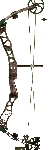 |  |
| Brace Height | 7.75 " | 7.38 " | 7.25 " |
| AtA Length | 32 " | 34 " | 31 " |
| Draw Length | 24 " - 31 " | 24 " - 31 " | 25 " - 30 " |
| Draw Weight | 40 lbs - 70 lbs | 50 lbs - 70 lbs | 40 lbs - 70 lbs |
| IBO Speed | 300 fps - 304 fps | 306 fps - 310 fps | 312 fps - 320 fps |
| Weight | 4.1 lbs | 4.4 lbs | 4.7 lbs |
| Let-Off | 75% | 75% | 75% |
| Where to buy Best prices online | |||
| compare more bows | |||
The Element's closest in-house cross-shop is the Bear Code, the other value single cam Bear built in the same 2006-2007 window. The Bear Code stretches the axle-to-axle length to 34 inches and quotes a slightly quicker 306-310 fps, which makes it the steadier, marginally faster of the two on a target face, while the Element's shorter 32-inch length is a touch handier in tight treestand quarters - the choice between them is really length-and-aim versus maneuverability, since both share the single-cam simplicity, the machined riser, and the durable Bear limb. The cross-brand alternative is the PSE Brute, a value single-cam hunter that PSE kept in the lineup for years across a 31-to-33.5-inch axle-to-axle range and a broad 40-to-70-pound draw-weight span. The PSE Brute casts a wider draw-weight net for very light-drawing or youth shooters and, in its faster trims, chronographs a bit hotter than the Element, but it asks the same value-tier compromises on fit-and-finish. The decision comes down to priorities: the Bear Element for a hunter who wants a proven, quiet, forgiving Bear single cam at close-to-moderate range, the Bear Code for a little more length and speed, and the PSE Brute for the widest draw-weight adjustability across a growing shooter.