
Bear Escalate Review
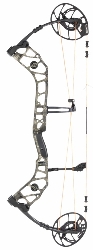

from $675
Pros
- Same EKO cam family as Bear's Refine flagship, dropped into a mainline bow - owners consistently rank it a standout value
- Selectable let-off (75, 80, 85, 90%) lets you trade holding weight for speed to match how you hunt
- Real speed for the tier - 339 fps IBO, and a measured 306 fps with a 400-grain arrow at 29 inches and 70 pounds
- The 2022 Vibration Reduction System, KillerWave dampeners and string-catch dampener noticeably cut post-shot buzz versus older Bears
- Ships tunable to your hold - two grips in the box plus an optional limb stop for a harder back wall
Cons
- Some shooters note residual buzz and a faint echo at the shot, felt in the grip hand - checking cam timing and adding grip tape help, though flagship-quiet bows like the Whitetail Legend Pro still damp a touch better
- Some shooters note the draw stacks a little on the back half before the wall - dialing let-off down to 75% eases the pull-through if you want a softer finish
Video
content from YouTube
Editors' review
Bear built the Escalate around a quiet flex: the same EKO cam that anchors the flagship Refine, dropped into a mainline hunting bow that sold for two hundred dollars less. That single decision defines the whole package. You get selectable let-off - 75, 80, 85, or 90 percent, chosen on the cam rather than mailed in from the factory - on a 31-inch, 4.1-pound rig that Bear rated to 339 fps IBO (the industry-standard chronograph number measured at a fixed 30-inch, 70-pound, 350-grain setup). Around that cam sit Bear's 2022 vibration package and a pair of grips, so the bow arrives ready to tune to your hand and your hold instead of demanding aftermarket parts first. It is the top of Bear's mainline hunting line for 2022 and 2023 - not a flagship on the price tag, but carrying a flagship's headline hardware. The question this review answers is simple: what does the buyer give up by taking the Refine's cam in a cheaper chassis, and for most hunters the honest answer is very little.
Finish
The Escalate shipped in five finishes across its two model years, more range than most bows at this price offer. TrueTimber Strata and Veil Whitetail cover the two dominant patterns hunters ask for by name, the full Fred Bear camo is the all-over woodland option, and Olive and Shadow give you solid-color choices for anyone who would rather not run a pattern at all. Bear's dip-camo coating has held up well across the brand's lineup for years, and nothing about the Escalate's application breaks that track record. The solid Olive and Shadow finishes in particular photograph cleanly and hide handling wear better than a busy pattern does. Left-hand shooters were not an afterthought here - the bow was cataloged in right- and left-hand builds rather than the right-hand-only trap that catches so many value models. For a mainline bow, five finishes plus both hands is a genuinely complete spread.Riser
The Escalate rides a machined aluminum riser with the cutout-heavy, performance-shaped look Bear reserves for the top of its mainline range. What matters more than the styling is what Bear mounted into it: the Vibration Reduction System places a hard-polymer-over-rubber damping disc dead center at the top and bottom of the riser, tuned to soak up the residual buzz that travels through the handle after the shot. Bear's own figure is up to 25 percent less residual vibration, and the placement is deliberate rather than decorative. The riser keeps aluminum limb pockets - a sensible, proven choice at this price that holds limb alignment without the cost of a machined-in system. Threaded accessory holes are placed where a modern rest and sight expect them, so a drop-away or a fixed-blade rest bolts up solid and stays put even if you knock it in the field. It is a riser built to carry a fast cam quietly, and it does the job without pretending to be a carbon flagship.Grip
Bear did something unusually buyer-friendly here: the Escalate ships with two grips, so the choice of hand feel is yours out of the box rather than an aftermarket errand. The headline option is the new-for-2022 GRIZgrip, a thicker ergonomic panel with a subtle hump that pushes the palm into a repeatable, low-torque position - drawing the bow, I found it genuinely does steer the hand to the same spot shot after shot rather than just filling space. For shooters who prefer a leaner handle, the older slim Bear grip is still in the box, and it swaps on with a couple of screws. Not everyone warms to the GRIZgrip - some shooters find its removable panel a touch slick - which is exactly why the two-grip box matters: switch to the slim grip or add grip tape and the objection disappears. That flexibility matters more than it sounds: grip fit is the single most personal contact point on a bow, and getting to pick between a filled and a slim profile without buying anything is a real advantage for a household where more than one person shoots the bow.Limbs
The Escalate uses Bear's pre-loaded split limbs seated in machined aluminum pockets, a combination the brand has run reliably across its hunting line for years. Draw weight comes in two module options - a 45-to-60-pound build and a 55-to-70-pound build - and each carries Bear's usual 15-pound adjustment range, so a 70-pound bow backs cleanly down to 55 and a 60-pound bow down to 45. That is a wider bottom-end than many competitors give you, which makes the bow easier to share across seasons or to shoot at reduced weight during off-season practice. Adjustment is done at the limb bolts with a hex wrench; no press is needed to move weight within a module's range. As with any pre-loaded limb system, the sound practice is to turn both bolts evenly and keep top and bottom in step. Owners report no pattern of limb trouble on this platform, which tracks with the aluminum-pocket design's long history in Bear's catalog.Eccentric System
This is where the Escalate earns its keep, because the cam is the flagship's. The EKO system is a single-cam design whose defining trick is selectable let-off: by moving the draw-stop pegs and modules you set the holding weight to 75, 80, 85, or 90 percent, a choice most bows in this bracket simply do not offer. In practice that turns one bow into two personalities - run 75 percent for a firmer, more energized feel and a touch more retained speed, or take it to 90 percent and hold almost nothing on a long treestand sit. At the top setting on a 70-pound build you are holding seven pounds at full draw. Bear rates the EKO at 339 fps IBO, and that speed shows up honestly on a chronograph: a 400-grain arrow at 29 inches and 70 pounds clocked 306 fps in hands-on testing, and a heavier 410-grain hunting shaft at 28 inches came in at 287 - real hunting-weight numbers, not marketing headroom. Draw-length adjustment lives right on the cam across the 26-to-30-inch range, no module purchase required. The EKO shares its feel with the Refine and the Redemption, which is exactly the point: the buyer is getting the cam Bear engineers put on bows costing meaningfully more. For a hunter who wants to fine-tune the balance of hold and speed, no other bow at this price hands you the dial.Draw Cycle/Shootability
Drawing the Escalate, the front end comes back smooth and easy, and then - depending on how you have set the cam - the personality changes at the back. At 85 percent let-off it rolls over fairly cleanly and settles into the shelf; push it to 90 and the cam sinks into a deeper valley where the holding weight all but vanishes. Pulling through it myself, I noticed the tail of the cycle stacks slightly just before the wall, a characteristic the 75-percent setting softens if you want a more linear pull. The back wall is where the optional limb stop pays off: on the cable stops alone the wall is solid but has a hair of give, while adding the limb stop turns it into a firm surface you can lean into for a consistent anchor. At the shot the Escalate settles fast - hands-on noise landed in the low-to-mid 90s dB, squarely mid-pack. The Vibration Reduction System does real work; the bow is clearly deader in the hand than Bears of a few years earlier. It is not flagship-silent, though: some shooters still feel a bit of buzz and a faint echo at the shot, part of which traces to the grip and cleans up with grip tape or the slim grip. For a fast bow at this price, that is a reasonable trade.Usage Scenarios
The Escalate is a whitetail and mule deer bow first, and a very good one. Picture a hunter who buys it in early summer, sets the cam to 90 percent let-off, and spends October in a treestand where the ability to hold at full draw through a long, slow approach matters more than raw speed - that is the Escalate's home water. Its 339-fps rating and honest 300-plus real-world speed give plenty of authority for deer-sized game out to normal bowhunting ranges, and the 4.1-pound mass sits light enough for the spot-and-stalk hunter covering ground on foot. The 26-to-30-inch draw range and 45-to-70-pound span cover most adult shooters and make it a sensible bow to share across a household or to grow into as a newer archer builds strength. A 3D shooter looking for an affordable, fast, adjustable rig for club nights will be well served, with the caveat that the short-valley 75-percent setting rewards staying engaged on the back wall. Where it is not the pick: a long-draw shooter over 30 inches is out of range, and a hunter chasing elk at extended distance would want a longer, faster flagship. For its intended job - a fast, quiet, deeply adjustable deer bow that does not cost flagship money - it fits a huge slice of the hunting world.Versions
The Escalate was sold across two model years, 2022 and 2023, with carry-over specs - the two versions on record reflect those model years rather than any hardware change. Within each year the bow was offered as a bow-only build at a $779.99 launch MSRP, and as a Ready-to-Hunt (RTH) package that adds a rest, sight, quiver, stabilizer and the accessories needed to shoot straight out of the box for buyers who would rather not assemble a kit piece by piece. Draw weight is chosen at purchase between the 45-to-60-pound and 55-to-70-pound module builds, and both right- and left-hand versions were cataloged. Whichever version a buyer picks, the shooting hardware - the EKO cam, the vibration package, the two grips - is identical; the choice is about what comes in the box and which draw-weight band you need, not about how the bow shoots.Bear Escalate vs Bear Resurgence, Diamond Edge 320
| Bow | Bear Escalate | Bear Resurgence | Diamond Edge 320 |
| Version | 2023 | 2023 RTH | 2022 |
| Picture |  |  |  |
| Brace Height | 6.5 " | 6.25 " | 7.25 " |
| AtA Length | 31 " | 32 " | 32 " |
| Draw Length | 26 " - 30 " | 25.5 " - 31 " | 15 " - 31 " |
| Draw Weight | 45 lbs - 70 lbs | 45 lbs - 70 lbs | 7 lbs - 70 lbs |
| IBO Speed | 339 fps | 335 fps | 320 fps |
| Weight | 4.1 lbs | 3.9 lbs | 3.6 lbs |
| Let-Off | 75% - 90% | 80% | 85% |
| Where to buy Best prices online | |||
| compare more bows | |||
The Escalate launched alongside the Bear Resurgence, and the two make the cleanest in-house comparison. The Resurgence is the value-package play: a DHC hybrid cam rated at 335 fps on a slightly longer 32-inch chassis, sold as a Ready-to-Hunt kit at $629.99, with a fixed 80 percent let-off. It is the bow for a buyer who wants a complete setup at the lowest price and does not care about selectable hold; the Escalate is the bow for a buyer who wants the flagship EKO cam and the ability to dial let-off from 75 to 90 percent, and who will pay a bit more for it. Cross-brand, the Diamond Edge 320 is the adjustability benchmark: a grow-with-you R.A.K.-package bow with a staggering 7-to-70-pound draw-weight span and 15-to-31-inch draw range at a $399 MSRP, but a slower 320-fps rating and a longer 7.25-inch brace built for forgiveness over speed. The Diamond Edge 320 wins outright for a family that needs one bow to fit a child and an adult, or for the shooter on the tightest budget; the Escalate is faster, quieter, and far more tunable at the top of the draw cycle. The decision comes down to priorities: the Diamond Edge 320 for maximum fit-range and lowest cost, the Bear Resurgence for a cheaper complete kit, and the Escalate for the buyer who wants real speed and flagship let-off adjustability without flagship pricing.