
Bear Frontier Review
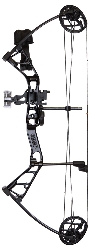

from $200.37
Pros
- Draw length adjusts across an 11-inch range from 14 to 25 inches - the same bow fits an 8-year-old at 14 inches and a 13-year-old at 25 inches, covering 4-6 years of growth without buying a second bow
- Ready-to-Shoot package ships with a Trophy Ridge 3-pin sight, Whisker Biscuit rest, 2-arrow quiver, and 2 carbon arrows pre-matched to the draw range - a first-time buyer opens the box and shoots that afternoon
- Dual-cam system is uncommon at the sub-$250 youth tier - Bear's lower-tier Brave and Pathfinder run simpler single-cam-and-idler layouts, while the Frontier inherits a synchronized dual-cam configuration normally reserved for higher tiers
- Bow mass of 2.9 pounds keeps the bow easy to hold up for a young shooter learning consistent form - fatigue ends a practice session faster than missing a target does, and a lighter bow lengthens the session
- Offset string suppressor reduces post-shot vibration and noise - a quieter, less buzzy shot is easier on a new shooter's hands and less startling, which matters more for first-bow learning than headline IBO numbers
Cons
- Peak draw weight tops out at 29 pounds - below the 35-40 pound minimum most states require for big-game hunting, making this a target and recreation bow rather than a hunting tool; hunters can step up to Bear's Shootout RTH
Video
content from YouTube
Editors' review
Most first bows last one season. The Frontier RTS is built to last four to six. Bear's 2026 youth release opens with one core idea - a chassis that grows with the archer across an 11-inch draw range, from a 14-inch starting setup that fits an 8-year-old through a 25-inch maximum that fits a 13- or 14-year-old in full stride. Bear pairs the Frontier with the Shootout RTH at the next tier as "two great choices to get into archery," but the Frontier owns the entry slot in Bear's 2026 youth lineup, positioned above the smaller Bear Brave and at a higher capability ceiling than the single-cam Bear Pathfinder. A 26-inch axle-to-axle frame, a 6-inch brace height, an ultra-smooth dual-cam system, and a complete Ready-to-Shoot package give a parent or grandparent a way to hand a kid a bow that does not feel like a toy.
Finish
Black is the sole finish option at launch. Bear has not introduced a camo variant, a two-tone limb option, or an alternative pattern for the 2026 model year - the entire Frontier RTS production runs in the same black coating across both the right-hand and left-hand SKU listings on Bear's site. The choice is consistent with the budget-tier positioning. Hydro-dipped camo adds cost that does not earn its keep on a target and recreation bow, and a beginning archer cares less about pattern than about whether the bow draws cleanly and the arrow flies where the sight points. The black coating is durable factory-applied across the riser and limbs, matching what Bear ships on other entry youth models like the Pathfinder. For households where finish variety matters - a sibling pair who each want their own color, or a backyard shooter who wants a more visible bow - the trade-off is to move up to Bear's Royale RTH, which ships in a wider palette but at a substantially higher price tier.Riser
The riser is a cast aluminum frame cut for the smaller scale a youth bow needs - 26 inches axle-to-axle, narrow enough through the grip to fit smaller hands without a knuckle clearance issue. Mounting positions follow the conventional Berger-hole pattern for the rest and a standard threaded sight hole rather than the Picatinny-style rail Bear puts on its adult hunting platforms, which is appropriate for a bow that ships with its accessories already mounted and tuned at the factory. An offset string suppressor mounts to the riser above the grip - a small rubber-tipped post that contacts the string after the shot and damps residual vibration before it reaches the limb pockets. Bear's lower-tier Brave and Pathfinder ship without a suppressor at all, so the inclusion here is one of the visible places where the extra $20 over the Pathfinder shows up. The cable management runs through a fixed cable rod rather than a roller slide - the simpler arrangement is correct for a bow that does not need to chase the last few fps of efficiency and benefits from one less component a kid can knock loose. The whole assembly is light enough to carry one-handed to the backyard target, with no hidden weight added by heavy accessory rails.Grip
The grip is integrated into the riser as a one-piece molded section rather than a separate swappable insert, which is the right design choice for a youth bow where shooters are still learning what hand position feels right. The profile is flat-backed and slightly narrower than an adult grip, sized to a kid's palm rather than a 7-inch-tall shooter's grip span. Bear has not advertised an aftermarket grip-swap path for the Frontier - the riser shape and the lack of a separate grip insert make custom replacements unlikely, and they would not serve the buyer anyway. The textured surface is durable enough for the hand of a 9-year-old who will inevitably leave the bow leaning against a fence overnight at least once. The flat-back design encourages a low-torque hand position - pressure against the meaty pad below the thumb rather than wrapped around the grip with the fingers - which is the foundation of consistent form a young archer will carry forward into any future bow. Compared to the Brave's smaller grip and the simpler single-cam Pathfinder, the Frontier's grip and riser scale fits the 8-to-14 age band where most first-real-bow purchases happen.Limbs
Split limbs sit in matched pockets at the top and bottom of the riser - the same arrangement Bear uses across the youth lineup. The 15-to-29 pound adjustment range is wide enough to start an 8-year-old at 15 pounds and finish a 13-year-old at 29, while the half-step adjustments via the limb bolts let a parent dial weight up by a few pounds every six to twelve months as the shooter's frame catches up to the bow. Adjusting draw weight needs nothing more than the supplied Allen wrench and follows the standard "turn out evenly on top and bottom" procedure that ships in the manual - no press required at any point in the adjustment range. The 29-pound ceiling is the limit for state-legal big-game hunting in most jurisdictions, which is the right cap for a recreation and target bow; if the shooter is ready to move into hunting, the bow has done its job and the family steps up to a 40+ pound draw platform. Limb pockets are durable enough to absorb a year or two of being leaned against trees, dropped on grass, and packed into car trunks for backyard practice. Bear has not published a limb-tip material or a lifetime cycle rating, but the limb design across its youth lineup has held up well in the field - the Pathfinder and Brave have the same basic limb architecture and a track record of staying tight across multiple shooting seasons.Eccentric System
The dual-cam system is the headline feature that justifies the Frontier's position above the Pathfinder and Brave - two synchronized cams driving the string together, rather than a single cam paired with an idler wheel. The 150 fps IBO rating (the industry-standard chronograph reading at the bow's maximum draw length and draw weight with a standard 5-grain-per-pound arrow) is the published ceiling at the 25-inch / 29-pound / Bear-supplied-arrow setup. Real-world speeds for a typical young shooter sit well below that ceiling - a 10-year-old at 19 inches and 20 pounds will see numbers in the 90 to 110 fps range, which is exactly the point: this is a learn-to-shoot bow, not a hunt-tomorrow bow. The dual-cam configuration gives more consistent nock travel than a single-cam at this tier, which translates into better arrow flight and a more honest read of whether the shooter or the bow is responsible for a poor shot. Let-off is 65 percent, meaning a 25-pound peak holds at 8.75 pounds at full draw - light enough for a 12-year-old's shoulders to settle into a steady aim without trembling. Draw length adjustment is module-based and runs in half-inch increments across the 14-to-25 inch range, no press required for the steps themselves. The cams are timed and tuned at the factory; the parent does not need a separate visit to a pro shop to set the bow up out of the box.Draw Cycle/Shootability
The dual-cam draw is smoother than the simpler arrangements on lower-tier Bear youth bows - a gradual ramp to peak weight with no early hump and a clean settle into the let-off valley. Drawing the bow at a 22-inch / 25-pound setup, I found the cam roll predictable and the back wall firm enough to feel like a real stopping point rather than a soft give - the kind of definite endpoint a young archer can anchor against and learn to trust. The 65 percent let-off creates a holding weight light enough that a kid can hold full draw for several seconds without the shaking that wrecks a beginner's aim, which means the difference between a productive practice session and a frustrating one. Shot noise is moderate - not Mathews-quiet, but the offset string suppressor noticeably knocks down the post-shot ring compared to the Brave's bare-riser layout. In my experience the noise level is right for a backyard target session; loud enough to feel like a real bow firing, not loud enough to upset a dog in the next yard. Hand shock is minimal at the 15 to 29-pound range - there is simply not enough energy in a 29-pound shot to transmit much shock through a riser this size, and the suppressor takes care of what little there is. Post-shot, the bow settles back to neutral quickly. The shot finish is appropriate for the age group: forgiving, audible enough to be satisfying, gentle on small hands.Usage Scenarios
Backyard target practice is the primary scenario - 10 to 30 yards into a foam block or a 3D deer target, a few dozen arrows per session, learning to draw against an anchor point and release cleanly. The Frontier fits the parent-and-kid Saturday morning where the kid takes the bow out, the parent supervises the first 20 shots, and the kid finishes the morning hitting a 6-inch group at 15 yards. Indoor range sessions at a 10- or 20-meter line work equally well - the 14-inch minimum draw length covers the smallest shooter at most introductory programs, and the bow's 26-inch axle-to-axle frame fits comfortably in a kid's bow case for transport. Family-share is the second scenario worth naming: a household with two kids three years apart can pass the same bow between them across a span of years, dialing the draw length and weight to whichever shooter is using it that afternoon. The cap at 29 pounds peak weight rules the Frontier out for big-game hunting in most states; a parent planning to step the shooter into deer hunting by age 13 or 14 should pair the Frontier with a follow-on hunting bow in the 40-pound class - Bear's Shootout RTH is the explicit next step in the same lineup. For 3D club shoots with kids' divisions, the Frontier sits at the right tier - fast enough to reach typical 3D target distances, light enough to walk a course without fatigue.Bear Frontier RTS vs Bear Pathfinder, PSE Mini Burner
| Bow | Bear Frontier | Bear Pathfinder | PSE Mini Burner |
| Version | 2026 RTS | 2026 | 2025 |
| Picture |  | 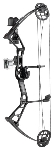 |  |
| Brace Height | 6 " | 6 " | 6.625 " |
| AtA Length | 26 " | 26 " | 26 " |
| Draw Length | 14 " - 25 " | 14 " - 25 " | 16 " - 26.5 " |
| Draw Weight | 15 lbs - 29 lbs | 15 lbs - 29 lbs | 30 lbs - 40 lbs |
| IBO Speed | 150 fps | 150 fps | 267 fps |
| Weight | 2.9 lbs | 2.1 lbs | 2.5 lbs |
| Let-Off | 65% | 65% | 65% |
| Where to buy Best prices online | |||
| compare more bows | |||
The Bear Pathfinder ($199.99 launch MSRP) shares the Frontier's chassis closely - same 26-inch axle-to-axle, same 6-inch brace, same 15-to-29-pound draw weight range, and the same wide 14-to-25-inch draw-length range - but runs a simpler single-cam-and-idler layout, ships without the offset string suppressor, and comes as a bow only without the Ready-to-Shoot accessory bundle. The Pathfinder fits a buyer happy to spec their own sight and rest who does not need the dual-cam's smoother, more consistent nock travel; the Frontier RTS adds the synchronized dual-cam, the string suppressor, and the complete accessory package for roughly $20 more. The PSE Mini Burner ($209.99 launch MSRP) is the closest cross-brand price competitor at the same tier - a 26-inch axle-to-axle compact at 267 fps IBO, draw weight 30-to-40 pounds and draw length 16-to-26.5 inches - but it starts the draw-weight range higher (30 vs 15 pounds), which makes it a fit for an older or stronger kid stepping closer to an adult setup, not a true beginner. The decision comes down to priorities: the Bear Frontier RTS for a parent who wants the widest draw-length growth range and a complete out-of-the-box package for the 8-to-14 age window, the Bear Pathfinder for a budget-minded household that wants the same growth range in a bow-only and prefers to pick their own accessories, and the PSE Mini Burner for an older child or small-framed shooter who needs more peak draw weight than 29 pounds.