
Bear Species XT Review


from $325
Pros
- Modern integrated mounting rare at this price - an IMS dovetail rest and a Picatinny sight rail, the kind of accessory interface usually reserved for flagships
- Compact and easy to handle - a short 30-inch axle-to-axle that stays balanced and maneuverable in a tight treestand or blind
- Quiet single-cam shot - ran noticeably quieter than a same-tier PSE single cam head-to-head, helped by the split-limb build
- Wide 23.5 to 30.5-inch draw, a 15-lb weight spread, and 80% let-off fit short-draw women, growing shooters, and most adults from one bow
- Durable where budget rivals cut costs - a machined aluminum riser and aluminum limb pockets instead of composite
Cons
- Stock grip is Bear's slim profile - shooters who want a fuller, hand-filling grip can add the Bear Paw grip for around $15, a quick drop-on swap
- Entry-level ready-to-hunt accessories - some owners find the bundled sight and rest merely adequate, though the IMS and Picatinny mounting make later upgrades painless
Video
content from YouTube
Editors' review
The XT in Species XT is about one thing the prior Species bows never had: mounting. Bear took the quiet, simple single-cam Species platform and bolted on an Integrate Mounting System (IMS) rest and Picatinny sight rail - the same kind of integrated accessory interface you normally meet on bows costing two and three times as much - then priced the whole package at $499.99 ready to hunt. Everything else is the Species formula buyers already know: a compact 30-inch axle-to-axle (the distance between the cam axles), a forgiving 6.75-inch brace height, a single cam with a comfortable 80% let-off (the percentage of peak draw weight the bow sheds at full draw), and 320 fps IBO (the industry-standard chronograph rating at a fixed 30-inch, 70-lb, 350-grain setup). It is the current, in-production member of the Species line for 2026 - the bow that replaced the discontinued Species EV, carrying the same chassis forward with the mounting upgrade as its headline. For the value-minded hunter who wants a quiet, easy-to-tune single cam but also wants a modern base to build accessories on, the XT answers a question the EV left open. The rest of this review is who it fits and what that mounting actually buys you.
Finish
Bear offers the Species XT in four patterns, which is a focused palette rather than the sprawling range the brand sometimes runs: True Timber Strata, the classic Fred Bear camo, Mossy Oak Bottomland for the old-school crowd, and a straight Black for shooters who want to match the rest of their kit or add their own wraps. Right-hand shooters get all four patterns, while left-hand availability is currently limited to the True Timber Strata finish - so southpaws do have an option, just not the full palette. The dip-and-cure camo finish is the same Bear runs across its hunting line, and out of the box the coating is clean, with no paint-adhesion issues on the samples owners have handled. The patterns are the practical hunting choices rather than loud graphics, and the Black in particular reads as a blank canvas for a shooter who wants to customize. For a sub-$500 ready-to-hunt bow, four honest finish choices in both hands is a fair, no-nonsense spread.Riser
The riser is machined aluminum on a deliberately short 30-inch axle-to-axle footprint, which keeps the bow quick to point and easy to swing in a blind or a tight treestand lane. The headline is the mounting: Bear built in a Picatinny sight rail - the same accessory standard used on AR-platform firearms - giving fore-and-aft sight positioning and tool-free sight swaps, and paired it with the Integrate Mounting System (IMS) interface for the rest, which locks the rest to the riser without the play of a traditional Berger-hole mount. That combination is the single biggest reason to choose the XT over the older Species bows, and it is genuinely uncommon at this price. The tall 6.75-inch brace height buys back the forgiveness a short riser would otherwise give up, so small form errors punish the shot less. The limb pockets are aluminum rather than the composite you often see when a bow drops under $500, and there are molded accessory mounting points for quivers and add-ons. It is a durable, thoughtfully equipped riser that spends its money where a hunter notices.Grip
The grip is Bear's slim one-piece profile, and it does what a hunting grip should: it sits flush in the palm and lines the bow up naturally, keeping torque out of the shot at full draw. The narrow shape rewards a repeatable hand position, which matters more on a short-axle bow where small steering errors show up downrange. Shooters who prefer a fuller, hand-filling grip are not stuck with it - Bear sells the Bear Paw grip as a roughly $15 drop-on upgrade that fattens the profile and adds a warmer surface for cold mornings. Between the slim stock grip and the optional Bear Paw, most hands will find a comfortable fit without aftermarket parts. It is a sensible, low-cost way to tune the feel of the bow to the shooter rather than the other way around.Limbs
The Species XT runs split limbs seated in those aluminum pockets, offered in two draw-weight brackets so a buyer matches the bow to the shooter. The 45-to-60-lb option and the 55-to-70-lb option each carry Bear's familiar 15-lb adjustment spread, which is the quietly useful part: a 70-lb bow backs down to 55 and a 60-lb bow backs down to 45, all with a turn of the limb bolts and no bow press. That spread is what lets a younger archer still building draw-weight, or a shooter working back from an injury, drop down now and climb back up over a season or two on the same bow. The pre-loaded split-limb design is the same basic architecture Bear runs across its hunting lineup, with a solid reliability record, and the aluminum pockets hold their setting through weather and hard carry. Nothing about the XT's limb execution departs from what has worked for Bear - it is proven hardware matched to a modern riser.Eccentric System
The heart of the XT is a single cam - one cam on the bottom with an idler wheel up top, inherently simpler to tune and keep in time than a twin-cam setup, which is the whole point of the Species line. Bear rates it at 320 fps IBO and sets the let-off at a comfortable 80%, so at full draw you hold meaningfully less weight - on a 70-lb bow that is roughly 14 lb in your fingers rather than the full peak while you wait out a deer. Draw length adjusts across the full 23.5 to 30.5-inch range through the cam, giving one bow a genuinely wide fit window without a press. The honest trade for a single cam at this price is speed: 320 IBO is a best-case number, and real-world velocity lands lower. The XT has not been independently chronographed yet, but its identical-chassis predecessor, the Species EV - same cam, same 30-inch geometry, same 80% let-off - clocked a consistent 264 to 265 fps with a 400-grain arrow at 29 inches and 70 lb, which is a fair preview of what the XT will post. That is plenty of kinetic energy for whitetails at sensible ranges, delivered by a cam that a first-time tuner can keep running.Draw Cycle/Shootability
Drawing the XT, what stands out is how unfussy it is: the single cam pulls smoothly to peak without a harsh hump, rolls into the valley, and the 80% let-off drops the holding weight away so you can sit comfortably at full draw through a long wait. It is not a flagship-smooth draw - at $500 you would not expect one - but it is honest and easy, and the cam adjustments are simple enough that a new owner can set draw length and weight without a trip to the shop. Where the bow earns its keep is the shot: in a same-tier head-to-head it ran quieter than a competing PSE single cam, and it is settled enough in the hand that it does not jump at release. What I notice most is how little the XT asks of the shooter - a quiet, low-drama shot from a bow you can tune yourself is exactly what a value-minded hunter wants on stand. Holding at full draw, I found the 80% let-off genuinely restful on a long sit. On the scale it is a mid-weight 4.4 lb, yet owners consistently describe it as carrying light and balanced in the hand, and loaded with its accessories the balance stays neutral rather than nose-heavy. For the money, the shooting experience is calm and forgiving rather than fast and demanding.Usage Scenarios
Picture a hunter who wants to set up once and grow into the bow: the Species XT ships ready to hunt, the IMS rest and Picatinny sight go on without fuss, and when that first budget sight eventually gets replaced with something nicer, the mounting is already built for it. The short 30-inch axle-to-axle and compact, balanced feel make it a natural for a mobile, run-and-gun hunter moving between stands, or for anyone shooting out of a cramped ground blind where a long target bow would be clumsy. The wide draw range and 15-lb weight spread open it well beyond one body type - a short-draw woman, a teenager growing into a hunting setup, or an adult returning to the bow can all find a fit, and the lighter draw-weight bracket keeps it reachable. It is a capable whitetail, hog, and black-bear bow at ordinary hunting distances, and the modern mounting makes it a smarter long-term base than most bows in its class. What it is not is a long-range speed rig or a dedicated target bow - the real-world velocity and short valley put it squarely in the practical-hunting lane it was built for.Versions
The Species XT is sold as a single ready-to-hunt configuration, the Species XT RTH, at a $499.99 launch MSRP. The package is Trophy Ridge's kit built around the bow's mounting system: an IMS Whisker Biscuit rest, a Picatinny-mounted four-pin sight, a five-arrow quiver, a stabilizer, a wrist sling, and a pre-installed peep and D-loop - everything needed to hunt except a release and arrows. It is offered in two draw-weight limb options, 45-60 lb and 55-70 lb; right-hand covers all four finishes, with left-hand currently cataloged in the True Timber Strata pattern. There is no bare-bow or stripped SKU; the XT is a ready-to-hunt proposition by design. Buyers cross-shopping the older, discontinued Species EV should note the XT is the current, in-production bow and the one Bear still stocks - the EV is now a closeout-and-used item, and the XT's IMS and Picatinny mounting is the concrete reason to step up to the newer bow.Bear Species XT vs Diamond Edge 320, PSE Stinger MAX
| Bow | Bear Species XT | Diamond Edge 320 | PSE Stinger MAX |
| Version | 2026 | 2022 | 2021 |
| Picture | 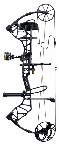 |  |  |
| Brace Height | 6.75 " | 7.25 " | 7 " |
| AtA Length | 30 " | 32 " | 30 " |
| Draw Length | 23.5 " - 30.5 " | 15 " - 31 " | 21.5 " - 30 " |
| Draw Weight | 45 lbs - 70 lbs | 7 lbs - 70 lbs | 45 lbs - 70 lbs |
| IBO Speed | 320 fps | 320 fps | 304 fps - 312 fps |
| Weight | 4.4 lbs | 3.6 lbs | 3.8 lbs |
| Let-Off | 80% | 85% | 80% |
| Where to buy Best prices online | |||
| compare more bows | |||
All three of these are single-cam, ready-to-hunt hunting bows in the roughly $449 to $499 range, which makes them genuine cross-shops, but each leans a different way. The Diamond Edge 320 matches the XT's 320 IBO and comes in a touch cheaper, built around maximum adjustability: a 15 to 31-inch draw and a 7 to 70-lb weight range let it start as a child's or beginner's bow and grow to a full adult setup, where the XT's 45-lb floor and 23.5-inch minimum assume an adult or near-adult shooter. The PSE Stinger MAX is the other value benchmark, a compact single cam with a 21.5 to 30-inch draw and a 28 to 70-lb range that leans toward taller or smaller-framed shooters depending on configuration, trading a little of the XT's quietness for PSE's slightly more aggressive feel. The XT's own case is the mounting - the IMS rest and Picatinny sight rail neither cross-brand bow offers - plus its compact 30-inch frame, 80% let-off, and quiet shot. The decision comes down to priorities: the Diamond Edge 320 for a family or grow-with-you buyer who needs the widest possible fit range, the PSE Stinger MAX for the shooter chasing PSE's platform at the price, and the Bear Species XT for the hunter who wants modern, flagship-style accessory mounting on a quiet, compact single cam.