
Bear Whitetail INT Review


from $500
Pros
- Flagship-grade EKO cam delivers near-rating speed for the tier: a 350-grain arrow clocks 334 fps at 70 lb, just 5 fps under the 339 rating
- Draw length adjusts 26-30 inches on a rotating module and let-off picks 75, 80, 85, or 90 percent, so fit changes without a bow press or new cams
- Back wall sits solid and non-spongy and the riser holds with little hand torque, which makes it forgiving and easy to aim at hunting distances
- IMS rest seat and Picatinny sight mounting bring flagship-style accessory integration to a mid-price bow and cut setup time
Cons
- Shot runs a touch louder with some post-shot vibration and is not flagship-quiet; a stabilizer and added string dampening tame it, and silence-first buyers should shoot one first
- Draw cycle is not flagship-smooth, with a slight hump into the valley as the trade for near-340 speed; worth drawing in person if you are stepping off a buttery flagship cam
- The flat grip face rounds off at the edges and does not suit every hand at full draw; a flat aftermarket grip is an inexpensive drop-in fix
Video
content from YouTube
Editors' review
Bear did something unusual with the Whitetail INT: it hung the EKO cam, the same cam system that drives its flagship hunters, on a bow that launched at a mid-tier price. The payoff shows up on the chronograph, where a 350-grain arrow leaves the string at 334 fps, within five feet per second of the bow's 339 IBO rating (the industry-standard speed measured at a fixed 30-inch, 70-pound, 350-grain setup). That is flagship-adjacent speed at well under half the price of a flagship. The INT is the 2025 name for the bow Bear sold in 2024 as the Whitetail Maxx, the same 31-inch chassis and the same specs, now carrying the integrated mounting features that earn it the "INT" (Integrate) tag. It is built for the adult hunter who wants genuine speed and a flagship cam without the flagship invoice, and it is honest about where the savings land. Draw it and you feel a bow that spent its budget on performance rather than polish.
Finish
Bear offers the Whitetail INT in five finishes: a solid Olive, a muted Throwback Green, and three camo-and-accent treatments in Veil Whitetail, Mossy Oak Bottomland, and Stone. The solid Olive and Throwback Green are the standouts for a hunter who wants a low-key, non-reflective bow that does not shout camo-pattern from across a parking lot, while Veil Whitetail and Mossy Oak Bottomland cover the classic treestand palettes. Left-hand shooters are served in Veil Whitetail, Mossy Oak Bottomland, and Stone; the two solid colors are right-hand only, so a left-handed buyer picks from the camo side of the lineup. The dip-coat finish is tidy out of the box, but it is worth setting expectations honestly: this is a value bow, and some long-term owners have noticed the limb graphics wearing or fading slightly at the edges after a season of hard use. That is cosmetic rather than structural, and it is the kind of trade a value bow makes that a flagship does not. For a hunter choosing a working tool over a safe-queen showpiece, the five-finish spread is generous for the category.Riser
The INT is built on a skeletonized aluminum riser that Bear introduced with this platform, and it looks considerably more expensive than it is, with aggressive cutouts that pull weight out without leaving the bow feeling flimsy. The headline is the accessory integration: an IMS (Integrate Mounting System) rest seat lets a compatible rest bolt directly to the riser instead of hanging off a Berger hole, and the sight side uses a Picatinny rail, the same accessory mounting standard used on AR-platform firearms, for a repeatable, rock-solid sight attachment. In my experience that combination is the single biggest time-saver on this bow: a Picatinny sight drops on square and a direct-mount rest cuts the fiddly centershot guesswork, so first setup goes faster and holds zero better than the usual budget-bow bracket stack. A roller cable guard handles cable management and takes friction out of the draw, a feature that normally lives a price tier or two up. The geometry is a 31-inch axle-to-axle, long enough to hold steady yet short enough to work a treestand, and the mass balances well in the hand once a stabilizer is threaded on.Grip
The grip is a direct, flat-faced panel grip that promotes a low-torque hand position, and it is the one place on the bow where personal taste will decide things. It is flat across the front, which I like for building a repeatable hand placement, but it rounds off noticeably at the side edges, and some owners have found that the rounded edges do not give them the locked-in confidence they want when holding at full draw. Drawing it myself I did not fight it, but I can see why a shooter coming off a flatter flagship grip would want more side support. The good news is that this is the easiest thing on any bow to change: the grip is a standard swap, and an inexpensive flat aftermarket grip or even a strip of grip tape dials in the feel for anyone who wants more edge. Hand-size sensitivity is mild here; medium and larger hands settle in fine, and smaller hands can add a side plate. For a hunter who shoots with a relaxed, open hand, the factory grip is perfectly workable as delivered.Limbs
The Whitetail INT runs split limbs in two draw-weight options, a 45-60 lb module set and a 55-70 lb set, each giving 15 pounds of in-range adjustment with a standard Allen wrench rather than a press. That spread covers the adult hunting band from a lighter 45-pound setup all the way to a full 70-pound whitetail-and-up rig, so a buyer picks the limb option that brackets their target weight and tunes within it. KillerWave limb dampeners sit on the limbs to soak up vibration at the shot, and they do real work holding the bow's post-shot behavior to a level that is acceptable for the price rather than buzzy. The limb pockets and geometry are shared with the rest of Bear's 2024-2025 performance line, a design the brand has shipped across several models without reliability complaints surfacing in owner reports. The draw-weight range is the clearest statement of who this bow is for: it is an adult hunting platform, not a grow-with-me youth bow, so a parent shopping for a 12-year-old should look elsewhere in Bear's lineup while an adult or a larger teen is squarely in range.Eccentric System
The cam is the whole story here. The EKO is a synchronized dual-cam system, the same cam family Bear fits to its flagship hunters, and finding it on a value-tier bow is the reason this model punches above its price. It is not a single cam and not a hybrid; both cams drive the string in sync, which is what lets a value bow hit these numbers. Draw length adjusts from 26 to 30 inches by rotating a module on the cam, no press and no separate mod kit required, and let-off (the percentage of peak weight the holding weight drops to at full draw) is selectable at 75, 80, 85, or 90 percent. That let-off range is genuinely useful: at 90 percent a hunter holds only a tenth of peak weight and can sit at full draw waiting on a deer, while dialing down to 75 or 80 percent firms the shot up for a target or spot shooter who wants a more active hold. The IBO rating is 339 fps, and unlike most value-bow marketing numbers it holds up under a chronograph. A 350-grain arrow at 70 pounds and a 30.25-inch draw ran an average of 334 fps, only five feet per second under the rating and fast enough to rank near the top of a field of bows that cost twice as much. Load a realistic heavy hunting arrow and the speed scales down sensibly: 296 fps with a 455-grain shaft at that same setup, and 284.6 fps with a 440-grain arrow at a shorter 28.5-inch draw. Those are honest hunting speeds, and they put the INT in flagship territory for kinetic energy at whitetail ranges.Draw Cycle/Shootability
A cam that makes this kind of speed has to pull for it, and the INT does not pretend otherwise. The front half of the draw is smooth and easy, then there is a slight hump as the cam rolls into the valley, nothing abrupt or obnoxious but clearly present, which is the honest cost of a near-340 fps bow rather than a flaw. Drawing it at 70 pounds I found the pull even and manageable, closer to a mid-stack flagship than to a harsh budget bow, and the back wall is the high point: it is solid and defined, not the spongy, keep-creeping wall that plagues cheap bows, so a shooter can lean into it and anchor with confidence. At full draw the hold is steady and notably low in hand torque, which is why owners describe the bow as forgiving and easy to aim; the 31-inch length helps it settle. The shot itself is where the price tier shows: there is a bit of hand shock and some post-shot vibration, and the report is on the louder end, a hair short of flagship-quiet even with the KillerWave dampeners doing their job. Some owners also note a distinctive post-shot behavior where the top of the bow pitches slightly toward them on release; it is a feel quirk rather than an accuracy problem, and a stabilizer with a touch of added dampening settles it. None of that undercuts the core experience, which is a bow that holds well, shoots accurately out to real hunting distances, and gives up only the last increment of flagship refinement.Usage Scenarios
Picture opening weekend: a hunter buys the RTH package on Saturday, has it set up and paper-tuned by Sunday afternoon on the strength of the direct-mount rest and Picatinny sight, and is sitting a treestand before the next workweek is out. That is the INT's native habitat, the all-around whitetail bow. Its 31-inch axle-to-axle is long enough to hold steady on a 20-yard broadside shot yet compact enough to maneuver in a tight stand or ground blind, and the near-340 speed flattens trajectory enough to forgive a misjudged yardage. It handles spot-and-stalk just as well, where the forgiving hold and quick draw-length tuning let a shooter dial the bow to their exact anchor. The speed and 70-pound ceiling give it the kinetic energy for whitetail, hog, and black bear at ethical ranges, and plenty of margin for a confident hunter stretching to 40 or 50 yards, which owners have confirmed the bow can group at. It doubles capably as a casual 3D or backyard target bow at the lower let-off settings. Where it is not aimed is the youth-growth role: the 45-pound floor and 26-inch minimum draw mean it is an adult-and-larger-teen bow, not a first bow for a small child.Versions
The Whitetail INT is the 2025 continuation of the bow Bear sold in 2024 as the Whitetail Maxx; the chassis, cam, and specs are unchanged, with the 2025 model adding the integrated mounting emphasis behind the "INT" name. At launch the Maxx carried a $599.99 bow-only price; the 2025 Whitetail INT launched at $629.99 bow-only and $729.99 for the Ready-to-Hunt package. The RTH package is the one most hunters should consider: it adds a complete Trophy Ridge kit built around an IMS V-Biscuit rest that uses the integrated seat, a Picatinny-mounted Fatal 4-pin sight, a 5-arrow quiver, a stabilizer, a Radical peep sight, and a wrist sling, leaving only arrows and a release to buy. Both versions come in the same five finishes, with left-hand availability limited to Veil Whitetail, Mossy Oak Bottomland, and Stone. A buyer who already owns a rest and sight they trust saves a hundred dollars with the bow-only version; a buyer starting fresh gets more value from the package than from assembling equivalent parts separately. Bear's in-house Alaskan XT sits one notch up as a hybrid-cam alternative for anyone who wants a slightly longer, 80-percent-let-off platform.Bear Whitetail INT vs Diamond Edge 320, PSE Stinger Max
| Bow | Bear Whitetail INT | Diamond Edge 320 | PSE Stinger MAX |
| Version | 2025 RTH | 2022 | 2021 |
| Picture | 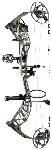 |  |  |
| Brace Height | 6.5 " | 7.25 " | 7 " |
| AtA Length | 31 " | 32 " | 30 " |
| Draw Length | 26 " - 30 " | 15 " - 31 " | 21.5 " - 30 " |
| Draw Weight | 45 lbs - 70 lbs | 7 lbs - 70 lbs | 45 lbs - 70 lbs |
| IBO Speed | 339 fps | 320 fps | 304 fps - 312 fps |
| Weight | lbs | 3.6 lbs | 3.8 lbs |
| Let-Off | 75% - 90% | 85% | 80% |
| Where to buy Best prices online | |||
| compare more bows | |||
Shoppers in this budget-hunting band usually cross-shop the Whitetail INT against two broadly adjustable value bows, the Diamond Edge 320 and the PSE Stinger MAX, and the three split cleanly on priorities. The Whitetail INT is the performance pick: its flagship-derived EKO cam and 339 IBO put it well ahead on speed, and its IMS and Picatinny mounting bring flagship-style accessory integration, but it sits at the top of this price group and asks the buyer to accept an adult-only draw-weight range. The Diamond Edge 320 is the maximum-adjustability pick, with a huge 7-to-70-pound draw-weight range and a wide draw-length span on a sub-$500 package, which makes it the better buy for a growing teen or a household sharing one bow, at the cost of a slower, more entry-level cam. The PSE Stinger Max splits the difference as the lowest-entry option, a broadly adjustable value hunter with a complete Ready-to-Shoot kit at a $479.99 package launch price, ideal for a first-time buyer who wants everything in the box and does not need chart-topping speed. The decision comes down to priorities: pick the Whitetail INT for speed and flagship-cam feel in an adult hunting rig, the Diamond Edge 320 for grow-with-me adjustability, and the PSE Stinger Max for the most affordable complete setup.