
Hoyt Carbon RX Twin Turbo Review
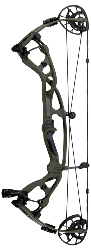

from $1350
Pros
- Knocks on its own speed rating - owners chronograph the mid-340s fps with a light arrow, where most speed bows fall well short of their published number
- Dead in the hand and quiet for a speed bow, with none of the violent jump older Hoyt turbos were known for
- Rotating-module HBX Twin Turbo cam lets short-draw shooters run a true turbo without buying a separate cam, and the let-off adjusts between 80% and 85%
- Solid back wall that does not creep - a fast bow you can actually settle into and aim
- RX-5 carbon side-plate grip gives a low-torque, repeatable hand position owners rate among Hoyt's best
Cons
- The cam draws stiffer through the last few inches and drops quickly into a short valley you must stay engaged on - most owners say it settles after a short break-in, and setting the let-off to 80% calms the rollover for a steadier wall
- The 5 7/8-inch brace height and steeper string angle at the top of the draw reward disciplined form - shooters who want maximum forgiveness over outright speed should handle one next to a longer-brace flagship first
Video
content from YouTube
Editors' review
Turbo bows have a reputation: harsh to draw, jumpy in the hand, loud on the shot - the price you pay for speed. The 2022 Hoyt Carbon RX Twin Turbo spends most of its first 20 arrows quietly dismantling that reputation. It carries a 350 fps IBO rating (the industry-standard chronograph number measured at a fixed 30-inch, 70-pound, 350-grain setup), and unlike most speed bows it very nearly delivers that number on a real chronograph - yet it shoots dead and quiet, more like Hoyt's smoother flagships than a stripped-down speed machine. The trick is an old chassis with a new engine: the carbon riser is carried over from the RX-5, but the cam on it is the brand-new HBX Twin Turbo, the first Hoyt turbo with a rotating module instead of a swap-in speed cam. That single change opens real speed to short-draw shooters who were previously locked out, and adds an adjustable back wall the old 75% turbos never had. This is the speed bow for the hunter who wants flat arrow flight and honest fps without fighting the bow to get it.
Finish
Hoyt offers the Carbon RX Twin Turbo across a deep finish range built for the field. The core palette runs Black Out, Wilderness, and Buckskin among the solids and earth tones, alongside Realtree Edge, Kuiu Verde 2.0, and Gore Optifade Subalpine and Elevated II for full concealment patterns - with Bone Collector and Cameron Hanes signature treatments rounding out the line, putting the practical count near ten. The dip-and-cerakote-style coatings Hoyt uses on its carbon tubes are chosen for abrasion resistance, which matters on a bow that spends seasons rubbing against treestand bark and pack frames. Carbon also runs warmer to the touch than aluminum in cold weather and does not bleed heat from your hand the way a bare alloy riser does, so the finish is doing insulation work as well as camouflage. For most hunters the decision comes down to matching the dominant cover of their region rather than chasing a specific named pattern, and Hoyt covers the major terrain types here.Riser
The riser is Hoyt's hollow carbon-tube construction, and on this model it is specifically the RX-5 platform carried forward rather than the streamlined single-piece riser that debuted on the 2022 RX-7. That is the one thing hands-on owners consistently say they would change, and it is worth being clear-eyed about: it is the prior-generation bridged-tube shape, not the newest Hoyt geometry. In practice it shoots like a Hoyt carbon flagship anyway, because the carbon does the work - it absorbs more vibration than aluminum and stays quiet on the shot. The In-Line accessory system is here in full: a built-in Picatinny sight rail (the same accessory-mount standard used on AR-platform firearms) that moves sight weight forward and in line with the bow, an Integrate dovetail rest mount machined into the riser, and the Short Stop stabilizer location that sits low and front-of-center to drop the center of gravity. At 33 inches axle-to-axle (the tip-to-tip cam distance) the riser gives the bow a stable, planted feel that owners single out as one of its better traits - long enough to hold steady, short enough to swing in a treestand. In my experience that 33-inch length is the sweet spot where a hunting bow stops feeling twitchy without crossing into target-bow sluggishness.Grip
The Carbon RX Twin Turbo wears the RX-5-generation grip - Hoyt's side-plate design - rather than the new VitalPoint grip that arrived on the RX-7 and Ventum Pro. That is not the downgrade it might sound like. Owners repeatedly call this one of their favorite Hoyt grips: it indexes the same way shot after shot, sits low enough in the hand to keep torque out of the equation, and crucially it does not want to rotate or roll under pressure. Settling into it, I found the hand position falls into the same spot without thinking about it, which is exactly what you want on a fast bow where small grip errors get punished downrange. Hoyt risers are known to be sensitive to a heavy palm - too much hand pressure pushes the shot - and this grip's narrow, repeatable shape makes that easy to avoid once you learn where your hand belongs. It is a familiar, proven shape rather than a reinvention, and on this bow that familiarity is a feature.Limbs
The Twin Turbo uses Hoyt's split-limb design anchored in the carbon riser, and it is offered from 30 to 70 pounds of peak draw weight. There is no 80-pound option, and it is worth knowing why: you cannot simply bolt the RX-7's heavier limbs onto this bow, because the Twin Turbo's limbs are a different length and deflection tuned to the more aggressive cam, so Hoyt does not build an 80-pound turbo. For the speed-focused hunter that 70-pound ceiling is rarely a limit - the bow stores enough energy that it produces strong numbers well before you reach max weight. Hoyt's limbs have a long reputation for durability across the carbon line, and nothing about this design departs from that track record; the limbs hold tune and shrug off the field abuse a hunting bow takes. Draw-weight changes follow the standard process of backing the limb bolts out evenly, no press required for weight adjustment within the range.Eccentric System
This is the heart of what makes the Carbon RX Twin Turbo different. The HBX Twin Turbo cam is a genuinely new design, and its headline change is the rotating module: where every previous Hoyt turbo required buying and installing a separate #2 or #3 speed cam to change draw length, this cam uses interchangeable modules on one cam body - a #2 module covering 25 to 28 inches and a #3 covering 28.5 to 30 inches. For a short-draw shooter that is the difference between being shut out of turbo speed and finally having access to it. The second change is let-off (the percentage by which holding weight drops from peak at full draw): it is adjustable between 80% and 85% by repositioning a draw-stop shoe, where the old turbos were locked at a punishing 75%. Speed is the point, and the bow delivers on it honestly. At a 30-inch, 70-pound setup owners measured 345 fps with a light 350-grain arrow - essentially its 350 IBO rating, which is rare; many bows in this class miss their published number by a wide margin. With realistic hunting arrows the same setup runs 310 fps at 440 grains, 301 fps at 450 to 480 grains, and near 290 fps at 510 to 520 grains; drop to the shorter #2 module at 28 inches and a 450-grain arrow still leaves 281 fps. Against Hoyt's own RX-7 on identical arrows, owners clock the Twin Turbo 10 to 18 fps faster across the board - meaningful flat-shooting margin at unknown yardage. The cam stacks a touch through the final inches, which is simply the cost of that speed, but it holds a clean, creep-free back wall once you are there.Draw Cycle/Shootability
Here is where the Twin Turbo earns its surprise. The draw starts smooth and stays smooth until the last three inches, where it stiffens and stacks before rolling into the valley - the valley being the low-tension pocket at full draw, and on a turbo it is short. It drops into that valley quickly, so you have to stay engaged and hold against the wall rather than relax into it; let off your tension and the bow wants to creep forward. Drawing it the first time, I expected the harsh, aggressive pull of older speed bows and did not get it - and that is the consensus, with owners noting that after 20 arrows the body adapts to the cycle and you stop thinking about the stack entirely. The two let-off settings genuinely change the feel: 85% gives a more comfortable, slightly bigger rollover into the wall, while 80% shortens the valley and firms the wall for shooters who do not want any dump at all. Where the bow really separates itself is the shot. It is strikingly dead in the hand - owners describe almost no felt vibration, comparing it favorably to the standard RX-7 and noting it lacks the sharp thump that lighter, more aggressive speed bows like the PSE Levitate deliver on release. It is quiet, too; standing next to it you hear little difference from Hoyt's slower flagships, though one owner noted a faint high-pitch ring on the shot. The back wall is solid and does not creep, which on a fast bow matters more than usual - it lets you aim a speed bow instead of merely surviving it.Usage Scenarios
The Carbon RX Twin Turbo is built for the hunter who wants speed first. Picture a western archer glassing a basin where the next shot could be 30 yards or 70: the flatter the arrow flies, the less a misjudged yardage costs, and this bow's honest mid-340s velocity with a light arrow flattens the trajectory exactly where it helps. It is just as much a whitetail bow - the 33-inch axle-to-axle length holds steady from a treestand, and the dead-in-hand shot keeps things quiet when a deer is close. The bow particularly answers a buyer who was previously locked out of turbo speed: a 26-inch-draw shooter can now run the #2 module and get real velocity without compromising to a longer cam. It will shoot 3D well for an archer who likes speed for the cut of a pin gap, though the short brace height and stacking draw make it less of a natural target bow than a longer, smoother flagship. Where it is not the obvious pick is the shooter chasing maximum forgiveness above all - someone who would rather give up 8 fps for a softer draw and a more generous brace. For the hunter who values flat, fast arrows and is willing to stay disciplined on the wall to get them, this is squarely the bow.Versions
The Carbon RX Twin Turbo is sold as a single bow rather than as graduated packages, with a launch MSRP of $1,799 placing it in Hoyt's carbon-flagship tier. There is no Ready-to-Hunt bundle; this is a bare bow you build to taste. The configuration choices happen at order time: the cam module (#2 for a 25 to 28-inch draw, #3 for 28.5 to 30 inches), peak draw weight in the 30 to 70-pound range, let-off set to 80% or 85%, and a finish from the broad lineup that includes the Bone Collector and Cameron Hanes signature options. Because the modules and let-off shoe are part of the cam rather than separate SKUs, a single bow can be re-tuned across that whole draw-length and back-wall range as your needs change - a teenager's 26-inch setup today can become a 29-inch setup in two years on the same bow.Hoyt Carbon RX Twin Turbo vs Bowtech SR350, PSE Evo NXT 33
| Bow | Hoyt Carbon RX Twin Turbo | Bowtech SR350 | PSE EVO NXT 33 |
| Version | 2022 | 2023 | 2020 |
| Picture |  |  |  |
| Brace Height | 5.875 " | 6 " | 7 " |
| AtA Length | 33 " | 33 " | 33 " |
| Draw Length | 25 " - 30 " | 25 " - 30 " | 26.5 " - 32 " |
| Draw Weight | 30 lbs - 70 lbs | 40 lbs - 70 lbs | 40 lbs - 80 lbs |
| IBO Speed | 350 fps | 350 fps | 314 fps - 322 fps |
| Weight | 4.5 lbs | 4.4 lbs | 4.5 lbs |
| Let-Off | 85% | 85 / 87% | 80% - 90% |
| Where to buy Best prices online | |||
| compare more bows | |||
Two bows frame the decision around the Carbon RX Twin Turbo, and they pull in opposite directions. The Bowtech SR350 is its near-perfect spec twin: the same 33-inch axle-to-axle length, the same 350 fps IBO rating, the same 25 to 30-inch draw range, and a near-identical 40 to 70-pound weight band at a comparable 4.4-pound mass. The SR350 is the other way to get this exact speed, in an aluminum riser with Bowtech's DeadLock tuning system and a slightly more forgiving 6-inch brace height, and it came in well under the carbon Hoyt's price. If your decision is purely which 350 fps flagship to buy, it comes down to carbon versus aluminum and Hoyt's In-Line accessory system versus Bowtech's tuning approach. The PSE EVO NXT 33 attacks from the other side: same 33-inch length, but a tall 7-inch brace height and a 314 to 322 fps cam built for forgiveness rather than top-end speed, at a $1,099 launch MSRP that undercuts both speed bows significantly. The Evo NXT 33 is the bow for the archer who would trade close to 30 fps for an easier draw, a steadier hold, and several hundred dollars saved. So the decision comes down to priorities: the Twin Turbo or the Bowtech SR350 for the shooter who wants maximum honest speed and will stay disciplined on the wall to get it, the PSE Evo NXT 33 for the shooter who values forgiveness and value over the last 30 fps.