
Bowtech Eva Shockey Gen 2 Review


from $900
Pros
- Carries the full Solution SD flagship platform - same DeadLock cams, limbs, and riser - scaled to women's draw weights rather than stripped of features
- FlipDisc toggles a smooth Comfort draw or a faster Performance setting, adding seven feet per second without changing limbs or buying a new bow
- DeadLock cam tuning corrects a left or right tear with an Allen key right on the shooting line, no bow press required
- Holds speed at short draw lengths where many bows fall off, posting mid-240s fps at just 50 lb and a 28.5-inch draw
- Proven through a full season of hard hunting with no string changes or repairs
Cons
- Some owners have noted a slight post-shot twang and it is not the quietest bow bare - the stabilizer and dampeners most hunters already run settle it
- Out-of-box mass sits nearer 4.2 to 4.4 lb on a scale than the 3.9 lb spec - pulling the stock Orbit dampeners trims it for those counting every ounce on long packs
Video
content from YouTube
Editors' review
Most bows marketed to women arrive with the flagship technology quietly removed to hit a friendlier price. The Eva Shockey Gen 2 does the opposite. Underneath the signature teal accents sits Bowtech's Solution SD - the same DeadLock cams, the same limbs, the same riser - rebuilt around women's and short-draw weight options rather than stripped of features. Sold from 2021 through 2023, it was the second generation of Eva Shockey's signature line, and where the lighter 2020 original chased speed, the Gen 2 chose a more forgiving 7-inch brace height (the gap between grip and string - more of it means more margin for a less-than-perfect release) and a tuning suite usually reserved for a brand's top hunting rigs. For a short-draw shooter who has spent years being handed entry-level equipment, that distinction is the whole story.
Finish
Across its three model years the Eva Shockey Gen 2 shipped in four core finishes: Smoke Grey, Black, Flat Dark Earth, and Mossy Oak Country DNA. What set it apart visually was the signature treatment - Eva Shockey's teal-blue accents woven through the string and cables, a grey cam in place of the usual black, and blue touches across the hardware. It is one of the few hunting bows where the cosmetic identity is part of the point; the teal is recognizable across a 3D range from a distance. The patterned Mossy Oak option covers anyone who wants the bow to disappear into timber, while solid Smoke Grey and Black read cleaner for a shooter who splits time between the woods and the range. Bowtech notes color options vary by year and that custom decoration carries an upcharge. Coating durability has held up in the field - one owner ran the bow through a full season of cold, heat, desert sand, wind, and snow, stored it carelessly in a soft case, and reported the finish and accuracy untouched.Riser
The riser is aluminum, lifted directly from the Solution SD, and its defining trait is how little it lets anything move. Bowtech's DeadLock pocket system locks the limbs into the pockets with a screw on each side, then locks the pockets themselves into the riser - the marketed idea being a single rigid structure that holds tune shot after shot. In practice the payoff shows up months later: an owner who put a year of hard use into one of these never had to re-press or re-tune it. The 30-inch axle-to-axle length (the cam-to-cam measurement) keeps the bow compact enough to swing through a treestand window, without being so short it pinches the string angle for a shorter draw. Threaded ports along the riser take Bowtech's Orbit dampeners, which stack to offset the weight of a loaded quiver and keep the bow balanced in the hand. A flexible roller cable guard routes the cables through rollers and flexes under load to pull torque off the cams at full draw - the same hardware Bowtech runs on its flagship hunters.Grip
The Clutch Performance Grip is a removable panel grip rather than a molded-in riser throat, and that matters more on a short-draw bow than it sounds. The default panels are flat and fairly narrow, giving the hand a clear flat to index against - at full draw the same hand position repeats, which is exactly what a shorter-draw shooter needs to keep groups tight. If the flat low-wrist shape does not suit you, Bowtech sells a Control grip with a higher wrist angle that pops on in seconds, and the panels come in several colors to match the signature look. I find this kind of swap-grip system underrated: hand fit is the most personal part of a bow, and changing it without a new riser removes the usual compromise. The grip also stays comfortable in cold weather, where a bare aluminum throat would not.Limbs
The limbs are where the Eva Shockey Gen 2 declares who it is for. Bowtech offers them in 40, 50, and 60-pound peak weights, and because the limb bolts wind each set down to a 30-pound floor, the bow spans an effective 30-to-60-pound window - wide enough to start a newer shooter low and follow her up to a full whitetail-capable setup. That 40-pound minimum peak, rather than a token 25 or 30-pound youth limb, is the point: this is built for an adult hunter, not as a stepping stone. The limbs are interchangeable, so a shooter who maxes out her 40-pound set can move to a 50-pound set for a few hundred dollars instead of buying a whole new bow - a genuinely cheaper path to more poundage as strength builds. The DeadLock pockets anchor the limbs with no detectable play, and across a season of hard use the limb-and-pocket interface is the part owners stop thinking about, because it never drifts.Eccentric System
The DeadLock cam system is the centerpiece, and it does two jobs most cams cannot. First, tuning: if the bow throws a left or right tear, you loosen a screw and turn an Allen key that walks the cam sideways on its axle, then lock it back down - no bow press, no shimming, done on the shooting line. For a shorter-draw shooter who may not keep a pressed-bow setup at home, correcting arrow flight with a single wrench is a real change in what ownership feels like. Second, the FlipDisc: a small module in the cam that flips between a Comfort setting and a Performance setting. Comfort gives a smoother pull and a deeper valley (the relaxed pocket at full draw where holding weight bottoms out) at 87 percent let-off - the share of peak weight your arms no longer hold once the cam rolls over - while Performance sharpens the draw and the back wall for more speed at 85 percent. On a chronograph the swing is real but modest: a 50-pound bow at a 28.5-inch draw pushing a 400-grain arrow read 244 fps on Comfort and 251 on Performance. The published 323 fps IBO (the industry's fixed-setup speed rating, taken at 30 inches and 70 pounds) is the chassis number - this women's spec tops out at 28.5 inches and 60 pounds, so the mid-240s is the honest real-world figure for the setup it actually ships in. Draw length adjusts from 23.5 to 28.5 inches through rotating modules.Draw Cycle/Shootability
Set to Comfort, the way it ships, the Gen 2 draws like a heavier-class bow scaled down. The cam builds to peak and then eases into a defined valley without the late hump that plagues short, fast cams - at 50 pounds I never felt like I was muscling it over the top. The back wall (the hard stop at full draw) is genuinely firm; it sits you against the cable stops with almost limb-stop solidity, giving the front sight somewhere to settle rather than float. Let down the shot and the bow is dead in the hand - no buzz travels back into the palm, and on a meter the shot reads 94 to 95 decibels at 50 pounds, quiet enough that the arrow striking the target is the louder sound. Flip the disc to Performance and the character changes: the draw stacks harder near the top and drops into the wall more abruptly, buying seven feet per second at the cost of a noticeably tougher pull. Most shorter or lighter-draw shooters will be happiest leaving it on Comfort, where the smoothness is the whole appeal; Performance is there for the stronger archer who specifically wants the speed and will accept the rougher cycle to get it. One thing worth flagging for the long run - a faint post-shot twang can surface over time, more a tuning-and-accessory matter than a flaw, and the kind of thing a stabilizer quietly handles.Usage Scenarios
This is a hunting bow first, and it fits the short-draw whitetail hunter most naturally - 30 inches axle-to-axle swings cleanly inside a treestand or a tight ground blind, and a 40-or-50-pound setting drives plenty of kinetic energy (the arrow's downrange punch) for deer across the 20-to-40-yard distances most stands cover. Picture a hunter who has spent three seasons borrowing a too-long bow set too heavy: she orders the Gen 2 in a 40-pound peak, dials it to 33 pounds while she builds form, and a year later has reached the top of the limb range and flipped to Performance for the extra speed - same bow, no upgrade purchase. I have watched a shooter follow that exact path, maxing a 40-pound set and stepping up to 50 rather than starting over. It doubles comfortably as a 3D and range bow thanks to the forgiving 7-inch brace and signature looks that stand out on a club night. The honest boundary is draw length: the cams stop at 28.5 inches, so an archer with a 29-inch-or-longer draw simply will not fit it and should look at a longer platform. Within its window, though, it asks for no compromises - a petite shooter gets flagship tuning and flagship build, not a de-contented starter bow.Bowtech Eva Shockey Gen 2 vs Bowtech Eva Gen3, Bowtech Eva Shockey SS
| Bow | Bowtech Eva Shockey Gen 2 | Bowtech Eva Gen3 | Bowtech Eva Shockey SS |
| Version | 2023 | 2026 | 2020 |
| Picture |  | 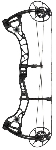 |  |
| Brace Height | 7 " | 6.125 " | 6.25 " |
| AtA Length | 30 " | 28 " | 31.5 " |
| Draw Length | 23.5 " - 28.5 " | 24 " - 29 " | 22.5 " - 28.5 " |
| Draw Weight | 30 lbs - 60 lbs | 30 lbs - 60 lbs | 30 lbs - 60 lbs |
| IBO Speed | 323 fps | 326 fps | 332 fps |
| Weight | 3.9 lbs | 3.9 lbs | 3.3 lbs |
| Let-Off | 85 / 87% | 85 / 87% | 80% |
| Where to buy Best prices online |
| ||
| compare more bows | |||
The cleanest way to place the Eva Shockey Gen 2 is against its own bloodline. Its successor, the Bowtech Eva Gen3, launched in 2024 at a $1,299 MSRP and pushed the design more aggressive: a shorter 28-inch axle-to-axle, a lower 6.125-inch brace, and a new GripLock adjustable grip and TimeLock cam-positioning system on a refined DeadLock platform. The Gen3 is the pick for a hunter who wants the most compact, modern rig and is comfortable with a lower, faster brace; the Gen 2's taller 7-inch brace makes it the more forgiving of the two, and on a closeout or used shelf it can be the smarter money. Going the other direction, the 2020 Bowtech Eva Shockey SS - the original Signature Series at an $899 launch MSRP - was lighter at 3.3 pounds and quicker on paper at 332 fps IBO, but it ran a longer 31.5-inch axle-to-axle, a lower 80-percent let-off, and lacked the full FlipDisc-and-DeadLock tuning depth the Gen 2 brought. Stepping from the SS to the Gen 2 traded a little weight and a little paper speed for a more forgiving brace, higher 85/87-percent let-off, and the complete tuning suite. The decision comes down to priorities: the Bowtech Eva Gen3 for the shooter who wants the newest and most compact platform, the Bowtech Eva Shockey SS for the lightest and cheapest entry, and the Eva Shockey Gen 2 for the most forgiving brace with full flagship tuning in the middle.