
Bear Legend XR Review


from $285
Pros
- Enormous adjustment span - 14 to 70 lb and 18 to 31 inch draw covers a youth shooter to a full-weight adult on one bow
- Adjustable cable slot holds performance and draw feel at low draw weights, so backing it down does not turn it sloppy
- Smooth hybrid-cam draw with a firm, defined back wall from the wide cable stop and a comfortable 85% hold
- Dead in the hand with little post-shot vibration for a mid-priced bow, thanks to KillerWave dampeners and the string stop
- Genuinely quick for its tier - 299 fps with a 350-grain arrow despite a 320 IBO rating, on an all-aluminum riser
Cons
- Shot noise sits at the upper end of the class at 98.1 dB - buyers stepping down from a flagship-quiet bow may notice, though it is dead in the hand and an added dampener tames it further
- The hybrid-cam draw is a touch firmer than Bear's smoothest EKO and single-cam bows - the 85% let-off eases the back end, and shooters who prize an ultra-soft pull can shoot one first
Video
content from YouTube
Editors' review
The Legend XR answers a question most hunting bows dodge: can one bow genuinely fit a 12-year-old and their father without shortchanging either? Bear's answer is the DHC-XR cam, a hybrid that stretches from 18 to 31 inches of draw and 14 to 70 pounds - more adjustment than any Legend before it. The trick most grow-with-me bows get wrong is that they go soft and sloppy once you crank the weight down; the XR fixes that with a three-position adjustable cable slot that keeps the draw crisp at low poundage. Wrap that around a 32-inch axle-to-axle (ATA, the tip-to-tip length that steadies the bow on aim), a 6.25-inch brace height, and an all-aluminum riser, and you have a real hunting rig rather than a compromise. It is not a flagship, and it does not cost like one - it is a mid-priced bow built to be the only bow a household needs for years. That combination of range and staying-power is the whole point of the XR.
Finish
The Legend XR shipped across a broad palette split by package: the Bow Only came in Fred Bear Camo, Mossy Oak Bottomland, Throwback Green, Olive, and Stone, while the ready-to-hunt package added Veil Whitetail, Olive, Inspire, and Stone. That spread deliberately spans two buyers - the traditionalist who wants a heritage camo like Bottomland, and the shooter who prefers a clean solid like Olive or Stone that reads as a working tool. The Throwback Green option is the character pick, pairing an olive riser with Fred Bear limbs for a nod to the brand's roots. All of it is the same durable dip-coat finish Bear runs across its hunting line, built to take the knocks a family bow absorbs over several seasons. It is a wide, genuinely useful menu rather than one or two token colors.Riser
The riser is all-aluminum with the skeletonized cutout pattern Bear uses to hold weight down while keeping the frame rigid, and the fittings are a step above what the price suggests. At 32 inches axle-to-axle the XR is a true hunting length - long enough to settle and hold steady on aim, short enough to carry and maneuver in the field. Bear machined the limb pockets from aluminum rather than molding them from polymer, which is the kind of detail that speaks to limb-to-riser rigidity and long-term durability on a bow meant to last. The riser carries double rest-mounting holes, including the triangle bolt pattern that accepts two-piece quivers, so a western hunter who leaves the quiver on has a clean mount. In my experience a mid-priced riser usually gives something away in fit or finish, and the XR mostly does not - it looks and feels like a more expensive bow than it is.Grip
The grip is Bear's thin aluminum profile, and the narrow shape is the point: it hands you a repeatable, low-torque position that keeps a hunting shot honest under pressure. There is no bulky palm swell to fight, so the hand lands the same way shot after shot, which is where accuracy at hunting distances actually comes from. It sits comfortably out of the box, and because it is a standard Bear grip, a shooter who wants a warmer feel in late-season cold can add a slip-on grip - a cheap change that alters nothing else about how the bow shoots. For most shooters the aluminum grip is comfortable as delivered and encourages the relaxed, un-torqued hand the bow rewards.Limbs
The Legend XR ships on either 45-60 lb or 55-70 lb limbs, but the DHC-XR cam is what makes the draw-weight story unusual: the cam mods take those limbs all the way down to 14 pounds, so the published range is a remarkable 14 to 70 pounds. That is the span that lets one bow start a new shooter light and grow with them to a full 70-lb hunting setup - the actual maximum you reach depends on your draw length, since a very short draw will not load the limbs to their peak. The limbs carry Bear's KillerWave dampeners, and in hand that shows up as a shot with little residual buzz. This is a proven, conventional limb layout rather than an experimental one, which is exactly what you want on a bow expected to stay tight through years of seasons. Draw-weight changes are a simple limb-bolt turn with an Allen wrench, no press required.Eccentric System
The DHC-XR cam is the reason this bow exists, and it is a genuine hybrid - a split-yoke idler up top feeding a power cam on the bottom, not a true dual cam, which buys it more speed than a single cam while staying easy to tune. Its headline is range: 18 to 31 inches of draw and, with the mods, 14 to 70 pounds, dialed in without swapping cams. The clever part is the three-position adjustable cable slot, and it solves the classic grow-with-me flaw - most adjustable bows go mushy and lose performance as you back the weight down, but moving the cable to match keeps the draw crisp and the back wall solid across the whole range. Let-off (the percentage of peak weight the holding weight drops to at full draw) is a high 85%, so a 70-lb draw holds around 10.5 lb - comfortable for a long wait on a stand. The speed is honest: the IBO rating (the industry chronograph standard at 30 inches, 70 lb, and a 350-grain arrow) is 320 fps, and a real chronograph at 70 lb, 29 inches, and 85% let-off returned 299 fps with a 350-grain arrow, 282 fps with a 400-grain hunting shaft, and 257 fps once you climb to a heavy 500-grain arrow. In my experience a bow with this much adjustment usually pays for it in speed, and the XR gives up surprisingly little.Draw Cycle/Shootability
Drawing the XR, the hybrid cam builds weight evenly and rolls cleanly over the top - it is close to the feel of Bear's smoother EKO cam, if not quite as silky, and the wide cable stop drops it into a genuinely solid back wall. What I keep coming back to is how well it holds its manners at low weight: I have drawn plenty of adjustable bows that go spongy once you crank the bolts out, and the XR's adjustable cable keeps the wall firm and the draw honest even down low. The 85% let-off makes the hold easy, with no drop-off at the back end, so settling the pin on a long sit is comfortable. The shot is dead in the hand with hardly any vibration, which is more than you expect at this price, even if the 98.1 dB report is toward the upper end of what a flagship would post. The thin aluminum grip keeps torque out of the equation and the whole bow settles quickly after the shot. It is an easy bow to shoot well early, which is exactly what its buyer needs.Usage Scenarios
The Legend XR is built to be a household's one bow for years. Picture a family where a 13-year-old starts at 20 pounds and a 60-pound father hunts the same rig every fall: the XR fits both today and follows the kid up in weight and draw length as they grow, without a second purchase. It is a capable whitetail and hog bow inside 40 yards, where the smooth draw, high let-off, and quiet-enough shot matter far more than a few fps, and the 32-inch length settles nicely on aim from a treestand or ground blind. A returning shooter rehabbing a shoulder can dial it down to a comfortable weight and walk it back up over a season. Its 320 IBO and 299 fps real-world speed give it enough trajectory to stretch to moderate ranges on deer. Where it is not the tool is the flat-out speed hunter chasing a flagship's fps at long range - but that buyer is shopping a different price class, and the XR never pretends otherwise.Versions
The Legend XR was sold in two package tiers, carried across two model years with identical specs:- Legend XR Bow Only - 2023 launch MSRP $459.99. Finishes: Fred Bear Camo, Mossy Oak Bottomland, Throwback Green, Olive, Stone.- Legend XR RTH - 2023 launch MSRP $559.99. Finishes: Veil Whitetail, Olive, Inspire, Stone. Adds the full Trophy Ridge kit: a 4-pin sight, Whisker Biscuit V rest, 5-arrow quiver, stabilizer, and a peep and D-loop.Both tiers use the same DHC-XR cam and 45-60 or 55-70 lb limbs in right and left hand, and both carried over from 2023 to 2024 unchanged. Shooters who want the same wide-adjust DHC platform in a more compact package should look at its 30-inch successor, the Bear Legend 30.Bear Legend XR vs Diamond Edge 320, Bowtech Amplify
| Bow | Bear Legend XR | Diamond Edge 320 | Bowtech Amplify |
| Version | 2024 RTH | 2022 | 2026 |
| Picture | 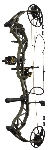 |  |  |
| Brace Height | 6.25 " | 7.25 " | 6 " |
| AtA Length | 32 " | 32 " | 31.5 " |
| Draw Length | 18 " - 31 " | 15 " - 31 " | 21 " - 30 " |
| Draw Weight | 14 lbs - 70 lbs | 7 lbs - 70 lbs | 8 lbs - 70 lbs |
| IBO Speed | 320 fps | 320 fps | 335 fps |
| Weight | lbs | 3.6 lbs | 4.0 lbs |
| Let-Off | 85% | 85% | 85% |
| Where to buy Best prices online | |||
| compare more bows | |||
The Legend XR competes squarely with the two benchmark wide-adjust value hunters, and the three sort out by what a buyer weighs most. The Diamond Edge 320 shares the XR's exact 320 fps IBO and its grow-with-me mission, packing a very broad draw-length and draw-weight range into a shorter, lighter chassis - it is the pick for a family that wants the most compact one-bow-fits-all and Diamond's Bowtech-derived tuning. The Bowtech Amplify pushes speed and range even further, pairing a 335 fps IBO with a Synchronized Binary Cam that reaches down to 8 pounds - the choice for a shooter who wants the widest span and binary-cam tunability. Against both, the Legend XR's edge is its 32-inch hunting length and the adjustable cable slot that keeps the draw crisp at low weight, plus aluminum limb pockets that punch above the tier. The decision comes down to priorities: the Diamond Edge 320 for the most compact grow-with-me rig, the Bowtech Amplify for the widest span and binary-cam speed, and the Legend XR for a full-length hunting feel that stays honest across its whole adjustment range.