
Bowtech Tomkat Review
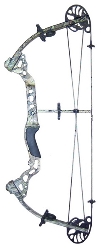

from $150
Pros
- Complete ready-to-hunt package - Hostage rest, fiber-optic sight, peep, quiver, sling and Hush Kit all in the box, the only BowTech sold this way
- Runs the same Binary Cam System as BowTech's flagships, with a solid, repeatable back wall that holds its timing
- Quiet, low-recoil shot straight from the factory Hush Kit - many owners shoot it well with no added stabilizer
- Compact 313/4-inch axle-to-axle with a tall 81/2-inch brace makes it easy to pack and steady to aim, a favorite for 3D
- Fast enough for real hunting - hunting-weight arrows fly around 280 fps, flat enough for typical whitetail ranges
Cons
- Entry-grade factory rest and sight - owners often swap both for better aftermarket parts, a cheap and common upgrade, since the bow itself is the value
- Tall brace and short axle-to-axle keep the speed but give a short valley - shooters wanting the era's most forgiving BowTech should look to a longer-riser model
Video
content from YouTube
Editors' review
BowTech built exactly one bow you could carry out of the shop fully dressed and hunt the same week - and it ran the same Binary Cam System as the company's flagships. The TomKat was BowTech's only complete-package bow, arriving with a Hostage capture rest, a fiber-optic sight, a peep, a quiver, a sling and the factory Hush Kit already installed. Where the rest of the lineup asked you to build a rig piece by piece, the TomKat was the shortest walk from purchase to practice, and it did it at a real value price for the mid-2000s. What kept it from feeling like a beginner's toy is the drivetrain: the Binary Cam that BowTech put on its serious hunting bows, tuned here with a choice of a speed or a smooth module. It gives up a little - the included accessories are basic, and the tall brace with a short axle-to-axle is more compact than forgiving - but as a value proposition it was one of the smartest buys of its era. Today it is a used-market find, and a good one for the archer who wants a lot of finished bow for very little money.
Finish
The TomKat shipped in the standard Realtree Hardwoods Green HD camo, dipped full-length so the riser, limbs and cam read as one continuous pattern. It was the single model BowTech held back from the target-color program of the period - while the up-line bows could be ordered in finishes like FireStorm Gray or a red-cammed Testarossa, the TomKat stayed a camo-only hunting bow, which fit its purpose and its price. A full camo dip on a machined-aluminum riser holds up well to brush and treestand rubs, and it hides outline in the woods the way a hunting finish should. For a used buyer today the finish is the easiest thing to judge from a photo: a TomKat with a clean, unfaded dip and tight cable serving has usually lived an easy life. There is no elaborate two-tone or tribute program here - this was a straightforward, get-to-work hunting look.Riser
The riser is machined aluminum built around BowTech's Vertical Force Technology (VFT), the era's approach to routing leftover shot energy straight down the riser and dissipating it before it reaches the hand rather than letting it ring through the bow. Its most distinctive feature is a wide shelf machined into the riser, which opens up a large sight window and clears room for the fall-away rests that were becoming standard equipment when the bow launched. The shelf is flared at the edge, so the arrow sits in a generous field of view and drop-away cabling has somewhere to go. Accessory mounting follows the traditional Berger-hole pattern of the time rather than any integrated rail, which means the TomKat accepts virtually any standard prong or drop-away rest without adapters - an advantage for a used buyer who wants to modernize the rig. It is an honest, no-gimmick riser whose real job is to hold the compact geometry steady and give the accessories a clean platform.Grip
The TomKat wears a standard BowTech grip rather than the ultra-thin side plates the company reserved for its up-line bows - its own catalog drew the line explicitly, noting that every BowTech except the TomKat carried the slim two-piece plates. That is a cost-point tell, but not a real drawback: the fuller grip fills the hand with a rounded, medium-width profile that many shooters find warm in cold weather and easy to index the same way every draw. A consistent hand position is where accuracy quietly comes from, and a grip you can locate repeatably helps a shooter torque the riser less. Anyone who prefers a slimmer feel can shape or replace it, since the two-piece design comes off with a couple of screws and standard aftermarket grips fit the platform. For its era and price it is a comfortable, low-torque grip that does its job without asking for attention.Limbs
The TomKat's limbs sit in solidly machined pockets, the dependable limb architecture BowTech ran across its mid-2000s hunting line. Draw weight is ordered by peak in three tiers - 50, 60 or 70 pounds - which covers a lighter-drawing shooter up through a full-power whitetail and elk setup. Each peak backs off roughly ten pounds at the limb bolts, so a 70-pound bow can be tuned down into the low 60s without new limbs, and moving between the 50/60/70 tiers means the matching limb set. There is no exotic-material story here; these are well-understood, solidly built limbs that have proven durable across the brand's bows of the period, and BowTech backed the bow with its first-owner lifetime warranty. It is a straightforward system any pro shop - or a confident home tinkerer with a press - can service without special tooling.Eccentric System
The heart of the TomKat is the Binary Cam System, BowTech's two-cam drivetrain in which the top and bottom cams are slaved to each other so they self-correct and cannot drift out of synchronization the way a classic two-cam can. That is the same cam family BowTech put on its flagship hunters, and finding it on the budget bow of the line is the TomKat's real headline. The version that immediately preceded it - the 2005 model - rode the company's earlier single-cam InfinityCam, and the move to Binary for 2006 is what turned the TomKat into a genuinely capable shooter. The system carries a solid draw post that gives a firm, repeatable back wall, and BowTech let the buyer set the personality with a module choice: a speed module rated 307-315 fps IBO (the industry-standard chronograph number, taken at a fixed heavy setup) or a smooth module rated 299-307 fps, both changeable in half-inch draw-length increments across a 27-31 inch range. Let-off (the share of peak weight the bow sheds at full draw) is adjustable from 65 to 80 percent, so a hunter can dial a relaxed, low-holding hold or a firmer target-style feel. What matters more than the IBO figure is the field number: with a hunting-weight arrow the TomKat clocks in around 280 fps, the normal gap between IBO and real-world speed on any bow, and plenty flat for whitetail ranges. In my experience, dropping a flagship cam onto a budget riser is exactly the kind of trade that makes a bow shoot like a costlier one, and the TomKat is a clean example.Draw Cycle/Shootability
Drawing the TomKat, the first thing you feel is how quickly the tall brace and short riser telegraph the bow's character - this is a compact, businesslike draw, not the long lazy pull of a target bow. It builds to peak and rolls into an easy hold at the 80-percent let-off setting, where the holding weight drops low enough to sit and wait, and the draw post stops you at a solid, defined wall. What you do not get is a deep valley: the tall 81/2-inch brace and short 313/4-inch axle-to-axle are tuned to keep speed, and the trade is a shorter valley that rewards staying engaged on the wall rather than relaxing into it. Where the bow genuinely shines is the shot - with the factory Hush Kit doing its work, it is quiet and nearly free of hand shock, and owners routinely shoot it well with no stabilizer at all. I found the most telling report to be a first-time-ever archer keeping three-inch groups at both 20 and 30 yards on a single pin, which speaks to how flat and forgiving the shot is once the bow is pointed. It is honest to say the TomKat is not the most forgiving BowTech of its day - the longer-riser models aim steadier - but for a compact, quiet, easy-to-shoot package it is hard to fault, and it will not wear your bow arm out on a long 3D course.Usage Scenarios
The TomKat is a whitetail and general big-game bow first. At a 60 or 70-pound peak it stores plenty of energy for deer, hogs and black bear at typical treestand and ground-blind distances, and its compact length swings easily inside a blind or a tight stand where a long target bow would fight you. That short 313/4-inch axle-to-axle is also why 3D shooters took to it - it hangs light on a walk-around course and does not tire the arm across a full round of targets. Because it ships as a finished rig, it is one of the best first bows of its era: a new archer can buy it Saturday, have it sighted in Sunday, and be hunting-ready inside a week, with a 50-pound peak that a smaller-framed or developing shooter can grow out of into the 60s and 70s. Picture a buyer walking into a pro shop opening week with no gear and a modest budget, walking out with a complete Realtree-camo rig, and sitting a treestand the following weekend - that timeline is exactly what the TomKat was built for. Where it is not the right tool is long-range target work or any situation that prizes maximum forgiveness and flat trajectory at distance; the compact, speed-leaning geometry points the other way. For a used buyer wanting a dependable, low-drama hunting rig with the accessories already hung, it still fits the treestand life well.Versions
The TomKat was a single-SKU package bow, sold only as the complete kit - bow plus Hostage rest, fiber-optic sight, peep, quiver, sling and Hush Kit - with no bare-bow option, which is part of why the value was so strong: the à-la-carte cost of the same gear ran higher than the package price. That package sold for roughly $550 in the mid-2000s, around $549 new with street prices near $568. Two things a buyer chose: the speed or the smooth module, and the peak draw weight at 50, 60 or 70 pounds. Across its Binary run the specs held steady with one small change - the 2006 bow carried an 8⅝-inch brace height, trimmed to 81/2 inches for 2007 and 2008, with the 313/4-inch axle-to-axle and 27-31 inch draw unchanged. The bow's own lineage is worth one note: the TomKat name goes back to 2002, and the 2005 model that immediately preceded this one was a different, single-cam (InfinityCam) bow offered only in 60 and 70-pound peaks, so a used shopper should confirm the Binary cam when the era is unclear.Bowtech Tomkat vs Mathews Classic, Hoyt Trykon
| Bow | Bowtech Tomkat | Mathews Classic | Hoyt Trykon |
| Version | 2008 | 2007 | 2007 |
| Picture | 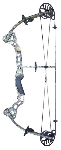 |  |  |
| Brace Height | 8.5 " | 7 " | 7 " |
| AtA Length | 31.75 " | 36 " | 33 " |
| Draw Length | 27 " - 31 " | 27 " - 31 " | 25 " - 31 " |
| Draw Weight | 40 lbs - 70 lbs | 40 lbs - 70 lbs | 40 lbs - 80 lbs |
| IBO Speed | 299 fps - 315 fps | 310 fps - 312 fps | 316 fps |
| Weight | 3.8 lbs | 3.6 lbs | lbs |
| Let-Off | 65% - 80% | 80%/65% | 65% or 80% |
| Where to buy Best prices online | |||
| compare more bows | |||
In the mid-2000s a hunter with a mid-price budget was cross-shopping exactly these three, and the Mathews Classic and Hoyt Trykon frame what the TomKat gives up and what it gains. The TomKat is the most compact of the trio at 313/4 inches axle-to-axle with the tallest brace height at 81/2 inches, which makes it easy to pack and steady to aim, and it is the only one of the three that arrives as a complete ready-to-hunt package rather than a bare bow. The Mathews Classic answers with more than four extra inches of length at 36 inches axle-to-axle for an even steadier hold, a single-cam SoloCam in place of the TomKat's two cams, a featherweight 3.6-pound carry a few ounces under the TomKat, and a $589 launch price for the bow alone - no accessories included. The Hoyt Trykon splits the difference on length at 33 inches and edges ahead on paper, with a 316 IBO from its Cam & 1/2 hybrid and the widest adjustment window of the three, reaching up to 80 pounds and down to a 25-inch draw, though its hybrid cam asks for a little more tuning attention than a self-correcting binary. All three are dependable era hunters, so the decision comes down to priorities: choose the TomKat for the most compact, highest-brace bow and a finished rig out of the box, choose the Mathews Classic for the longest, steadiest hold and the lightest carry, and choose the Hoyt Trykon for the widest adjustment range and a touch more speed.