
Bowtech Justice VFT Review

Pros
- Forgiving 8-inch brace height, one of the tallest of its era, makes it an easy bow to shoot accurately
- Fast and quiet for its day, with the lively, hard-hitting shot BowTech built its early reputation on
- Adjustable let-off from 65 to 80 percent, set right on the FreedomCam draw post with no new parts to swap
- Light 3.75-pound mass is easy to carry all day and steady to hold on a long sit
- Backed by BowTech's original-owner Lifetime Warranty, and every bow was hand-shot and chronographed at the factory
Cons
- FreedomCam is a twin-cam system that rewards periodic timing checks - shooters used to modern set-and-forget binary cams should keep it in tune with a press or a shop
- A low-300s fps IBO and mid-2000s ergonomics feel modest next to today's bows - best seen as an affordable used or backup rig, not a speed-chaser's flagship
Video
content from YouTube
Editors' review
Long before the 2024 Justice borrowed the name, the original Bowtech Justice VFT was a mid-priced hunting bow from the era when Bowtech was the fastest, loudest-talking newcomer in the room. Built on the FreedomCam and sold in 2004 and 2005 for around $639, it paired a genuinely forgiving 8-inch brace height with the lively speed the brand was making its name on - a combination that made it an easy bow to shoot well without giving up the punch a whitetail hunter wanted. The VFT in the name is Vertical Force Technology, Bowtech's parallel-limb design built to cancel recoil in the vertical plane for a quiet, low-hand-shock shot; on top of that the FreedomCam gives an adjustable let-off you set anywhere from 65 to 80 percent right on the draw post, no new modules required. Two decades on it is not a bow you buy new, but it is one you still find in trade bins and hand-me-down closets, and it remains a legitimately shootable, hunt-capable rig for a first-timer or a backup. This review covers the FreedomCam-era Justice VFT specifically - a different bow entirely from the modern binary-cam Justice, sharing only the name.
Finish
The Justice VFT shipped in a single finish, Mossy Oak Obsession, the high-contrast pattern Bowtech leaned on across its mid-2000s hunting line - unlike some of its FreedomCam siblings, which also offered solid Target Colors, the Justice was camo-only. Coverage was even across the machined riser and the split limbs, and the dip-and-cure finishes of the period have generally held up well - two-decade-old examples still show intact camo where the bow wasn't banged around. There was no premium or tribute finish tier. For a used buyer today, finish condition is mostly a cosmetic question, since the coating rarely affects how the bow shoots.Riser
The riser is machined aluminum with the reflex geometry and skeletonized cutouts typical of the FreedomCam era, holding the finished bow to a light 3.75 pounds. Compared with the 33-inch flagships of the day, the Justice VFT runs a shorter 31-1/4-inch axle-to-axle, which makes it a shade handier in tight quarters and out of a treestand while still keeping enough length between the axles for a stable full-draw hold. The 8-inch brace height is the defining number here: it sits the grip well back from the string, which is the single biggest reason the bow is as forgiving of small form errors as it is. This is a straightforward, honest chassis from a company that was, even then, obsessive about building a rigid, accuracy-first platform - Bowtech's marketing of the period made a point of hand-shooting and chronographing every bow before it left the building.Grip
The Justice VFT uses a traditional wood-and-side-plate style grip integrated into the riser, the standard approach of its era rather than the interchangeable modular grips that came later. It is a medium-fill shape that fills the hand without forcing a high or low wrist, and the natural material stays comfortable in cold weather where an aluminum grip can bite. There is no swappable-grip system, so a shooter who wants to change the throat angle is looking at aftermarket or a wrap, but for most hunters the stock grip lands in a neutral, low-torque position out of the box. It is a period-correct grip that does its job without drama.Limbs
The Justice VFT runs split limbs seated in Bowtech's pivoting limb pockets, the design the brand used to keep the whole riser-and-limb structure behaving as one rigid unit. This is where the VFT name actually lives: VFT stands for Vertical Force Technology, a limb design engineered so the limbs' working forces act in a vertical plane and cancel one another on release rather than driving forward, which is the source of the bow's quiet, low-vibration shot. Draw weight came in peak options of 50, 60, and 70 pounds across both years, with a 70-and-80-pound reach available in 2004 before the 80-pound option was dropped for 2005, and each peak backs down about 10 pounds for fine-tuning. That covers everything from a lighter-drawing hunter to a full 70-pound whitetail-and-bigger setup, and in 2004 an 80-pound option for the heavy-poundage crowd. The split-limb design of the period is durable and well proven across Bowtech's early lineup; a used example's limbs are worth a quick inspection for stress cracks near the tips the way any two-decade-old bow should be, but the design itself has aged well.Eccentric System
The heart of the bow is the FreedomCam, Bowtech's twin-cam system from just before the brand's Binary Cam arrived, and it is worth keeping separate from the VFT limbs - the limbs quiet the shot, the cam sets the draw and the hold. Rather than preset drilled holes, the FreedomCam uses a slotted draw stop that allows infinite draw-length micro-adjustment, with the base draw length set by 1-inch and half-inch modules across the 25-to-30-inch range. The draw post is also where the let-off adjusts: by rotating it you set the hold anywhere from 65 to 80 percent, trading a longer, more relaxed holding weight for a shorter, snappier valley without buying a single new part. IBO speed lands at 294 to 302 fps for the 2005 bow and a hair quicker 296 to 304 fps in 2004 - genuinely fast for a mid-priced bow of that period, if modest by modern standards. Bowtech's own literature called the FreedomCam's draw stop the most solid wall on the market at the time, and drawing one confirms the marketing was not empty: the wall is firm and the anchor repeats. As a twin-cam it does ask for the occasional timing check to keep the cams synchronized, the one bit of upkeep a modern binary-cam shooter has to relearn.Draw Cycle/Shootability
Drawing the Justice VFT, what stands out is how much the tall 8-inch brace does for the shot: the bow is forgiving, quiet, and lively off the string in a way that flatters the shooter. In my experience an 8-inch brace at this speed is exactly the combination a developing hunter wants - enough forgiveness to cover a slightly imperfect release, enough speed to flatten a 20-yard trajectory. Set toward the 80-percent end of the let-off range the holding weight drops away for a comfortable, relaxed aim on a long sit; dial it back toward 65 percent and the valley tightens up for a shooter who likes to stay hard into the wall. Owners consistently describe the shot as fast and quiet, and the bow sends a cheap arrow into the bag with authority - this was never a soft-shooting target rig, it is a hunter's bow that likes to move. The FreedomCam's firm wall gives a defined, repeatable anchor, and the light 3.75-pound mass keeps it easy to hold and easy to pack. It is an approachable, confidence-building bow to shoot, which is a large part of why used examples still get carried into the woods.Usage Scenarios
The Justice VFT is a whitetail and general-hunting bow, and a genuinely good entry point into archery even today. Picture a new-ish bowhunter who picks one up used for a couple hundred dollars: the forgiving 8-inch brace covers early form mistakes, the adjustable let-off grows with them as their hold improves, and ~300 fps is plenty for deer inside typical stand ranges. Its 50-to-70-pound range - with an 80-pound option in the 2004 build - and 25-to-30-inch draw fit most adult hunters, and the short 31-1/4-inch axle length works well from a treestand or a ground blind where a longer bow gets awkward. It also makes a sensible, cheap backup for a Bowtech owner who wants a familiar-feeling second rig, or a first bow for a teenager transitioning to adult poundage. Where it is not the right tool is the modern speed race or a serious tournament line - twenty-year-old geometry and low-300s speed simply do not keep up with current flagships, and that is fine, because this bow is about affordable, forgiving hunting, not chasing fps.Versions
The Justice VFT was produced across two model years with the same FreedomCam chassis and only minor differences. The 2004 build offered peak draw weights of 50, 60, 70, and 80 pounds and an IBO speed of 296 to 304 fps. The 2005 build dropped the 80-pound option to a 50/60/70 lineup, ran a hair slower at 294 to 302 fps, and carried a period MSRP of around $639. Both years shipped in Mossy Oak Obsession and shared the 31-1/4-inch axle-to-axle, 8-inch brace, 25-to-30-inch draw, 65-to-80-percent adjustable let-off, and 3.75-pound mass. There were no package or accessory-kit SKUs - the Justice VFT was sold as a bare bow of its year.Bowtech Justice VFT vs Mathews Switchback, Hoyt Trykon
| Bow | Bowtech Justice VFT | Mathews Switchback | Hoyt Trykon |
| Version | 2005 | 2007 | 2007 |
| Picture |  |  | 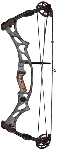 |
| Brace Height | 8 " | 7 " | 7 " |
| AtA Length | 31.25 " | 33 " | 33 " |
| Draw Length | 25 " - 30 " | 25 " - 30 " | 25 " - 31 " |
| Draw Weight | 40 lbs - 70 lbs | 40 lbs - 70 lbs | 40 lbs - 80 lbs |
| IBO Speed | 294 fps - 302 fps | 318 fps | 316 fps |
| Weight | 3.75 lbs | 4.34 lbs | lbs |
| Let-Off | 65-80% | 65% or 80% | 65% or 80% |
| Where to buy Best prices online |
| ||
| compare more bows | |||
In its day the Justice VFT slotted in as the affordable, forgiving option against the two bows that defined mid-2000s hunting. The Mathews Switchback is the legend of the era - a single-cam SoloCam bow renowned for a smooth draw and a famously quiet shot, running a 33-inch axle-to-axle, a 7-inch brace, and a quicker 318 fps IBO, but at a premium price and with the tighter valley single-cam shooters either love or fight. The Hoyt Trykon comes at it from the Cam & 1/2 side, also 33 inches and 7 inches of brace with 316 fps and a broad 40-to-80-pound range, a slightly faster and longer-limbed hunter than the Bowtech. Against both, the Justice VFT trades a couple fps for the most forgiveness of the three - its taller 8-inch brace and shorter 31-1/4-inch length make it the easiest to shoot well and the handiest in tight cover, and its adjustable let-off gives it a tuning trick neither rival offered at the post. The decision comes down to priorities: the Mathews Switchback for the shooter who wants the smoothest, quietest premium single-cam, the Hoyt Trykon for the one who wants a touch more speed and reach, and the Justice VFT for the hunter who wants a forgiving, adjustable, affordable bow that still punches hard.