
Mathews ARC 34 Review
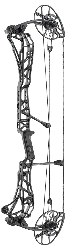

from $64.99
Pros
- SWX-2 cam with perimeter weight holds real speed on a long, forgiving chassis - chronograph testing reads 337 fps with a 350-grain arrow at 30 inches and 70 pounds on a 34-inch, 6.5-inch-brace bow
- 34-inch axle-to-axle and a 6.5-inch brace deliver a steady, settled hold - owners describe it as pointing and aiming noticeably better than the prior 33-inch Lift X
- Silent Connect anchor and a Bridge-Lock side-rod mount are machined into the riser, not bolted on - fewer brackets, less rattle, and a rigid, quiet platform
- Among the quietest, most dead-in-hand shots of the 2026 class - minimal post-shot vibration even with no monkey-tail dampeners on the string
- SWX-Z Comfort mod turns the draw butter-smooth with no back-end dump for a few fps, while the standard SWX mod stays fast - one bow, two draw characters
Cons
- The standard SWX mod is fast but stacks a touch firm right before the valley - shooters who want a gentle, rolling draw should plan on the SWX-Z Comfort mod, which smooths the cycle for a small speed trade
- Draw weight starts at a 55-pound floor - lighter-draw and youth shooters are better served by the Lift platform, which drops to 45 pounds
- At 4.3 pounds and 34 inches it is a bigger carry than the compact ARC 30 - backcountry hunters counting every ounce may prefer the shorter sibling
Video
content from YouTube
Editors' review
The surprise of the ARC 34 is the number on the tape measure: 34 inches axle-to-axle, the longest hunting bow Mathews has built in this line, in a year when most of the industry is chasing shorter and more compact. The longer riser buys a steadier hold and a more forgiving string angle, the kind of stability target shooters take for granted and hunters usually have to give up. What makes it work is that Mathews cut so much metal out of the new chassis that the longer bow still lands at 4.3 pounds - and then made it shoot like a smoke show, with hands-on chronograph readings of 337 fps from a 350-grain arrow on a 6.5-inch brace. The cam is the second-generation SWX-2 with perimeter weight technology borrowed from the Title target line, built to hold velocity once a peep and D-loop are on the string, and it now ships with a choice of draw character: the fast standard SWX mod or the smoother SWX-Z Comfort mod. Add the riser-integrated Silent Connect anchor and Bridge-Lock side-rod mount, a limb angle pulled back from past-parallel for a quieter, lower-vibration shot, and the ARC 34 reads as Mathews' bid for the taller shooter, the Western hunter, and anyone who wants flagship target-grade stability in a bow they can carry into the backcountry.
Finish
The ARC 34 ships in 13 finish options at one price point, all configurable through the Mathews Bow Builder. The nine solid finishes are Black, Kodiak Brown, Shale, Earth, Green Ambush, Mossy Oak Bottomland, KUIU Verde, First Lite Specter, and Optifade Subalpine, with Kodiak Brown the new addition for 2026. The four Fade-to-Black variants - Kodiak Brown, Shale, Earth, and Green Ambush, each fading to black at the limb tips - give a two-tone look that pairs a body color with black limbs. Beyond the stock 13, the Bow Builder layers on limb-color, string-color, and dampener-color combinations, which is how Mathews advertises over a thousand configurations of the same bow. The hard-coat coating is consistent with the Lift platform - durable in normal use, though contact with hard treestand surfaces will eventually show wear like any anodized hunting riser. For most buyers the choice is a base camo or solid that matches their setup; the Builder is there for shooters who want the rig color-matched end to end.Riser
The riser is a clean-sheet design and the reason the long-axle math works. Mathews cut more metal out of it than the prior generation - a longer, wider-bridged chassis that, thanks to the aggressive skeletonizing, still weighs less than a shorter bow would have a few years ago. The Silent Connect anchor is machined directly into the riser rather than bolted on as a separate aluminum piece, and the V-bar mount is now an integrated Bridge-Lock-style side-rod port you thread through the back rather than a traditional through-bolt plate. Both changes do the same two jobs: they cut weight and they make the connection more rigid, which is where the bow's low vibration and quiet shot start. The geometry leans toward the Title target riser, with beefed-up sections where the riser meets each limb pocket. Bridge-Lock sight and stabilizer mounting carries over, and the modules are backward compatible across the Lift, Lift X, Lift X 33, and the new ARC line, so a shooter stepping up keeps their existing mod investment. Building one up, I found the integrated side-rod mount and SCS anchor erased the bolt-on accessory clutter a longer hunting bow usually collects - and a built-in sling attachment that used to be a paid add-on now comes as part of the riser.Grip
The ARC 34 uses the BOND grip system, the same two-piece side-plate setup found across the current Mathews hunting line. The buyer gets three profiles to choose from - Contour, Taper, and Engage - a genuine improvement over the older arrangement that offered only the Engage grip or bare side plates. The Engage profile is not to everyone's taste; its rounded shape can encourage small left-right hand placement errors, and shooters chasing the cleanest release often swap to a Contour plate or an aftermarket grip that fits the standard pattern. The throat depth and moderate profile suit a hand looking for repeatable placement without forcing a high or low wrist, and the plates pop off quickly for anyone who prefers shooting directly off the riser. Because the grip hardware carries over unchanged, torque behavior matches the Lift platform shooters already know. The practical point is the same as on the compact sibling: if the stock grip does not fit your hand, the fix is an inexpensive plate, not a limitation of the bow.Limbs
The ARC 34 runs a split-limb design with the redesigned limb assembly Mathews built for the 2026 ARC platform. The limb angle is pulled back from the deep past-parallel geometry of recent Mathews bows - the limbs sit a little more laid out, with the axle end pushed to stretch the bow to 34 inches even though the riser itself is not proportionally longer. The redesigned limb cup is smaller and lighter than the Lift X 33 version, and combined with the heavily machined riser it keeps a 34-inch aluminum bow at 4.3 pounds on the scale. Limb Shift technology carries over, letting the shooter clean up left-right paper tears at the limb tip without a bow press - a tuning convenience that genuinely shortens setup. Draw-weight modules cover 55, 60, 65, 70, 75, and 80-pound peaks, each with 10 to 12 pounds of bottom-end give, so a single bow drops from a hunting 80 down toward a comfortable 3D weight with a module change rather than a limb swap. The trade against the compact ARC 30 is the floor: at 55 pounds minimum this is an adult-poundage hunting bow, and shooters who need lighter draw weights belong on the Lift platform.Eccentric System
The SWX-2 cam is the heart of the platform and the clearest upgrade over the Lift X 33. It is the second generation of the SWX cam - same module interface, so existing SWX mods still fit - with perimeter weight added at the outer edge of the wheel, a design Mathews has run on its Title target cams for years to keep the cam turning over efficiently and gain speed without piling on mass or limb tension. The IBO rating is up to 343 fps, matching the prior Lift X 33 on paper, but the real story is what the perimeter weight does for retained speed under a hunting setup. Hands-on chronograph numbers from a 350-grain arrow at 30 inches and 70 pounds land at 337 fps with the standard mod - a strong reading for a 34-inch bow with a forgiving 6.5-inch brace - dropping to 300 fps with a 450-grain hunting arrow and 251 fps with a heavy 650-grain shaft. Pulled back to a realistic 29-inch, 65-pound, 450-grain hunting setup the bow still runs 280 fps. Let-off is selectable at 80% or 85% through the standard module. The bigger decision is the mod itself: the SWX-Z Comfort mod trades a few fps for a draw that rolls over with no back-end dump, while the standard SWX mod keeps the full speed at the cost of a firmer stack into the wall - a real fork in how the same bow feels.Draw Cycle/Shootability
The ARC 34 gives the shooter two distinct draw cycles from one cam, and the choice defines the bow. The standard SWX mod is fast and rewards an aggressive shooter, but it stacks a little firm right before the valley - engaging, not harsh, though shooters new to that feel notice it. Fit the SWX-Z Comfort mod and the cycle changes character entirely: it rolls over the peak and settles in with no hard dump at the back, smooth enough that drawing 70 pounds feels closer to 60. Drawing the Comfort setup myself, the difference from the standard mod was immediate - the same bow, a far gentler ramp, and a back wall you ease into rather than hit. The 34-inch axle-to-axle length pays its dividend here: the long riser and shallow string angle make the bow sit still on the target, and owners coming off the older 33-inch Lift X consistently note that the ARC holds and points better. Post-shot behavior is the headline - the bow settles dead in the hand with little to no vibration, and even without monkey-tail string dampeners owners rate it among the quietest hunting bows of the year, with an independent decibel reading around 80 dB. For a long-axle aluminum hunter, the combination of a still riser, a quiet shot, and a draw you can tune to taste is the bow's real argument.Usage Scenarios
The ARC 34 is built for the hunter who would rather have stability than the last inch of compactness. The 34-inch axle-to-axle and 6.5-inch brace make it a natural for Western spot-and-stalk, open-country whitetail, and any hunt where a steady hold at longer distance matters more than tight maneuverability - the long riser holds on target the way a hybrid target bow does. Taller shooters and longer-draw archers fit it especially well, with a draw-length range running out to 32 inches. It is equally at home doubling as a 3D and backyard target rig: drop the draw weight with a module, fit the Comfort mod, and the same bow that hunts elk in October shoots a relaxed indoor round in January. Treestand and tight-ground-blind hunters who prize a short bow should look hard at the compact ARC 30 instead, since 34 inches is more bow to manage in a cramped blind window. The 4.3-pound mass is reasonable for the size but is heavier than the sub-four-pound ARC 30, so backcountry hunters counting ounces over miles have a real decision between the two. For the shooter who wants one flagship that hunts hard and shoots target-steady, the ARC 34 covers the most ground.Mathews ARC 34 vs Mathews Lift X 33, Hoyt REDWRX Carbon RX-4 Ultra
| Bow | Mathews ARC 34 | Mathews Lift X 33 | Hoyt REDWRX Carbon RX-4 Ultra |
| Version | 2026 | 2025 | 2020 |
| Picture |  |  | 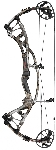 |
| Brace Height | 6.5 " | 6.5 " | 6.75 " |
| AtA Length | 34 " | 33 " | 34 " |
| Draw Length | 26.5 " - 32 " | 26 " - 31.5 " | 27 " - 32 " |
| Draw Weight | 55 lbs - 80 lbs | 45 lbs - 80 lbs | 30 lbs - 80 lbs |
| IBO Speed | 343 fps | 343 fps | 334 fps |
| Weight | 4.3 lbs | 4.26 lbs | 4.1 lbs |
| Let-Off | 80% or 85% | 80% or 85% | 85% |
| Where to buy Best prices online | |||
| compare more bows | |||
The ARC 34 sits in the long-axle hunting-flagship class against two natural cross-shops. The Mathews Lift X 33 is the bow it directly succeeds - 33 inches axle-to-axle, the same 6.5-inch brace, the same up-to-343 fps IBO, and a near-identical 4.26-pound mass, at a $1,449 launch MSRP. What the ARC 34 adds for its slightly higher price is the second-generation SWX-2 cam with perimeter weight, the new SWX-Z Comfort mod that the first-gen SWX cam never offered, and the riser-integrated SCS and side-rod mounts. A shooter happy with a Lift X 33 already owns most of the spec sheet; the upgrade is in cam feel, the smooth-mod option, and the cleaner integrated build. The Hoyt REDWRX Carbon RX-4 Ultra comes at the same 34-inch length from a different material philosophy - a carbon riser at 4.1 pounds, a longer 6.75-inch brace for even more forgiveness, an up-to-334 fps IBO, and a $1,749 launch MSRP from its 2020 release. It is the option for the buyer who specifically wants a carbon riser's warmth and damping and the most forgiving brace of the three, and is willing to pay the carbon premium. The ARC 34 lists at $1,569 launch MSRP, and the decision comes down to priorities: the ARC 34 for the buyer who wants the current Mathews long-axle flagship with two-character cam tuning and integrated hardware; the Mathews Lift X 33 for the shooter who wants nearly the same chassis a tier cheaper; the Hoyt REDWRX Carbon RX-4 Ultra for the buyer set on a carbon riser and the longest, most forgiving brace.