
Mathews Outback Review


from $249.99
auctions from $389
Pros
- Forgiving by design - a tall 7.5-inch-plus brace height on a short 31.5-inch frame smooths out form errors and rewards accuracy
- Whisper-quiet shot - the ball-bearing roller guard, string suppressors, and Harmonic Damping kill noise and hand-shock right at the shot
- Smooth single-cam draw - the StraightLine cam builds gently to peak and rolls into a soft valley, easy to pull even at 70 pounds
- Light and compact - 4.3 pounds and 31.5 inches axle-to-axle carry all day and clear treestand rails and blind windows without snagging
- Built to last - the single cam and factory finish hold up through hard seasons, with many owners still shooting theirs fifteen-plus years on
Cons
- Not a speed bow - real hunting-weight speeds land around 250 to 275 fps, well under the 308 IBO, so shooters chasing a flat trajectory may prefer a faster hybrid or binary-cam bow of the era
- Draw-length changes mean a full cam swap - the solo cam has no adjustable modules, so on a used bow it is worth confirming the installed cam matches your draw, or budgeting a pro-shop cam change
Video
content from YouTube
Editors' review
Twenty years after it left the Mathews lineup, the Outback is still climbing into treestands - and that says more about it than any spec sheet. Released in 2004 and built through 2006, it was Mathews' short, forgiving hunting single-cam: 31.5 inches axle-to-axle, a tall brace height, and a StraightLine cam tuned for a smooth pull rather than a screaming IBO number. It never chased speed, and it aged into one of the most quietly respected classics the brand ever made. Owners keep it, hand it down, and buy it used because it does the fundamentals - forgiveness, silence, and reliability - better than a lot of faster bows that came after. This is the bow for the hunter who cares more about where the arrow lands than how fast it gets there. If you are shopping the used market for a first serious hunting rig or a nostalgic Mathews, the Outback is one of the safest bets in its price range.
Finish
Mathews finished the Outback the way it finished its whole mid-2000s hunting line: a full-coverage hunting camo dip over the machined aluminum riser and limbs, built to disappear against timber and brush. There is no flash here and none was intended - the Outback was a working hunter's bow, and its finish was chosen for concealment and toughness rather than showroom shine. What stands out two decades later is how well that coating has held up; owners who have carried the same bow through many seasons find finishes that still cover and protect, with wear showing mainly at the grip throat where every bow eventually rubs. If you are buying used, that durability is a genuine advantage - a well-kept Outback often looks close to how it left the shop. Expect honest hunting camo rather than a catalog of decorative patterns, and judge a used example by its grip and cam wear more than by its finish.Riser
The Outback riser is machined aluminum built around Mathews' Perimeter Weighted Technology, which pushes mass toward the outer edges of the riser to raise the bow's resistance to torque and steady it in the hand. Even by the standards of its day it is a short riser - the whole bow is only 31.5 inches axle-to-axle - yet Mathews kept it stable rather than twitchy. Two features do the quiet work: a Harmonic Damping System module tucked into the riser to soak up post-shot vibration, and string suppressors that stop string oscillation before it turns into noise. The ball-bearing roller guard routes the cables with minimal friction and keeps the draw consistent shot to shot. Cable-guard torque, the usual enemy of a single-cam bow's tune, is well managed here. It is a straightforward, honest riser - no carbon, no modular accessory rail, just well-executed aluminum engineering that has proven it can take twenty years of field use and keep shooting straight.Grip
Mathews fitted the Outback with its Inline grip - a slim, direct grip that seats the hand low and close to the riser's centerline. The narrow profile is the whole point: it gives the hand one repeatable place to sit, which keeps torque out of the shot and reinforces the forgiveness the rest of the bow is built around. Shooters with larger hands sometimes find it thin, and that is the most common grip note owners raise, but a narrow grip is easier to shoot consistently than a fat one once the hand learns it. There is no rubber overmold or warming insert here - it is a functional hunting grip from an era before those became standard. If you prefer more fill, a slip-on aftermarket grip solves it in minutes, though most owners leave it stock because the low, narrow hand position is exactly what makes the Outback point and hold the way it does.Limbs
The Outback carries what Mathews advertised as its most parallel limbs to that point - limbs angled so their recoil largely cancels at the shot, which is a big part of why the bow shoots so quietly and with so little hand-shock. They ride in pivoting limb cups, the pocket design Mathews used before its later bows moved to a different system, and that geometry has proven reliable: owners report limbs that stay true, that do not twist under draw, and that survive being let down, re-tuned, and even re-limbed years later without drama. The bow is offered in 40, 50, 60, and 70-pound peak weights, adjusted the conventional way through the limb bolts, so a shooter can back a 70-pound bow down a few pounds for the off-season or crank it back for hunting. That spread covers everyone from a smaller-framed hunter to a full-power whitetail or elk setup. The most impressive thing about these limbs, though, is simple longevity - twenty-year-old examples are still holding weight and still safe to shoot, which is not something you can say about every bow of the era.Eccentric System
The heart of the Outback is the StraightLine OTHP single cam - one cam on the bottom, a ball-bearing idler wheel up top - the design philosophy Mathews rode to the top of the hunting market in this era. A single cam like this is inherently easy to keep in tune because there is no second cam to synchronize, and that simplicity is a big reason Outbacks stay shooting for decades on basic maintenance. The published IBO speed is 308 fps, but that number only shows up at the industry test setup: maximum draw weight, a light arrow, and the lower let-off. In the real world, at hunting weights and hunting arrows, owner chronograph readings cluster between about 250 and 275 fps - 264 fps from a 63-pound bow throwing a 390-grain arrow, 273 fps from a 60-pound setup, the low 270s from a 72-pound bow with a 340-grain shaft. That is honest single-cam hunting speed rather than flagship velocity, and it buys the forgiveness the bow is known for. Let-off is selectable at 65 or 80 percent depending on the cam, so you can pick a stiffer, shorter valley for a crisp shot or a deeper let-off to hold longer on an animal. The one thing to plan around is draw length: the solo cam has no adjustable modules, so each cam is cut for a specific draw. In my experience that is the single most important thing to get right on a used Outback - moving from a 28-inch to a 30-inch setup is not a quick module turn but a full cam swap done in a press, so confirm the installed cam matches your draw before you buy. It is worth knowing, too, that the 30-inch 65% cam will not step up to 80%, though the 30-inch 80% cam adjusts down - a small quirk that only matters if you draw long.Draw Cycle/Shootability
Draw the Outback and the first thing you notice is how little drama there is. The StraightLine cam builds to peak weight gradually, with no aggressive front-end spike, then eases into a valley that lets the pin settle instead of fighting you. Drawing a 60-pound example, I was struck by how gently it loaded - owners who describe the pull as smooth as silk are not exaggerating, and it is a big part of why the bow is so easy to shoot accurately in the cold or from an awkward treestand angle. The back wall is defined without being harsh, giving a consistent stopping point to anchor against. At the shot, the parallel limbs, roller guard, and Harmonic Damping do their job: the bow is genuinely quiet and settles with very little vibration in the hand. There is no meaningful hand-shock to flinch against, which feeds straight back into accuracy. What I keep coming back to with this bow is the balance: light enough to hold up all day, stable enough at full draw to forgive a shaky moment. It is not fast, and it never pretended to be; what it offers instead is a shot cycle that a nervous first-timer and a veteran elk hunter both find easy to repeat.Usage Scenarios
The Outback is, first and last, a whitetail and general big-game hunting bow, and it fits that role beautifully. Picture a hunter who buys a clean used one in late summer, has a pro shop confirm the cam matches a 28-inch draw and set it to 62 pounds, sights it in over a weekend, and is in a treestand by opening morning - the Outback rewards exactly that kind of no-fuss setup. Its forgiveness and quiet make it ideal for close-cover treestand and ground-blind hunting, where a still, silent bow and a steady hold matter more than raw speed. At practical hunting distances inside 40 yards, the 250-to-275 fps it produces carries plenty of energy for whitetail, hogs, and even elk for a hunter who keeps shots reasonable. It is also an excellent first serious bow: the smooth draw and tall brace let a newer archer build good form instead of fighting the equipment. Where it shows its age is long-range speed shooting - a spot or 3D shooter chasing a flat 50-yard pin, or a hunter who wants to reach well past 50 yards, will want more velocity than a mid-2000s single cam delivers. Within its lane, though, it is hard to outgrow: plenty of hunters have shot the same Outback for fifteen seasons and never felt undergunned in the woods.Mathews Outback vs Bowtech Allegiance, Hoyt Trykon
| Bow | Mathews Outback | Bowtech Allegiance | Hoyt Trykon |
| Version | 2006 | 2008 | 2007 |
| Picture |  |  | 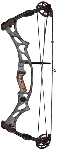 |
| Brace Height | 7.5 " | 7.25 " | 7 " |
| AtA Length | 31.5 " | 33.25 " | 33 " |
| Draw Length | 26 " - 30 " | 26.5 " - 30.5 " | 25 " - 31 " |
| Draw Weight | 40 lbs - 70 lbs | 50 lbs - 70 lbs | 40 lbs - 80 lbs |
| IBO Speed | 308 fps - 310 fps | 317 fps - 335 fps | 316 fps |
| Weight | 4.3 lbs | 3.8 lbs | lbs |
| Let-Off | 65% or 80% | 65% - 80% | 65% or 80% |
| Where to buy Best prices online | |||
| compare more bows | |||
Cross-shopped against its mid-2000s peers, the Outback is the smooth, forgiving choice rather than the fast one. The Bowtech Allegiance, a hugely popular bow of the same years, runs a binary cam on a longer 33.25-inch frame and a 7.25-inch brace, and it is noticeably faster - an IBO in the 317-to-335 range depending on setup - with a more aggressive, energy-first draw. The Hoyt Trykon splits the difference: a Cam & 1/2 hybrid on a 33-inch riser with a 7-inch brace and a 316 IBO, a wider 40-to-80-pound weight range, and Hoyt's firmer, speed-leaning feel. Both competitors give up something the Outback keeps. Their longer axle-to-axle lengths and shorter brace heights trade away a measure of the Outback's short-frame maneuverability and forgiveness for velocity, and their more aggressive cams ask a little more of the shooter through the draw. The Outback answers with the smoother pull, the quieter shot, and the shorter, handier frame - the things that make it easy to shoot well under pressure. None of the three is a bad bow; all were excellent for their day. The decision comes down to priorities: the Bowtech Allegiance or the Hoyt Trykon for the hunter who wants flatter trajectory and more downrange energy, the Outback for the hunter who values a forgiving, silent, easy-to-tune bow that shoots the same every time. Buyers who want to stay in the Mathews family with a touch more speed can also look at the Outback's own successor, the Switchback, which pushed the IBO to 318 on a 33-inch frame while keeping much of the Outback's shootability.