
PSE Mach 33 DS Review
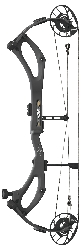

from $1450
Pros
- Aims like a target bow - the pin parks and stays, steady enough that shooters run indoor Vegas 300 rounds with their full hunting rig on it
- Smoother draw than the compact 30 DS - the cam rolls over cleanly with none of the faint hump you feel on the shorter bow
- Very quiet with a dead-in-the-hand shot, unusually settled for a sub-4-pound carbon bow
- Remarkably light for a 33-inch carbon at 3.9 pounds - a longer, steadier platform that still carries barely heavier than the compact 30 DS
- USA-made Dead Frequency Carbon riser - stiff, temperature-neutral, and among the very few carbon bows built in the United States
Cons
- The stock grip runs wide and is not adjustable on PSE's hunting line - shooters who want a narrower or custom fit add an aftermarket plate such as UltraView's or Nock-On's, a quick bolt-on fix
- At 3.9 pounds the light frame can get nudged by wind and feels less planted than a heavy aluminum bow - a front stabilizer with a little mass steadies it
Video
content from YouTube
Editors' review
A carbon hunting bow steady enough that shooters run competitive indoor 300 rounds with their hunting rig - that is the pitch the Mach 33 DS actually delivers on. PSE built it as the big brother to the Mach 30 DS, the bow that took Outdoor Life's 2024 Editor's Choice, and then the 33 went one better: it won Outdoor Life's 2025 Editor's Choice and Field & Stream's Best Bow of the Year the same season. Stretched to 33 inches axle-to-axle on the same USA-made Dead Frequency Carbon chassis, it trades a few feet per second of the 30's speed for a longer, more forgiving platform that holds dead-still on the pin. For 2026 PSE swapped the long-serving EC2 cam for the new FDS (Force Distribution System) cam, lifting the IBO rating to 342 fps while keeping the smooth draw. The surprise is the weight: a 33-inch carbon bow that comes in at 3.9 pounds, barely more than its compact sibling. This is the DS line's all-arounder - the bow for the hunter who wanted the Mach 30 but wished it were a little bigger and a little steadier.
Finish
The Mach 33 DS ships in the same seven-finish palette as the rest of the DS carbon line: Black, Charcoal, and Clay Brown for a solid, understated riser, and Olive Green, Kuiu Verde, Mossy Oak Bottomland, and Kryptek Skyfall for hunters matching a specific landscape. Because the finish is laid over a woven carbon riser rather than a painted aluminum extrusion, it reads as a working tool rather than a showpiece, and the camo patterns wrap the riser, limbs, and cams for a consistent look. Seven options is a generous list for a carbon flagship - the woven-riser finishing process is involved enough that many carbon competitors offer only two or three colorways. The solids lean tactical while the patterns cover both timber and open-country needs. A treestand whitetail hunter and a Western spot-and-stalk hunter can buy the identical bow and still disappear into completely different country.Riser
The riser is the story of this bow. It is a Dead Frequency Carbon structure - a proprietary foam-cored carbon riser, made in the USA, which is notable in itself because very few makers build their carbon risers domestically. On a 33-inch bow that long, light riser makes up most of the overall length, and that is the mechanical reason the Mach 33 DS holds so well: the mass is spread out along a stable spine rather than concentrated in short, twitchy limbs. Carbon buys the same dividends here it does across the line - a chassis stiffer than aluminum, one that stays temperature-neutral so it never stings a bare hand on a January morning, and a low mass that matters on a long carry. The front end is genuinely accessory-flexible: a Picatinny rail is built into the riser face for pick-mount sights, a QAD integrated rest plate is fitted, and there are conventional Berger-hole and side-mount positions as well - though shooters running a side-mount sight will need to pull the centered Picatinny rail, which sits proud enough to interfere. Cable containment runs through a solid, rigid roller guard rather than a flexing slide. In my experience a long carbon riser like this one is what separates a bow you can hunt from a bow you can also shoot a target round with - the extra inches do the aiming work for you.Grip
PSE molds the grip directly into the carbon riser, and it is a moderately wide, fixed shelf - there is no adjustable grip plate on the hunting line the way there is on PSE's target bows. That suits shooters whose hands sit naturally into a fuller grip, but those who want a narrower throat or a custom heel angle will feel the lack: the fix is an aftermarket side plate, and the Nock-On/UltraView collaboration plates that bolt to the riser's threaded bosses are the popular choice, with some shooters simply adding grip tape for a more secure hold. The narrow-to-wide direction of that swap matters - you can always build a grip up, so if the stock shelf doesn't fit, a plate solves it in minutes. The bare carbon throat is low and close to the centerline, which keeps torque leverage down once your hand learns the position. It is the one part of the bow shooters consistently want more adjustability on, and the one part PSE could most easily improve.Limbs
The Mach 33 DS runs PSE's split limbs in the brand's limb-vise pocket system, which keeps the pocket clamped dead-center over the riser no matter where the limb bolt sits - the kind of detail that keeps a long carbon bow shooting true as you adjust weight. Draw weight is set by the limb in 10-pound peaks - 50, 60, 70, and 80 pounds - chosen at purchase, with a full 10 turns of let-down beneath each peak. The wide-limb geometry is deliberate: a broader limb base widens the bow's working platform and adds to the stability that defines this model. PSE's split-yoke cable system lets you twist one leg for fine paper-tuning, though the EZ.220 spacer system is the primary and more precise way to move cam lean. The limbs are the same fundamentally proven design PSE runs across its lineup, which on a bow you might carry into the backcountry is exactly the reliability you want. Peak-weight changes are a simple bolt turn; only cam-lean and draw-length spacer swaps call for a press.Eccentric System
The cam is what changed for 2026. The EC2 cam - the large, smooth Evolve-style wheel PSE ran for years - has given way to the new FDS (Force Distribution System) cam, which lifts the IBO rating to 342 fps, up from the EC2's 338, while PSE's aim was to add speed without roughening the draw. The new cam is a shade more aggressive than the famously buttery EC2 - it loads with a bit more energy up front - but shooters still call it smooth for an aggressive cam. On a chronograph the FDS bow averaged 335 fps with a 350-grain arrow at 70 pounds and a 30-inch draw, a few fps under its rating with a clean setup, and 278 fps in a realistic 65-pound, 29-inch, 450-grain hunting configuration. That is honest hunting velocity, a touch behind the shorter, punchier 30 DS by the 5 to 7 fps a longer, more forgiving brace naturally costs. Let-off is adjustable at the module without a press - the EC2 ran 80, 85, and 90 percent; the FDS cam moves the band to an adjustable 70 to 85 percent for a crisper valley and a firmer wall. Draw length spans 25.5 to 31 inches in half-inch steps - a full inch longer than the 30 DS reaches - via the EZ.220 spacer system, which also sets cam lean in 0.020-inch increments. What every shooter notices is the rollover: the cam eases over the top and into the valley without the faint hump the compact 30 carries, which is the single biggest reason the 33 draws smoother than its sibling.Draw Cycle/Shootability
Drawing the Mach 33 DS back to back with the Mach 30 DS is the clearest way to feel what it does: the 33 is the smoother of the two, the cam rolling cleanly over the peak where the 30 carries a faint hump just before the break, and at 70 pounds the 33 feels closer to a 60-to-65-pound bow in the hand. Then you settle onto the target and the pin simply parks. This is where PSE's Full Draw Stability system earns its name - the way the cam rolls over and the limbs flex actually extends the brace height dynamically at full draw, so the 6-3/8-inch static brace behaves like a considerably longer one and actively fights the torque your hand introduces. The effect is dramatic enough that shooters take this hunting bow to indoor Vegas 300 rounds and 50-yard target lines with a full hunting setup and hold their own - steadiness you rarely get from a sub-4-pound carbon bow. At the shot it is quiet - measured in the high 70s to low 80s on a decibel meter - and dead in the hand, the Dead Frequency Carbon soaking up the thump carbon bows usually transmit. The one honest caveat is the flip side of that light mass: in a stiff crosswind the bow wants to drift on the target more than a heavy aluminum rig would, and adding a front stabilizer with a little weight plants it. What I keep coming back to is the aim - I would not normally trust a carbon hunting bow with a competition 300 round, and this is the rare one I would.Usage Scenarios
The Mach 33 DS is the DS line's do-everything bow. Its 33-inch frame and target-grade hold make it a natural for the hunter who also shoots 3D and indoor leagues in the off-season - one bow that hunts in November and shoots a Vegas 300 in January. For pure hunting it covers the field: treestand whitetail work where the longer riser steadies a long-held shot, spot-and-stalk where the light carry matters, and open-country hunts where the extra axle-to-axle helps you hold a pin at distance. The draw length reaching 31 inches opens it to taller and longer-draw shooters the compact 30 DS leaves out, and the 80-pound limb option gives elk and big-game hunters real kinetic-energy headroom. Where it gives ground is on the two extremes of the family: a hunter who prizes maximum maneuverability in tight ground blinds is better served by the 30 DS, and a dedicated long-range target shooter who wants the most forgiving platform of all should look at the 35 DS. For the widest slice of hunters, though - the ones who want one carbon bow that does nearly everything well - this is the pick.Versions
The Mach 33 DS is sold as a single bare-bow model, differentiated by finish and by year-version of the cam. The current 2026 Mach 33 DS Carbon carries the new FDS (Force Distribution System) cam - 342 IBO, 6-3/8-inch brace, adjustable 70 to 85 percent let-off - at a $1,999 launch MSRP in seven finishes. The prior 2025 Mach 33 DS Carbon ran the EC2 cam (338 IBO, 6-5/8-inch brace, 80 to 90 percent let-off) on the identical Dead Frequency Carbon chassis at the same price - and it is the version that actually won the 2025 Outdoor Life Editor's Choice and Field & Stream Best Bow of the Year honors. A buyer shopping a leftover or used EC2 example gets the same award-winning riser, grip, limbs, and stability, trading a few fps of rated speed and a slightly different let-off band for whatever the prior year discounts. Draw weight is chosen by limb set (50/60/70/80) at purchase in either version.PSE Mach 33 DS vs Mathews Lift 33, Bowtech SR350
| Bow | PSE Mach 33 DS | Mathews Lift 33 | Bowtech SR350 |
| Version | 2026 FDS | 2024 | 2023 |
| Picture |  | 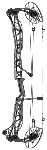 |  |
| Brace Height | 6.375 " | 6.5 " | 6 " |
| AtA Length | 33 " | 33 " | 33 " |
| Draw Length | 25.5 " - 31 " | 26 " - 31.5 " | 25 " - 30 " |
| Draw Weight | 40 lbs - 80 lbs | 45 lbs - 80 lbs | 40 lbs - 70 lbs |
| IBO Speed | 342 fps | 343 fps | 350 fps |
| Weight | 3.9 lbs | 4.26 lbs | 4.4 lbs |
| Let-Off | 70% - 85% | 80% or 85% | 85 / 87% |
| Where to buy Best prices online | |||
| compare more bows | |||
The Mach 33 DS sits in the 33-inch all-around bracket, and its two most direct rivals are both aluminum flagships that cost meaningfully less. The Mathews Lift 33 is the closest match on paper - 33 inches axle-to-axle, a 6.5-inch brace, and a 343 IBO rating almost identical to the PSE's 342 - at a $1,299 launch MSRP, and it brings Mathews' signature dead-quiet shot and build quality. The Bowtech SR350 is the speed play of the three: a 33-inch, 6-inch-brace bow rated up to 350 IBO with Bowtech's DeadLock tuning, also launched at $1,299. Against both, the Mach 33 DS asks $700 more, and the honest question is what that premium buys - the answer is carbon: a riser a half-pound lighter than the aluminum bows, temperature-neutral in cold, USA-made, and the Full Draw Stability hold that lets it double as a target rig. The decision comes down to priorities: the Mach 33 DS for the hunter who specifically wants the lightest, steadiest carbon platform and will pay for it, the Mathews Lift 33 for the shooter who wants flagship silence and near-identical specs while keeping $700, and the Bowtech SR350 for the buyer chasing the most raw speed per dollar.