
Bowtech BlackKnight Review

Pros
- Top-of-era speed - 342-350 fps IBO, with owners clocking real hunting arrows in the low-to-mid 320s (327 fps with a 380-grain shaft at 63 lb)
- Holds like a target bow - the long riser settles the pin, and owners repeatedly rate it as accurate as a premium target rig, only much faster
- Lower hand shock than its speed reputation suggests - many owners describe minimal shock and a smoother release than comparable bows of the era
Cons
- Short 5 3/4" brace height and the aggressive dual cam make it less forgiving of form errors - a specialist's bow; shooters who want margin should look at a longer-brace design instead
- Shallow valley and a hard-holding wall - the cam wants to pull forward if you relax, so stay engaged on the back wall; anyone used to a relaxed 80% let-off should shoot one first
Editors' review
This is the bow that started it all. When BowTech rolled its first product up to the 2000 ATA trade show, the pitch was not subtle: bring your own bow, run it across our chronograph, and watch the BlackKnight beat it. In a field where 300 fps was fast, the BlackKnight advertised 350 - and that single number launched a company and a two-decade reputation for "the fastest bows in the world." Two-plus decades later it is a legacy bow, sold used, but understanding it explains the whole BowTech speed lineage that followed. The BlackKnight is a pure speed specialist from the mid-2000s: a true dual-cam "Dually" on a long machined-aluminum riser, tuned for velocity and a rock-steady hold rather than for a soft, forgiving draw. It rewards a shooter with disciplined form and punishes one without. This review covers the single-name BlackKnight (2000-2005); its later sibling, the Black Knight 2, is a separate bow.
Finish
The BlackKnight shipped in the full-coverage hunting camo patterns of its day. The 2004 catalog sheet lists Mossy Oak Obsession as the finish, the dense green-and-shadow pattern that was BowTech's signature dip through the mid-2000s. There is no premium-finish tier or target color here - this was a hunting bow sold in a hunting wrap, dip-coated over the machined aluminum riser and the limbs alike. The camo has aged well on surviving examples, which is typical of the era's dip finishes, though two decades of use means most bows on the resale market show handling wear at the grip and shelf. Buyers shopping one today are choosing it for what it does, not for a finish menu.Riser
The riser is where the BlackKnight earns its accuracy reputation. It is a long machined-aluminum riser, deeply cut out to shed weight, and its length stretches the axle-to-axle out to 36 1/4" and plants the bow steady in the hand. Owners consistently single out the hold: the long riser makes the pin sit still, and more than one compared its aim to a dedicated target bow. The trade-off is size and weight; at 36 1/4" between the axles this is a full-length rig, not a compact treestand bow, and the mass sits between 3 lb 11 oz and 4 lb 3 oz depending on the model year. Cable management is a simple cable-rod guard of its era - appropriate to the bow's age and part of why it is straightforward to work on.Grip
The BlackKnight carries a slim wood grip insert set into the riser throat - narrow front-to-back, in the style of mid-2000s speed bows, which encourages a consistent, low-torque hand placement. There is no modern interchangeable side-plate system; the grip is what it is, and its narrowness is part of why the bow aims well for shooters who set their hand the same way every time. Cold-weather hunters used to a fatter, warmer grip may want a slip-on aftermarket grip, which fits the riser throat without trouble. It is a grip that rewards repeatable form rather than one that forgives a sloppy hand.Limbs
The BlackKnight's limbs seat in BowTech's Pivoting Limb Pocket, a design the catalog describes as built to hold consistent peak efficiency as you back the bow down from its top draw weight. That matters on a bow offered in 50, 60, and 70 lb peak weights: the pocket geometry is meant to keep the limbs working evenly even when a shooter dials weight down from the marked peak, which protects both tune and speed. The limbs are deeply preloaded to feed the aggressive Speed Dual Cam, which is where most of the bow's velocity comes from. Adjustment is old-school - a bow press and limb-bolt work rather than tool-less modules - so setup and weight changes are a pro-shop job, not a tailgate one. Across BowTech's mid-2000s run this limb-and-pocket approach proved durable, and surviving bows are generally still shooting.Eccentric System
The heart of the BlackKnight is BowTech's "Speed Dual Cam" - a true dual-cam system (two matched cams, top and bottom, that BowTech branded the "Dually"), before the company moved to its later binary designs. This is a velocity-first cam: the published IBO rating is 342-350 fps (IBO being the industry-standard chronograph rating at a fixed 30-inch, 70-pound, 350-grain setup), which was genuinely at the front of the pack in 2004-2005. Real-world numbers back it up without the marketing gloss - owners running hunting-weight arrows report the low-to-mid 320s, for example 321 fps from a 60-pound, 29-inch setup with a 300-grain arrow, and 327 fps from a 380-grain shaft at 63 pounds. The let-off is 65% (let-off is the percentage of peak weight the bow drops to at full draw), which is low by modern standards - you hold noticeably more weight at full draw than on today's 80% bows, a deliberate choice that keeps the cam aggressive and fast. BowTech re-engineered the cam geometry for the 2004 "new improved" version, and the catalog specifically credits that revision with a smoother break-over, an easier draw, and a quieter release than the earlier cam. Even so, this is not a gentle system; the speed comes from a cam that loads hard and holds hard.Draw Cycle/Shootability
Drawing a BlackKnight, you feel immediately that speed was the priority. The cam loads hard and early - there is no soft front-end ramp here - and it climbs to a firm, defined wall with almost no valley behind it. That shallow valley is the single most-cited handling trait among owners: relax at full draw and the cam wants to creep forward, so the bow demands that you stay actively engaged against the wall. It is, by broad owner consensus, not a beginner's bow; you have to be on top of your form to get the best from it. What surprises people is the back end of the shot. For a bow this fast, hand shock is reported as minimal - several owners rate it smoother through the shot than heavier, slower bows they had owned - and shot noise is generally called reasonable for the speed, with most of the racket that does show up traceable to the sight and rest rather than the bow itself. In my experience with speed bows of this generation, that combination - aggressive draw, dead-in-the-hand release - is exactly what a disciplined shooter is buying: you accept a working draw cycle in exchange for velocity and a shot that does not beat you up.Usage Scenarios
The BlackKnight fits the experienced hunter or target shooter who wants maximum arrow speed and will put in the form work to shoot it well. For a whitetail hunter who values a flat trajectory and the forgiveness of guessing yardage slightly wrong, that 350-fps rating is the whole point - and owners did exactly that, taking plenty of deer with this bow over the years. It doubles capably as a target and 3D rig thanks to the steady hold from the long riser; more than one owner preferred it on paper. Handed one on the used market today, the first thing I would check is draw-length fit - at 25 to 30 inches it suits mid-draw shooters, and the modules are not a tailgate change. Where it asks for care is the tight treestand and the heavily layered late-season hunt: the short 5 3/4" brace height is less forgiving of a torqued shot and can catch a loose sleeve, so a hunter in bulky clothing should be mindful of the string path. It is not the bow for a brand-new archer or for someone who wants to relax at full draw and wait out an animal - the low let-off and short valley make holding harder work than a modern hunting rig.Versions
The BlackKnight was produced from 2000 through 2005 as a single-name model, evolving year to year rather than splitting into package SKUs. The two best-documented years: the 2004 "new improved" version carried the re-engineered cam, a listed mass of 3 lb 11 oz, and a Mossy Oak Obsession finish; the 2005 version shared the same geometry (5 3/4" brace, 36 1/4" axle-to-axle, 25-30" draw, 50-70 lb, 65% let-off, 342-350 fps) with a listed mass of 4 lb 3 oz and a $749 MSR. Buyers today encounter these only on the used market, so condition, draw-length fit, and string age matter far more than which model year it is. Note the naming: the single-word BlackKnight reviewed here is distinct from BowTech's later Black Knight 2, and from the unrelated 2013 Carbon Black Knight - three different bows that share a name.BowTech BlackKnight vs Mathews Switchback, PSE X-Force
| Bow | Bowtech BlackKnight | Mathews Switchback | PSE X-Force |
| Version | 2005 Dually | 2007 | 2009 (GX Cam) |
| Picture | 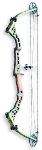 |  |  |
| Brace Height | 5.75 " | 7 " | 6 " |
| AtA Length | 36.25 " | 33 " | 33.5 " |
| Draw Length | 25 " - 30 " | 25 " - 30 " | 26 " - 30 " |
| Draw Weight | 40 lbs - 70 lbs | 40 lbs - 70 lbs | 40 lbs - 80 lbs |
| IBO Speed | 342 fps - 350 fps | 318 fps | 344 fps - 352 fps |
| Weight | 4.188 lbs | 4.34 lbs | 4.2 lbs |
| Let-Off | 65% | 65% or 80% | 75% actual |
| Where to buy Best prices online |
| ||
| compare more bows | |||
Set the BlackKnight against the two bows a mid-2000s buyer actually cross-shopped, and its identity gets sharp. The Mathews Switchback is the opposite philosophy from the same era: a single-cam bow built around forgiveness, a quiet shot, and a smooth, relaxed draw, and it became one of the most popular hunting bows of its era precisely because it was easy to shoot well. Where the BlackKnight makes you earn its speed, the Mathews Switchback gives up some velocity for a draw and hold that forgive a mediocre form day - the classic speed-versus-forgiveness fork. The PSE X-Force sits on the BlackKnight's side of that fork: it picked up the "fastest bow in the world" torch later in the decade with an even more radically reflexed riser and a short brace height, chasing raw fps at the same cost in forgiveness. Against the PSE X-Force, the BlackKnight is the older and slightly more civilized of the two speed demons, with a hold that many owners rate as steadier. The decision comes down to priorities: the Mathews Switchback for the hunter who wants an easy, quiet, forgiving bow and will trade fps for it; the BlackKnight or the PSE X-Force for the shooter who wants a flat-shooting speed rig and has the form to run it.