
Bowtech BlackHawk Review


from $499.99
Pros
- Pocket-sized and under three pounds - the sub-29-inch frame swings up fast and holds easy from a treestand or inside a cramped ground blind where a long bow fights you
- Dead in the hand for a value bow - owners report little to no hand shock even shooting it bare, without hanging a stabilizer on the front to quiet it down
- High, dial-in let-off - the InfinityCam's continuously adjustable 65-to-80% hold lets you trade holding weight for aiming steadiness, and owners favored the 80% setting for all-day hunting
Cons
- The short 28 7/8-inch axle-to-axle rewards clean, relaxed form; shooters who want a more forgiving stance at full draw, or who draw long, may prefer a longer-riser bow such as the TomKat
- A long-discontinued model, so factory InfinityCam draw modules and string sets are special-order today - a used buyer should budget a shop-built custom string and have the cam timing checked before hunting it
Editors' review
In 2003, when most hunting rigs still stretched 34 to 40 inches between the axles, BowTech built one that measured just under 29 inches and weighed less than three pounds - and it still cleared the low-310s in IBO speed (the industry's standard chronograph rating at a fixed 30-inch, 70-pound, 350-grain setup). That is the BlackHawk in one line: the shortest, lightest single cam BowTech made in its day, aimed squarely at the hunter who climbs trees and crawls into blinds rather than the one who shoots spots at 50 yards. It sits at the value end of the early-2000s BowTech lineup, well below the flagship Patriots and Samsons, yet it borrows the same machined-riser, continuously-adjustable InfinityCam DNA. A single cam (one cam on the bottom, a plain idler wheel up top - simpler to tune and quieter than the twin-cam rigs of the era) keeps it forgiving and calm. The surprise is how civil a bow this small and this cheap turned out to be in the hand. This review covers the standard BlackHawk; the short-draw BlackHawk2 and the women's LadyHawk are separate bows on a different cam, not versions of it.
Finish
For 2004 the BlackHawk shipped in Mossy Oak Break Up, the full-coverage woodland camo that was BowTech's house pattern that season, with solid target colors offered as the alternative for shooters who did not need to disappear into a treeline. That camo-or-solid choice is the whole palette - this was a value hunting bow, not a finish showcase, and BowTech reserved its wider pattern menus for the flagship lines. The dip-and-clear camo of the era holds up reasonably to brush and weather but will show ring wear at the cam and limb tips over years of hard use, which is worth a look on any used example today. Documentation for the 2002 and 2003 finish options is thin - the owner's manuals list specs, not colors - so treat the Break Up-plus-solids lineup as the confirmed 2004 offering rather than a guarantee for the earlier years. If a pristine factory finish matters to you on a bow this old, inspect photos closely before buying.Riser
The riser is machined aluminum in the reflexed, compact geometry that lets the BlackHawk hit its sub-29-inch length without giving up usable brace height (brace height is the gap from the string to the grip at rest; more of it is more forgiving of small form errors). It carries a standard cable guard and slide to route the control cable clear of the arrow, and BowTech set the bow up to accept the common accessory mounting of the day, so a period rest and sight bolt straight on without adapters. There is no modern rail or integrated rest mount here - this is a traditional Berger-hole hunting riser from before those systems existed, and that is exactly what a shooter restoring one should expect. The short, stiff riser is the foundation of the bow's whole personality: it is what makes the BlackHawk so quick to point and so easy to live with in tight quarters. Paired with that compact build, it also keeps the bow's mass astonishingly low for an aluminum-riser compound, which is the number that defines this bow more than any other.Grip
The BlackHawk wears the slim, low-profile grip typical of early-2000s BowTech - a narrow throat that sits directly into the web of the hand rather than filling the palm. On a bow this light, a slim grip is a real advantage: there is so little mass out front that hand torque has less to twist against, so a relaxed, repeatable hand position comes naturally once you stop death-gripping it. Shooters with large hands may find it on the thin side, which is the usual fix-it-with-side-plates situation of the era - aftermarket or shop-made grip plates were common currency on these bows and remain the easy way to tailor the fill. In my experience a bow this light actually punishes a tense grip more than a heavy target rig does, so the move is to let the bow sit in the hand and trust the wrist sling. Keep the hand soft and the BlackHawk rewards you; wrestle it and the low mass will tell on you at the target.Limbs
Draw weight runs 40 to 70 pounds across the 2003 and 2004 bows, broad enough to cover essentially every North American hunting application from a youth-friendly 40-pound setup up to a full 70-pound elk-capable draw. The earliest 2002 BlackHawk was offered only in 60 and 70 pounds - a pure adult hunting bow - so BowTech widening the floor to 40 pounds for 2003 is what opened the model to smaller-framed and younger shooters. Limb tiller is set at the factory and adjusts conventionally at the limb bolts, with BowTech's guidance of three to four pounds of weight change per full turn and a hard limit of two-and-a-half turns from the top. The strings and cables were not sold with premium custom sets from the factory on this value model, so a shooter then - and especially a restorer now - gains real performance and tuning stability from a modern, pre-stretched custom string. That upgrade is the single best thing you can do for a used BlackHawk before it sees the woods again.Eccentric System
The InfinityCam is the heart of this bow and the reason it still deserves attention. It is a single cam - one cam driving the bottom limb, a simple idler wheel riding the top - which was BowTech's calm, easy-to-tune answer to the buzzier twin-cam designs of the early 2000s. What set it apart from the ordinary single cams of its day is the draw adjustment: instead of a handful of pre-drilled holes that lock you to fixed draw-length and let-off steps, the InfinityCam uses a continuously machined slot and a sliding draw post, so let-off (the percentage your holding weight drops to at full draw) tunes anywhere across a 65-to-80% range rather than in coarse jumps. Draw length changes by swapping modules in one-inch steps, with the post fine-tuning up to a half inch on either side of the module's base length - just remember that moving the post shifts let-off and valley together, so dialing an exact let-off at an exact draw takes a little trial and error at the shop. On speed, the 2003 and 2004 bows carry a 309-to-317 fps IBO rating, genuinely quick for a compact value single cam; the original 2002 bow, with its longer 9 1/8-inch brace height and shorter draw-length top end, rated a more modest 290-to-298 fps. Two speed nocks ride the string near the bottom axle to wring out those last few feet per second, and BowTech was explicit that adding or removing them only costs performance. For a bow that undercut the flagships by hundreds of dollars, that cam is a remarkable amount of real tuning range.Draw Cycle/Shootability
Drawing the BlackHawk feels like what it is - a forgiving single cam with no drama on the way back. The front end builds smoothly rather than stacking, the cam rolls into the let-off, and the InfinityCam's stop drops you onto a defined wall (the back wall - the hard stop you pull into at full draw) to anchor against, firmer than the mushy walls some single cams of the era settled into. The 80-percent let-off setting is the one owners reached for in the stand, and it is easy to see why: holding a fifth of peak weight at full draw buys the extra seconds you need waiting on a deer to clear brush. Where the BlackHawk genuinely surprised its owners is the shot - repeated reports describe it as nearly free of hand shock even stripped bare, sitting still at the shot without a stabilizer bolted on to tame it. In my experience that calm is partly the single-cam simplicity and partly the stiff little riser, and it is not something you expect from a sub-$500 bow of this vintage. The honest counterpoint is mass: at under three pounds the BlackHawk is lively, not dead-weight steady, so a tense or torqued hand shows up faster at the target than it would on a heavy target rig - keep the grip soft and let the wrist sling do its job. One owner trading up from a heavier BowTech did note more hand shock than his larger bow, so a buyer stepping down from a flagship-quiet rig should shoot one first. Draw it relaxed, settle into that defined valley (the relaxed window at full draw before the wall), and it is a genuinely pleasant, quiet little bow to shoot.Usage Scenarios
This is a treestand-and-blind whitetail bow first and foremost. Picture the hunter easing a bow up through tangled branches to a stand platform before first light - a 40-inch target rig snags and clatters; the under-29-inch BlackHawk comes up clean and points fast in the cramped space. The same compactness pays off in a ground blind, where drawing a long bow without clipping a wall is its own small battle and this one simply fits. From 2003 on, the 40-to-70-pound range makes it a legitimate grow-with-me option too: start a teenager at 40 pounds in the backyard and the same bow carries them to a full 60- or 70-pound hunting setup a couple of seasons later. It handles whitetail, hogs, and antelope at typical bow ranges comfortably, and the low-310s speed keeps the pin gaps manageable out to sensible hunting distances. What it is not is a long-range target or spot bow - the short axle-to-axle that makes it so handy in the woods gives up the rock-steady hold a spot shooter wants at 50 yards, and that is a deliberate trade, not a flaw. As a light, cheap, reliable backup hunting bow for someone whose main rig is a modern flagship, a clean used BlackHawk still earns its spot in the truck.Versions
The BlackHawk ran for three model years as one bow that evolved rather than as separate SKUs, so there are no package or color tiers to choose between - just year-to-year changes:- 2002 BlackHawk: 28.5-inch ATA, 9 1/8-inch brace, 26-to-31-inch draw, offered only in 60 and 70 pounds, 290-298 fps IBO, 3.1 pounds. The original, longer-brace, adult-only configuration.- 2003 BlackHawk: 28 7/8-inch ATA, 8 1/8-inch brace, 25-to-30-inch draw, 40-to-70 pounds, 309-317 fps IBO, 2.85 pounds. The redesign - lower brace, broader draw-weight floor, faster, lighter.- 2004 BlackHawk: essentially the 2003 bow at an 8-inch brace and 2 pounds 13 ounces, 309-317 fps IBO, finished in Mossy Oak Break Up plus solids, with a confirmed launch MSRP of $499.Not to be confused with the short-draw BlackHawk2 (a 2004 RascalCam youth bow, 21-to-27-inch draw) or the women's LadyHawk - those are separate models, not versions of this one.BowTech BlackHawk vs BowTech TomKat, PSE Firestorm
| Bow | Bowtech BlackHawk | Bowtech Tomkat | PSE Firestorm |
| Version | 2004 (Infinity Cam) | 2008 | 2007 Lite NH |
| Picture | 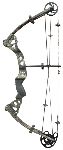 | 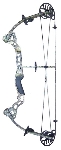 |  |
| Brace Height | 8 " | 8.5 " | 8.75 " |
| AtA Length | 28.875 " | 31.75 " | 29.5 " |
| Draw Length | 25 " - 30 " | 27 " - 31 " | 26 " - 30 " |
| Draw Weight | 40 lbs - 70 lbs | 40 lbs - 70 lbs | 50 lbs - 70 lbs |
| IBO Speed | 309 fps - 317 fps | 299 fps - 315 fps | 292 fps - 300 fps |
| Weight | 2.813 lbs | 3.8 lbs | 3.3 lbs |
| Let-Off | 65% - 80% | 65% - 80% | 65% or 80% (adj) |
| Where to buy Best prices online | |||
| compare more bows | |||
All three are compact, value-tier single-cam hunters from the same early-2000s window, and a buyer shopping that corner of the market genuinely cross-shopped them - the BlackHawk-versus-Firestorm matchup was a real debate on the hunting forums of the day. The Bowtech Tomkat is the in-house sibling and the natural first comparison: it shares the InfinityCam and the sub-$500 positioning (listed at $479 in the 2004 BowTech catalog) but runs a longer 31.75-inch frame and a taller 8.5-inch brace, trading the BlackHawk's pack-light handiness for a steadier, more forgiving hold - the pick for a shooter who wants a BowTech value bow but shoots better off a longer riser. The PSE Firestorm comes at it from another brand with the same idea executed softer: a 29.5-inch frame and a generous 8.75-inch brace make it the most forgiving of the three to shoot, though its 292-to-300 fps rating and 50-to-70-pound range give up a little speed and the low-poundage flexibility the BlackHawk gained in 2003. Against both, the BlackHawk is the smallest, lightest, and fastest of the trio, and the one owners most often praised as dead in the hand. The decision comes down to priorities: the BlackHawk for the hunter who values a pocket-sized, quick, low-shock treestand bow above all; the TomKat or the PSE Firestorm for the shooter who will trade a few feet per second and a few inches of maneuverability for the steadier aim a longer frame and taller brace deliver.