
Bowtech Justice Review


from $275
Pros
- Quiet, low-vibration shot - Orbit Dampeners settle the riser fast and the bow shoots dead in the hand
- FlipDisc comfort-to-performance modules flip the draw from smooth to aggressive, adding a few fps with no module to buy
- Comfortable low-torque grip that shooters rank with the best in the class, right alongside an Elite
- Forgiving 6.875-inch brace and a light 4.3-pound mass make it an easy bow to hold steady from a treestand
- Proven Bowtech binary-cam build with a dry-fire-resistant limb design, at the entry price of the 2024 lineup
Cons
- No DeadLock cam or yoke tuning here - tuning is the traditional shim-and-press route, so shooters who want click-adjust flagship tuning should step up to the Core SR
- Fixed riser grip with no interchangeable-grip system - owners who like swapping grip shapes can fit an aftermarket grip or side plates to dial in the feel
- Tuned for comfort over raw speed, so hunting-arrow speeds land in the mid-250s to high-270s fps - buyers chasing maximum flat-shooting range may want a faster flagship
Video
content from YouTube
Editors' review
The Justice answers a simple question: what is the cheapest way into a real Bowtech? At $1,099 it was the entry point of Bowtech's 2024 lineup, sitting a full $300 under the Core SR and SS and $700 under the Carbon One X - and unlike those flagships, it never appeared in the glossy print catalog. Instead of the newest DeadLock hardware, it leans on proven, older Bowtech engineering: a Synchronized Binary Cam, Dual Lock limb pockets, and past-parallel split limbs that have been quietly working on the brand's bows for years. The result is a bow that shoots like a Bowtech but skips the flagship price and the flagship tuning frills. It is a hunting bow first - 50 to 70 pounds, a forgiving near-seven-inch brace, and a light 4.3-pound mass built for the treestand rather than the target line. Think of it as the deer-woods Bowtech for the shooter who wants the brand's quiet, comfortable shot without paying for the parts a flagship needs and a hunter rarely touches.
Finish
The Justice ships in four finishes that cover the range from disappear-in-the-timber to matte-tactical: Mossy Oak Country DNA for hunters who want a full camo pattern, plus three solids - Black, OD Green, and Smoke Gray. The Country DNA pattern is the same modern high-contrast Mossy Oak treatment Bowtech uses across its hunting line, breaking up the riser against bark and brush. The three solids read cleaner and more understated, and OD Green in particular gives a subdued, non-camo look that still vanishes at the edge of a field. Coverage is even across the machined riser cutouts and the limbs, and the poundage is printed right on the bottom limb - a small, practical touch that tells you at a glance what the bow is set at. Every finish carries the same price; there is no camo upcharge on this model.Riser
The riser is machined aluminum with an aggressive skeletonized cutout pattern that pulls weight out of the middle of the bow, which is a big part of why the finished rig comes in at a light 4.3 pounds. This is a value chassis, so it does without the flagship extras - there is no DeadLock cam-adjust hardware and no flex or roller guard system, just a clean, rigid platform built around the Dual Lock limb pockets. Those pockets clamp the limb so the riser, pocket, and limb behave as a single unit, which is the foundation of the bow's accuracy and its solid, repeatable back wall. Cable containment is handled by a straightforward rod rather than a roller guard, keeping cost and complexity down. Reflex geometry and the near-seven-inch brace height give the bow a stable, forgiving feel at full draw. It is an honest, no-frills riser - the money went into how the bow shoots, not into hardware most hunters never adjust.Grip
The grip is one of the quiet highlights of this bow. It is a fixed grip integrated into the riser - no interchangeable-grip system like you get further up the Bowtech line - but the shape itself is excellent: narrow, low-torque, and comfortable enough that shooters rank it with the best grips on the market and put it right next to an Elite for feel. In my experience a grip this thin is where cheaper bows usually give themselves away, and the Justice does not; the hand sits naturally into the throat with no forced wrist angle and very little torque encouraged into the shot. The trade-off is flexibility: if you like swapping grip shapes or side plates the way flagship owners do, you will not find that option here without going aftermarket. For most hunters, though, a grip that is simply comfortable out of the box matters more than a grip you can reconfigure, and this one delivers.Limbs
The Justice uses past-parallel split limbs seated in the Dual Lock pockets, and it is a limb design with real history on Bowtech's bows. The axles mount to the tips of the limbs rather than passing through the center of the limb, which meaningfully lowers the risk of a cracked limb in the event of a dry-fire - a genuinely useful margin of safety on a bow aimed at buyers who may be newer to the brand or to archery. The limbs are available in three peak draw weights - 50, 60, and 70 pounds - each adjustable ten pounds down from peak, covering everything from a lighter-drawing hunter to a full 70-pound whitetail-and-bigger setup. A witness window lets you see how much thread is left in the limb bolt, so you always know where you stand on the adjustment range. Drawing this at 60 pounds I found the limbs stored energy smoothly and predictably, with no harshness stacking up near the wall. The square limb edges can chip if you bang them against a stand or a rock, so a little care in the field pays off, but structurally this is a stout, forgiving limb system.Eccentric System
The heart of the Justice is a Synchronized Binary Cam - two cams slaved to each other rather than to the limbs, so the system self-corrects its timing and holds tune through shooting cycles, the "set it and forget it" trait Bowtech built its reputation on. Layered on top is the FlipDisc module, and this is the feature that punches above the price: a rotating disc on the cam lets the shooter flip between a smooth "comfort" draw and a more aggressive "performance" setting that adds about five feet per second, without buying separate modules the way some competitors require. Marketing IBO is 326 fps, but the real story is what it does with a hunting arrow. On a chronograph at 28 inches, 61 pounds, and a 410-grain arrow, the bow ran 251 fps in comfort mode and climbed toward 260 in performance; step up to 70 pounds at a 29-inch draw and it posted 288 fps with a lighter arrow and 273.7 fps with a hunting shaft. Those are honest, deer-woods numbers - not a speed-bow, but plenty for typical whitetail ranges. Let-off is listed at 85 percent, though hands-on it feels lighter still - the bow holds only around six and a half pounds at a 68-pound peak, a relaxed wall that is easy to settle into for a long sit. Draw-length adjustment covers 25.5 to 31 inches in half-inch increments. Tuning is where the value shows - without a DeadLock cam you tune the traditional way, with shims and a press, rather than dialing the cam left and right by hand.Draw Cycle/Shootability
Drawing the Justice, the front end starts firm and then rolls into a gentle, gradual let-off rather than dumping into the valley - there is no sharp hump to fight through, which is exactly what you want on a cold morning when your muscles are stiff. What struck me most is how solid the back wall is for a value bow: the draw stop hits a defined, repeatable position with no mush, giving you a consistent anchor shot after shot. In comfort mode I found the cycle genuinely easy - a 60-pound setting drew like something lighter, easy enough that a shooter who struggles with an aggressive 350-fps flagship cam will pull this all day without strain. Flip to performance and the ramp gets a touch more assertive in exchange for the speed bump, so you can tune the feel to your own strength. The shot itself is the payoff: Orbit Dampeners kill the vibration so thoroughly that the bow sits dead in the hand, quiet and still, with the arrow hitting the target about the time the bow finishes settling. This is where the Bowtech DNA is unmistakable - the Justice may be the cheapest bow in the family, but it shoots with the calm, low-hand-shock signature the brand is known for.Usage Scenarios
The Justice is a whitetail-and-general-hunting bow through and through. Its forgiving near-seven-inch brace, light 4.3-pound mass, and quiet shot make it a natural treestand and ground-blind companion, where a bow you can hold steady one-handed while a buck works closer matters more than raw speed. Picture a hunter who is stepping up from an entry rig to their first premium-brand bow: they can walk into a Bowtech dealer, have the Justice set to their draw and poundage on the spot - no proprietary press gymnastics required - and be shooting broadhead groups the same week. Its 50-to-70-pound range and 25.5-to-31-inch draw cover the vast majority of adult hunters, from a lighter-drawing shooter at 40 pounds effective up to a full 70-pound elk-capable setup, though at hunting-arrow speeds in the 250s to 270s it is happiest inside typical whitetail distances rather than reaching way out. It also makes a smart backup bow for a Bowtech owner who wants the familiar grip and cam feel in a second, less-expensive rig. Where it is not aimed is the tournament speed-race - this is a comfort-and-quiet hunting tool, not a flat-shooting 3D specialist.Versions
The Justice is sold as a single bow-only model - there is no RTH package or electronics SKU - at a $1,099 launch MSRP, which made it the most affordable bow in Bowtech's 2024 lineup. The only choices at purchase are the three peak draw weights (50, 60, or 70 pounds), your draw hand (right or left), and one of the four finishes (Mossy Oak Country DNA, Black, OD Green, or Smoke Gray). Every configuration carries the same price and the same specification; there is no premium finish or upgraded-cam variant. Buyers build their own setup from there, adding a rest, sight, and stabilizer to taste, since the bow ships as a bare platform rather than a ready-to-hunt kit.Bowtech Justice vs Hoyt Torrex, Elite Kure
| Bow | Bowtech Justice | Hoyt Torrex | Elite Kure |
| Version | 2024 | 2021 | 2020 |
| Picture | 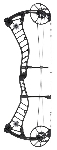 |  |  |
| Brace Height | 6.875 " | 7 " | 6.563 " |
| AtA Length | 31.5 " | 30.75 " | 31.813 " |
| Draw Length | 25.5 " - 31 " | 26 " - 30 " | 23 " - 30 " |
| Draw Weight | 40 lbs - 70 lbs | 30 lbs - 70 lbs | 30 lbs - 70 lbs |
| IBO Speed | 326 fps | 327 fps | 265 fps - 335 fps |
| Weight | 4.3 lbs | 3.8 lbs | 4.6 lbs |
| Let-Off | 85% | 80% | 70% - 90% |
| Where to buy Best prices online | |||
| compare more bows | |||
The Justice occupies a clear slot - a real hunting bow from a premium brand, without flagship money - and two cross-brand bows frame the decision. The Hoyt Torrex is the closest philosophical twin - Hoyt's value hunting bow, an IBO near-match at 327 fps versus the Justice's 326, with a similar 30.75-inch axle-to-axle and a 7-inch brace - but it launched far cheaper, in the sub-$600 range, and gives up the FlipDisc comfort/performance trick and the Orbit-damped, dead-in-the-hand shot the Bowtech is known for. If your budget is tighter and you want a proven premium-brand hunting bow for the least money, the Hoyt Torrex is the play. The Elite Kure comes at the decision from the other side: it launched right around the Justice's $1,099 and is a more adjustable, more feature-rich hunting bow, with an adjustable let-off from 70 to 90 percent and a broader 23-to-30-inch draw range that fits more shooters, plus Elite's own reputation for a smooth draw. Where the Justice keeps things simple and comfortable, the Elite Kure hands you more knobs to turn for the same outlay. The decision comes down to priorities: the Hoyt Torrex for the buyer who wants premium-brand hunting performance at the lowest price, the Elite Kure for the buyer who wants maximum tunability at the same money, and the Justice for the shooter who specifically wants Bowtech's quiet, comfortable shot and set-and-forget binary cam without paying for a flagship.