
Mathews Lift 33 Review


from $900
Pros
- Won the decibel-meter shootout on multiple independent tests, reading about 73 dB three feet from the shot - quieter than the V3X and Halon X and about as dead-in-hand as a hunting bow gets
- Drives real hunting speed off an easy draw - 310 fps with a 400-grain arrow and 292 fps with a 450 at 70 lb / 30 inch, from one of the smoothest speed-bow draws Mathews has built
- Genuinely light for aluminum at roughly 4.3 pounds, undercutting many carbon rivals while giving the long riser more mass to plant the pin
- The 33-inch riser runs nearly the full axle-to-axle length, so the bow holds like a target rig - the pin floats and settles instead of chasing the target
- SwitchWeight-X modules set draw length, poundage, and let-off together, so one bow spans 55 to 80 pounds and shifts fit season to season without a re-limb
Cons
- Some early-2024 RPD limbs splintered - Mathews' indefinite pass-down warranty covers the limbs even on a used bow, swaps the full set in about a week or two, and reports the fault resolved on current production, so new or used is protected
- The valley is a touch short and the cam wants to keep going, so pull-through shooters staying leaned into the firm wall are rewarded - anyone who likes a long, relaxed valley may want to shoot one first
- The stock Engage grip is rounded and full for a performance bow - some owners swap to Mathews side plates or an aftermarket grip, an easy, inexpensive change if the factory shape does not suit your hand
Video
content from YouTube
Editors' review
Mathews built a 33-inch aluminum bow that weighs what a carbon bow weighs, holds like a target bow, and shoots quieter than anything in its class - and then charged less than a carbon flagship for it. That is the Lift 33 in one line. Where the shorter Lift 29.5 is the compact, quick-handling half of the 2024 platform, the 33 is the do-everything member: a longer riser that plants the sight picture, a brand-new SwitchWeight-X cam that pulls easily yet posts real speed, and the RPD limb system that leaves the riser stone dead the instant the arrow is gone. The headline is the sound - on independent decibel meters the Lift 33 came in the quietest bow on the bench, several dB under bows that normally win those tests. It draws smoother than the 29.5 because the added length eases the cam over the top, and it settles against a rock-firm wall that pull-through shooters live for. It is aimed squarely at the accuracy-minded hunter who wants forgiveness, silence, and a long-riser hold in a package light enough to carry all day. There is one honest wrinkle in the story - an early limb episode - and Mathews answered it with a warranty that is worth reading before you dismiss the bow.
Finish
The Lift 33 ships in a generous twelve-finish menu for a flagship. Three solid colors anchor the line - Black, the new-for-2024 Earth (a warmer brown than the prior Granite), and Granite itself in a muted gray. Camo shoppers pick from First Lite Specter, GORE OPTIFADE Elevated II, GORE OPTIFADE Subalpine, and a retro Mossy Oak Bottomland for the traditionalists. The genuinely new option is the Fade-to-Black series, which starts solid up top and transitions to black down through the lower riser and limb - offered as Earth/Black, Granite/Black, and Green Ambush/Black. On a riser this long the fades read especially clean, and the solid Earth and Granite show off the machining. Mathews' Bow Builder program extends the personalization to riser and limb accents for anyone who wants a one-off. Anodizing quality is consistent with the rest of the Mathews line and wears well across hard seasons. It is more solid-color latitude than most rivals hand you, and the fade series gives the platform a look that is unmistakably its own.Riser
The riser is the reason the Lift 33 exists. Mathews machined it so long that it measures roughly 33.5 inches to the limb-pivot - about 101 percent of the axle-to-axle length, squarely in target-bow territory - and because accuracy tracks with riser length, that is where the bow's dead-steady hold comes from. Pushing the string farther from the grip's pivot means small hand movements move the bow less at the shot, so the pin simply wanders less than it does on a shorter chassis. What is remarkable is that they hollowed so much aluminum out of that long riser that the bare bow still comes in around 4.3 pounds, lighter than many carbon rivals of the same size. Setting one up, I found the long riser does much of the aiming work for you - the sight picture plants and holds rather than drifting. It carries forward the integrated Mathews kit: the Bridge-Lock dovetail channel that swallows a compatible sight through the riser centerline, a Bridge-Lock stabilizer cutout, an integrated dovetail rest mount, and Center Guard cable containment that keeps vane clearance clean through the draw. A new axle-over-limb assembly suspends the axle on a machined block above the limb rather than drilling through its side, cutting failure points and giving the limb more work surface. This is a riser engineered to hold, and it does.Grip
The Lift 33 wears Mathews' Engage grip, a rounded, textured panel seated centered in the riser and - new for this platform - built to accept the Shot Sense electronics puck that reads level, torque, and shot count back to a phone app. Centered placement makes finding the same hand reference easy shot to shot, and it pairs naturally with the bow's steady-hold personality. The one honest quibble that repeats across owners is the profile: the Engage grip is fuller and more humped than some shooters want from a performance bow, and a few find it harder to index a perfectly repeatable hand than a flatter grip would allow. That is subjective and easily solved - Mathews' own side plates strip the panel down to a thin, low-torque surface, and a host of aftermarket grips fit the platform for anyone who wants more fill, a squarer edge, or different texture. The narrow, warm rubber suits medium and smaller hands and rewards a relaxed, torque-free hold, which is exactly what a long-riser bow wants. For most hunters the factory grip needs nothing more than a session of letting the bow sit in the hand. Grip feel is the most personal thing on any bow, and this platform makes changing it trivial.Limbs
The Lift 33 runs Mathews' RPD - Resistance Phase Damping - limb system: an eight-limb design, four per end, sandwiched on an elastomer core that kills vibration and sound right at the source before it reaches the riser. The limbs sit heavily preloaded and well beyond parallel, curling inward at full draw so recoil largely cancels itself, which is a big part of why this bow feels so dead after the shot. Peak weight is set through the cam module rather than by backing off limb bolts, so the limbs stay in their efficient range at full draw across the whole 55-to-80-pound span. Honesty requires noting that a number of early-2024 Lifts had RPD limbs splinter or crack in service; Mathews did not recall the bow but instead extended an indefinite, transferable pass-down warranty that covers the limbs even on a used bow, replaces the full limb set on a claim, turns most claims around in roughly a week or two, and states the fault is resolved on current production. In practice that makes the limbs the best-protected part of the bow - the warranty follows the limbs, not just the first buyer. The eight-limb RPD architecture itself is the original Lift limb; the 2025 Lift X later moved to the ARC7 limb, but on this 2024 bow the RPD-plus-warranty package is what you own. It is a limb system with a real history behind it and a warranty built to stand behind it.Eccentric System
The Lift 33 introduces Mathews' SwitchWeight-X cam, a larger-circumference, oval-ish eccentric that replaces the long-running SwitchWeight (old modules do not carry over). A single module sets draw length, let-off, and peak weight together, so reconfiguring fit or poundage is a module swap rather than a re-limb - and the poundage steps run 55, 60, 65, 70, 75, and 80 pounds, a rare factory 80-pound option in a bow this smooth. Let-off is offered at 80 or 85 percent; on 85-percent mods a drawboard reads a holding weight near 13.4 pounds, which works out closer to 81-82 percent in practice. The IBO rating (the industry chronograph standard at a fixed 30-inch, 70-pound, 350-grain setup) is up to 343 fps, and unusually for Mathews the cam actually lives up to it: on the chronograph the Lift 33 posted 332 fps with a 350-grain arrow at 30 inches and 70 pounds, the fastest ATA-spec reading on one tester's entire bench, then 310 fps with a 400-grain arrow and 293 fps with a 450 - genuine hunting speed from a draw this easy. GoHunt's chronograph tracked the same story down through heavy shafts, 296 fps with a 460-grain arrow and 283 with a 507 at 80-percent let-off. Draw-length changes still run through the top-hat system on the axle, so a draw change is a dealer job rather than a tool-free rotation. For a hunter who wants a forgiving, quiet bow without surrendering real velocity, this cam is a genuinely well-judged balance of speed and smoothness.Draw Cycle/Shootability
Drawing the Lift 33 is where the length pays off. The SwitchWeight-X cam weighs up a touch early - it stacks slightly in the first quarter - then rolls over more gently than the shorter Lift 29.5 does, because the added axle-to-axle length and the longer riser ease the transition rather than dumping abruptly into the valley. That valley is honest but a little short: the cam wants to keep going, so this is a bow for the shooter who leans into the wall and breaks the shot, not one who parks in a long, lazy valley. The back wall itself is superb - rock-firm, with maybe a millimeter of give under a hard pull, the kind of cable-stop wall pull-through shooters live for. Then comes the part that wins it awards: on independent decibel meters the Lift 33 read about 73 dB three feet from the bow, several dB under the fleet it was tested against and quieter than both the V3X and the Halon X, with the RPD limbs and riser cutouts leaving the riser stone dead the instant the arrow leaves. Shooting mine, I noticed the arrow hitting the target before the bow had fully finished settling - it is that quiet and that still. Post-shot vibration on the meter came in low for a bow this light and this long, which is the harder trick, since long light bows usually buzz more. Combined with the long-riser hold, the Lift 33 is a bow you settle on target, break cleanly, and barely hear.Usage Scenarios
The Lift 33 is the accuracy hunter's Lift. Picture a whitetail hunter in an open hardwood setup with a 40-yard lane: the long riser floats the pin, the shot arrives before the deer can react, and the whole rig is quiet enough that a second animal in the group never flinches. It shines for the western hunter glassing across a canyon and settling in for a steady, longer poke, where the forgiving hold and real 290-plus-fps hunting speed flatten the trajectory and the light weight keeps it easy on the pack across miles of country. The 80-pound module option makes it a legitimate pick for the hunter chasing elk or bigger who wants extra penetration insurance without giving up the smooth draw. It is a natural one-bow answer for the shooter who also runs summer 3D leagues, since the steadiness that helps on foam helps on game. With a heavy hunting arrow it covers whitetail, mule deer, antelope, black bear, and elk at honest bowhunting ranges. It is less ideal for the hunter squeezing into a cramped box blind or pushing through the thickest timber, where the shorter Lift 29.5 tucks in better, and its 26-inch draw floor rules out the very shortest-draw archers. For the shooter who values a dead-steady, silent hold above all, it is close to ideal.Versions
The Lift 33 is sold as a single bow configuration at a $1,429 launch MSRP; there is no separate package tier - you pick a finish and a SwitchWeight-X module for your draw length and poundage, and the bow is the bow. Draw weight is chosen at purchase via the module (55, 60, 65, 70, 75, or 80 pounds) and can be changed later with a mod swap rather than a new SKU, and let-off is set by choosing 80- or 85-percent mods. Within the family, the shorter Lift 29.5 ($1,329 launch) is the compact 29.5-inch sibling - same platform, same cam family, tighter and lighter for close-quarters and shorter-draw shooters - and it is the natural cross-shop for anyone who does not need the 33's longer hold. Looking forward, the 2025 Lift X 33 is the successor that added press-free Limb Shift tuning, the ARC7 limb, and the BOND grip; buyers who specifically want those upgrades should price the newer bow, while those after the original quiet, light, hold-focused 33 at its lower street price are exactly who this 2024 model still fits. All finishes carry the same price, so the choice among the twelve colors and the fade series is purely aesthetic.Mathews Lift 33 vs Hoyt Ventum Pro 33 and PSE EVO NXT 33
| Bow | Mathews Lift 33 | Hoyt Ventum Pro 33 | PSE EVO NXT 33 |
| Version | 2024 | 2022 | 2020 |
| Picture | 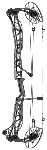 |  |  |
| Brace Height | 6.5 " | 6.375 " | 7 " |
| AtA Length | 33 " | 33 " | 33 " |
| Draw Length | 26 " - 31.5 " | 26 " - 31 " | 26.5 " - 32 " |
| Draw Weight | 45 lbs - 80 lbs | 40 lbs - 80 lbs | 40 lbs - 80 lbs |
| IBO Speed | 343 fps | 334 fps | 314 fps - 322 fps |
| Weight | 4.26 lbs | 4.67 lbs | 4.5 lbs |
| Let-Off | 80% or 85% | 80% or 85% | 80% - 90% |
| Where to buy Best prices online | |||
| compare more bows | |||
Among longer, forgiveness-first aluminum flagships, the Lift 33's closest cross-shops are the Hoyt Ventum Pro 33 and the PSE EVO NXT 33 - all three built on 33-inch axle-to-axle chassis for a steady, target-style hold. They bracket a real price band: the PSE EVO NXT 33 is the value pick at $1,099 launch, the Hoyt Ventum Pro 33 sits at $1,349, and the Lift 33 tops them at $1,429. On speed the Lift leads: its 343 IBO and real 310-fps-with-a-400-grain chronograph reading beat the Hoyt Ventum Pro 33's 334 IBO and clear the PSE EVO NXT 33's 314-to-322 rating by a wide margin, so the Mathews gives up the least velocity to get its forgiveness. The Hoyt Ventum Pro 33 is the near-twin in mission - a 6.375-inch brace and aim-first aluminum riser put it a hair behind the Mathews on both speed and hold - so the choice there comes down to Mathews' class-leading quiet and lighter mass versus Hoyt's HBX rail accessory system and slightly different grip feel. The PSE EVO NXT 33 comes at forgiveness from the extreme end: its 7-inch brace height is the most forgiving of the three and its price is the friendliest, but it gives up real speed, making it the pick for a shooter who prizes a stress-free, ultra-stable shot over velocity and wants to spend the least. Against both, the Lift 33's signature is combining the quietest shot on the bench with the lightest weight and the most speed. The decision comes down to priorities: the Lift 33 for the hunter who wants silence, light weight, and speed together, the Hoyt Ventum Pro 33 for a near-identical mission on Hoyt's platform, and the PSE EVO NXT 33 for maximum brace-height forgiveness at the lowest price.