
Mathews Lift RS Review


from $64.99
Pros
- Genuinely fast for its size - real chronograph readings hit 312 fps with a 434-grain arrow at a 28-inch draw, rare speed for a 27.75-inch bow
- Extremely compact and light at 3.92 pounds, among the lightest bows made, ideal for saddle hunting, treestands, and tight box blinds
- Groups tightly at distance despite the short 27.75-inch frame and 5.5-inch brace - holds well and prints small groups out to 60 yards
- Two limb sets widen the fit - lightweight 41 to 60-pound limbs bring youth, women, and short-draw adults onto a full Lift riser; standard limbs reach 80 pounds
- Press-free Limb Shift tuning gets a bare bow to a bullet hole with a wrench, no bow press needed
Cons
- Draw length caps at 29 inches - a hard fit boundary, so longer-draw shooters should step up to the Lift X 33 or the long-draw Lift XD instead
- The BOND grip is hand-fit dependent - some shooters love it, others prefer a flatter aftermarket grip like the UltraView B-Real 2.0, so try the three profiles first
- Slightly livelier in the hand after the shot than the longer, heavier Lift models - a normal trade for a sub-4-pound compact, and a heavier stabilizer setup settles it
Video
content from YouTube
Editors' review
Short bows are supposed to be twitchy. The conventional wisdom says a compact axle-to-axle and a low brace height buy you speed at the cost of forgiveness, and that a bow this small will punish a rushed release. The Mathews Lift RS spends its whole existence arguing the opposite. This is the compact, short-draw member of the 2025 Lift X family - a 27.75-inch axle-to-axle bow (the tip-to-tip cam distance that governs balance and maneuverability) weighing a scarcely believable 3.92 pounds, one of the lightest hunting bows on the market. It carries the entire Lift X platform - the press-free Limb Shift tuning, the redesigned ARC7 limbs, the deep Bridge-Lock accessory integration - and points all of it at the shooter who wants speed in the smallest possible package. Mathews rates it up to 353 fps, and it earns the "RS" the way a shooter earns a reputation: quietly, then all at once. It also does something the spec sheet does not advertise - it groups. For the saddle hunter, the box-blind whitetail chaser, and the short-draw archer who has always been handed a compromise, this little bow is the rare one built specifically for them.
Finish
The Lift RS comes in eleven finishes, all priced identically - the pattern you choose is about your hunting ground, not your budget. The solids run Black, Earth, and Shale, with Green Ambush for a green-forward palette. The camo and partner patterns cover the range of terrain: Mossy Oak Bottomland for early-season timber, KUIU Verde and Sitka OptiFade Subalpine for open western country, and First Lite Specter as an all-purpose concealment pattern. Three Fade-to-Black options - Shale, Earth, and Green Ambush each dissolving into black at the limbs - give the compact riser a striking two-tone look that has become a signature on the Lift line. The anodized-and-dipped coating is standard Mathews durability, made to shrug off a season of being packed in and out of a treestand. On a bow this small and this often carried, the finish holds up where a hunting bow gets handled most, and every pattern shares the same coating quality.Riser
The riser is a study in subtraction. To get to 3.92 pounds on a 27.75-inch frame, Mathews skeletonized the machined-aluminum riser aggressively and shortened everything it could, and the result is a bow that feels feather-light and balances better in the hand than its numbers suggest. The Bridge-Lock system routes the sight and stabilizer through the riser rather than bolting them off the front, which matters even more on a short bow - it keeps mass centered instead of hanging it out where a compact frame would feel nervous. There is one honest consequence of the small riser: it is too short to carry a rear stabilizer grommet, so shooters who run a back bar mount it off the Bridge-Lock hardware instead of a dedicated rear boss. It is a different setup, not a worse one, and most compact-bow shooters will never miss the rear mount. The XO limb legs - small feet that let the bow stand on its limbs instead of its cams - are a genuine convenience in a box blind, letting you set the rig down without laying it in the dirt.Grip
The BOND grip is a three-profile system, swappable inserts wrapped in textured polymer with a firmer surround and a relieved thumb cutout that Mathews reshaped after early customers flagged a hotspot on the pre-release version. Reaction to it is genuinely split, and buyers should go in knowing that. Some shooters rate it among the most comfortable grips they have ever held; others find it a touch high or prone to roll and swap to a flatter aftermarket grip such as the UltraView B-Real 2.0, which still drops onto these new Mathews risers with a simple friction fit. In my experience that divide comes down almost entirely to hand size and where a shooter likes the pressure to sit - it is a fit question, not a quality one. The practical advice is to shoot all three BOND profiles before deciding, and to know that if the stock grip is not your hand, the swap is quick and inexpensive rather than a dealbreaker.Limbs
The RS rides ARC7 limbs, Mathews' redesigned limb built on a new material and a multi-step production process the company calls more durable and more efficient through the load sequence than anything it had built before. That matters for a specific reason: the 2024 Lift saw isolated limb-cracking reports, and Mathews answered with both the new ARC7 build and rewritten warranty guidelines that cover any affected owner - early hands-on feedback points to the issue being resolved rather than repeating. The more interesting story here is the two limb families. The standard limbs peak at 55, 60, 65, 70, 75, or 80 pounds; the lightweight limbs peak at 41, 45, 49, 52, 56, or 60 pounds, and that lower set is what makes the RS quietly important. Ordered with the 41-pound limbs, the bow reaches down into the low-30-pound draw-weight and short-draw territory that used to require the discontinued Mathews Prima - meaning youth, smaller-framed, and lower-poundage shooters get a full Lift riser instead of a stripped-down starter bow.Eccentric System
The RS runs the SwitchWeight X cam, tuned here for shorter draws, and it is the engine behind the "racing speed" name. It is module-based: draw weight swaps in 5-pound steps, and let-off (the percentage of peak weight the holding weight drops to at full draw) sets to 80 or 85 percent by module, with draw length adjusting from 23.5 to 29 inches. Mathews rates the bow up to 353 fps and de-rates it to 343 fps at the top 29-inch draw, and the real-world numbers land where a fast compact should: at a 28-inch draw and near 80 pounds, one build measured 312 fps with a 434-grain arrow, while a 70-pound, 28.5-inch setup running a heavier 448-grain arrow logged 287.9 fps - noticeably quicker than the longer Lift X 33 on the same test. Drop into the lightweight limbs and the range opens the other way: a 60-pound, 20.5-inch configuration still delivered 240 fps with a hunting-weight arrow. The 29-inch draw ceiling is the one hard rule of this cam - it is optimized for short draws, and it is not the bow for anyone who draws longer. Within its window, though, it is one of the fastest small bows you can buy.Draw Cycle/Shootability
Here is the part that surprises people. A 27.75-inch bow with a 5.5-inch brace has every reason to feel harsh, and the draw does run a touch firmer than the longer Lifts - there is a bit of a hump and a little stacking on the back half as the fast cam builds energy, and the valley is short in classic Mathews fashion, so staying engaged on the back wall matters. But the shot itself is where the RS makes its case. Drawing and holding it, what struck me is how steady a bow this small sits: shooters consistently report printing tight groups out to 60 yards, arrows tracking flat and true, with a hold that behaves nothing like the twitchy reputation short bows carry. At lower draw weights on the lightweight limbs the draw smooths out considerably - one shop demo through a 60-pound setup described barely feeling the cam roll over at all. There is a little more life in the hand after the shot than you get from the longer, heavier Lift X 33, which is simply the physics of a sub-4-pound bow, and a heavier stabilizer setup damps most of it out. The overall impression is a fast, honest bow that rewards a shooter who stays disciplined on the wall - and then puts the arrow exactly where it was aimed.Usage Scenarios
The RS is built for the shooter who wants to disappear into tight spaces. Its natural home is the whitetail woods: saddle hunters and treestand hunters who need a bow that swings clear of branches and platform straps, and box-blind hunters who want something short enough to maneuver through a window. Picture the Saturday-morning saddle hunter climbing 25 feet with a 3.92-pound bow clipped to the pack - the weight simply disappears, and the 27.75-inch frame turns cleanly inside a cramped setup. It is also, importantly, the answer for short-draw archers who have spent years on bows that never quite fit: the 23.5-to-29-inch range and the lightweight limb set make it a real hunting bow for smaller-framed shooters, women, and youth moving up from a starter rig, without dropping them onto a toy. It suits the shooter who values maneuverability and speed over the last ounce of dead-in-hand calm, and who does most of their shooting inside 60 yards. It is emphatically not a long-draw bow - anyone over 29 inches should look at the Lift X 33, and true long-draw archers at the Lift XD. Know your draw length first; if you are short-to-average and want compact speed, few bows fit the brief this well.Versions
The Lift RS is sold as a single model at a $1,399 launch MSRP, identical across all eleven finishes - the pattern does not change the price. There is no Ready-to-Hunt package; Mathews sells the bow and layers its Bridge-Lock accessory ecosystem (sight, stabilizer, quiver, XO limb legs) separately. The one real configuration choice is the limb set: standard 55-80-pound limbs for full hunting power, or lightweight 41-60-pound limbs for short-draw, lower-poundage, youth, and women shooters - the same riser either way. Within the wider 2025 Lift family, the RS is the compact / short-draw specialist: the Lift X 29.5 and Lift X 33 cover standard draws in 29.5-inch and 33-inch frames, while the Lift XD serves long-draw archers out to 33.5 inches. All share the same Limb Shift Technology, ARC7 limbs, BOND grip, and integration hardware - the RS simply packs it into the smallest, lightest, fastest-per-inch chassis in the line. Within the family, the choice is made by your draw length and how compact you want the bow.Mathews Lift RS vs Hoyt Ventum Pro 30, Bowtech SR350
| Bow | Mathews Lift RS | Hoyt Ventum Pro 30 | Bowtech SR350 |
| Version | 2025 | 2022 | 2023 |
| Picture | 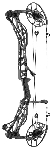 |  |  |
| Brace Height | 5.5 " | 6 " | 6 " |
| AtA Length | 27.75 " | 30 " | 33 " |
| Draw Length | 23.5 " - 29 " | 25 " - 30 " | 25 " - 30 " |
| Draw Weight | 41 lbs - 80 lbs | 40 lbs - 80 lbs | 40 lbs - 70 lbs |
| IBO Speed | 353 fps | 342 fps | 350 fps |
| Weight | 3.92 lbs | 4.45 lbs | 4.4 lbs |
| Let-Off | 80% or 85% | 80% or 85% | 85 / 87% |
| Where to buy Best prices online | |||
| compare more bows | |||
Placed against the two aluminum flagships a compact-speed shopper cross-shops, the RS's identity gets sharp. The Hoyt Ventum Pro 30 is the compact-forgiving pick at a $1,249 launch MSRP: a 30-inch frame, 6-inch brace, and 342 IBO make it steady and easy to shoot, but at 4.45 pounds it is the heaviest of the three and the longest-braced-shooter's comfort choice. The Bowtech SR350 is the speed benchmark at a $1,299 launch MSRP: a 33-inch bow rated up to 350 IBO, fast and stable but the least compact of the group. The Mathews Lift RS undercuts both on the two numbers that define a compact hunting bow - it is the shortest at 27.75 inches and the lightest at 3.92 pounds - while its 353 IBO actually edges the SR350's speed, and its lightweight limb option reaches down to 41 pounds and the low-30s draw weights that neither rival offers. The decision comes down to priorities: the Hoyt Ventum Pro 30 for the shooter who wants maximum forgiveness and does not mind the weight, the Bowtech SR350 for the shooter who wants speed on a longer, steadier 33-inch frame, and the Mathews Lift RS for the saddle-and-treestand hunter who wants the fastest, lightest, most maneuverable bow of the three and fits inside its 29-inch draw ceiling.