
Bowtech MightyMite Review


from $200
Pros
- Genuinely compact and light - a 301/2-inch axle-to-axle on the VFT version at roughly 31/2 pounds slips through a treestand or climber where a full-size bow fights you
- Fast for its footprint - owners clock a hunting-weight arrow near 306 fps at 70 pounds, plenty flat for whitetail ranges from a bow this short
- Real 60-70 pound hunting power in a short-draw-friendly 25-30 inch range - a full-power bow that actually fits a smaller-framed or short-draw adult
- Consistently described by owners as quiet, accurate and easy to shoot, on both the InfinityCam original and the VFT redesign
- VFT-era laminated wood grip runs narrow and fills a smaller hand well, a real upgrade over the plain factory grip of the earlier years
Cons
- Aggressive cam with a firm, sudden back wall - the valley is short and the wall arrives fast, so shooters coming off a smooth single-cam should shoot one first and use the adjustable draw stop to soften the let-off
- Some hand shock and a bit of "thud" on the bone-stock VFT bow - owners report it tunes out almost completely with a set of limb dampers, worth budgeting a few dollars for if you step down from a flagship-quiet bow
Editors' review
The Mighty Mite is one of the few hunting bows named after a person - specifically after BowTech CEO John Strasheim's grandson, born three and a half months premature at one pound five ounces in 1998, whom the NICU nurses nicknamed "Mighty Mite" for a will to live that defied the odds. The bow lives up to the name: it is one of the smallest bows BowTech ever built, and it hits like something much larger. Where most short bows of the early 2000s asked you to trade power and speed for a compact frame, the Mighty Mite kept a full 60 to 70 pounds of draw weight and an IBO speed rating (the industry's fixed-setup chronograph number) in the 310s and 320s, on an axle-to-axle length that started at 311/2 inches and shrank to 301/2 on the 2004 redesign. It ran the length of BowTech's early-2000s catalog, from 2001 through 2005, in two clear chapters - an InfinityCam original and a VFT-riser redesign. It was never the most forgiving bow in the shop, and it was never meant to be. It was built for the archer who wanted a real hunting rig in the smallest, quickest package BowTech could machine, and today it is a used-market find worth understanding before you buy.
Finish
Through the redesigned VFT years the Mighty Mite shipped in Mossy Oak Obsession, dipped full-length so the machined riser, the limbs and the cam read as one continuous pattern - and unlike several of its up-line siblings, which could be ordered in BowTech's target-color options, it stayed a camo-only hunting bow, which fit its purpose. The earliest bows are reported in Mossy Oak Break-Up, the woodland standard of the day. A full camo dip over a machined-aluminum riser is a durable finish that hides the bow's outline in timber the way a hunting pattern should, and it holds up to the brush-and-bark abuse of treestand life. For a used buyer, the finish is the easiest thing to read from a photograph: a Mighty Mite with a clean, unfaded dip and tight, unfrayed cable serving has usually lived an easy life. There is no tribute graphic or commemorative dip here despite the name's origin - the bow stayed a straightforward, get-to-work hunting finish across its run.Riser
The riser is machined aluminum, and the single biggest change across the bow's life happened here. The 2004 redesign moved the Mighty Mite onto BowTech's Vertical Force Technology (VFT) riser, a design the company built to take the leftover energy of the shot and dissipate it in equal and opposite directions, canceling hand shock and vibration before it reaches the hand. The InfinityCam originals of 2001 to 2003 predate that riser, which is part of why the two eras feel different at the shot. Accessory mounting follows the traditional Berger-hole pattern of the period rather than any integrated rail, so the Mighty Mite accepts virtually any standard prong or drop-away rest without adapters - useful for a used buyer modernizing the rig. The geometry is unapologetically short: this is a riser built to keep the bow compact and quick, not to stretch it long for a steadier hold. It is an honest, purpose-built chassis whose whole job is to hold that small footprint together and give the accessories a clean platform.Grip
Grip is the one place the earlier and later bows genuinely diverge in the hand. The redesigned VFT bows wear a narrow laminated-wood grip that owners single out for praise - slim in the palm, close to the Hoyt profile in feel, and a good fit for a smaller hand, which suits a bow aimed partly at shorter-draw shooters. The pre-VFT originals were the opposite story: their factory grip was the model's most common complaint, and a fair number of owners simply pulled it off and wrapped the bare riser in moleskin to slim it down and warm it up. If you are shopping a 2001-2003 bow, treat the grip as something you may want to modify; a wrap or an aftermarket grip is a cheap fix, and the slimmer VFT-era grip is one reason to prefer the later version. A grip you can locate the same way every draw is where quiet accuracy comes from, and the VFT bow gives you that out of the box.Limbs
Draw weight is ordered by peak, and the range tells you who each era was for: the InfinityCam originals came in 60 and 70-pound peaks, full-power only, while the VFT redesign added a 50-pound option to open the bow up to lighter-drawing shooters. Each peak backs off roughly ten pounds at the limb bolts - no more than about two and a half full turns - so a 70-pound bow tunes down into the low 60s without new limbs, though moving between the 50, 60 and 70-pound tiers means the matching limb set. There is no exotic-material story here; these are solidly built, well-understood limbs of the type BowTech ran across its early-2000s hunting line, seated in machined pockets, and BowTech backed the bow with its first-owner lifetime warranty. For a used buyer that warranty has usually lapsed with the original owner, so the practical points are simpler: check the limbs for cracks or splinters at the pockets, and know that any competent pro shop with a press can service them without special tooling.Eccentric System
The engine is BowTech's InfinityCam, a single cam that carried the Mighty Mite across every model year - the "VFT" in the later name is the riser, not a new cam. Draw length is set by a module system, one inch per module on the originals and refined to half-inch increments on the VFT bows, then fine-tuned by a rotating draw post marked S and L that stops the string exactly where you want it and gives the bow its wall. Let-off (the share of peak weight the bow sheds at full draw) is adjustable from 65 to 80 percent through the post setting and module choice, so you can dial a relaxed low hold or a firmer, target-style feel. What defines this cam is that BowTech asked a genuinely small bow to hit a 314-322 fps IBO number, and there is no free lunch in that: the cam is eager, and the wall is abrupt. In my experience a cam rated that fast on a frame this short always draws with some attitude, and the Mighty Mite is a clear example - it builds quickly and, as owners put it, when it rolls over the top it really drops into the wall. Real-world speed lands where you would expect: one owner chronographed a 354-grain arrow at 306 fps from a 70-pound bow at a 29-inch draw and 65 percent let-off, the normal gap between IBO and a hunting arrow, and plenty flat for the distances this bow is meant for. One tuning note matters for used buyers especially: the draw stop interacts with everything, and pushed too far it can let the buss cable ride into the axle and wear it, so inspect the axle area on any used bow and make small stop adjustments rather than large ones.Draw Cycle/Shootability
Drawing the Mighty Mite tells you immediately what kind of bow it is. It is a quick, businesslike pull, not the long lazy draw of a target bow - one owner compared its draw cycle to a Parker UL31, and that eager character fits a bow chasing this much speed from this little length. It builds to peak and rolls hard into a firm back wall (the solid stop your draw settles against), and the trade for the speed is a short valley (the relaxed pocket at full draw) that rewards staying engaged rather than creeping. What I keep coming back to is how honestly the bow wears its priorities: it chose compactness and speed, so it asks a little more discipline of the shooter in return. At the shot, the two eras differ. The InfinityCam originals earned a reputation as quiet, low-recoil and accurate - owners routinely called them extremely quick and, for the specs, surprisingly forgiving. The bone-stock VFT bow shows a little more character: owners describe some hand shock, a bit of a thud, and a bottom limb that kicks at the shot, and they are candid that it is not a Mathews or a high-end Hoyt straight off the shelf. The good news is that it tunes out - the same owners report that a set of limb dampers takes it to almost no shock or recoil at all. Set up with a damper or two, the Mighty Mite is a quiet, accurate, genuinely fun little bow to shoot.Usage Scenarios
The Mighty Mite is a hunting bow first, and its short, light frame is the whole point. At a 60 or 70-pound peak it stores plenty of energy for whitetail, hogs and black bear at typical treestand and ground-blind distances, and its compact length swings easily inside a blind or a tight stand where a long bow would clatter against the rails. Owners who hunt from climbing stands gravitated to it precisely because a short, light bow is the one you actually want to haul up a tree and maneuver at the top. It is also a natural for the short-draw or smaller-framed adult hunter - the 25 to 30-inch draw range paired with real 70-pound power means a shooter with a 26 or 27-inch draw gets a bow that fits without dropping to a youth-capped model, and more than one owner with a short actual draw described it as fitting them perfectly. That same light, compact carry made it a quiet favorite for walk-around 3D shooting, where you are on your feet across a full course. Where it is not the right tool is long-range target work or any discipline that prizes maximum forgiveness - the short, speed-leaning geometry points the other way. Picture a climbing-stand hunter with a 27-inch draw who is tired of long bows fighting him in the tree: he sets the Mighty Mite to a 70-pound peak and an 80 percent let-off, hangs a light rest and sight, and has the most maneuverable full-power rig on the mountain - that is exactly the archer this bow was machined for.Versions
The Mighty Mite ran in two clear chapters under one name. The InfinityCam original (2001-2003, and forum-attested back to a 2000 model) is a 311/2-inch axle-to-axle bow with a 7.2-7.25-inch brace height, offered in 60 and 70-pound peaks on a non-VFT riser, and it is the version owners praise as quiet and forgiving-for-the-specs but sometimes fault for its plain grip. The VFT redesign (2004-2005) is the more refined bow: BowTech shortened it to about 301/2 inches axle-to-axle, raised the brace height to 7⅝-73/4 inches, added the 50-pound limb option for a 50-to-70-pound span, fitted the praised narrow laminated grip, and - most importantly - put it on the vibration-damping VFT riser. Both eras share the InfinityCam, the 25-30 inch draw range, and 65-80 percent adjustable let-off; the buyer's choices within a bow were the peak weight and the draw module. It sold for roughly $600 in the mid-2000s, a reasonable price for a machined-aluminum BowTech of the day. Two lineage notes help a used shopper: the Mighty Mite was discontinued after 2005 - the year before BowTech moved its whole hunting line onto the Binary Cam for 2006 - and the larger Patriot was its bigger InfinityCam brother, so when an online listing is vague about the year, confirm whether you are looking at the pre-VFT original or the VFT redesign, because they handle differently.BowTech Mighty Mite vs Mathews Outback, Hoyt Trykon
| Bow | Bowtech Mighty Mite | Mathews Outback | Hoyt Trykon |
| Version | 2005 VFT | 2006 | 2007 |
| Picture | 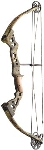 |  | 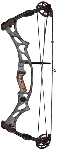 |
| Brace Height | 7.625 " | 7.5 " | 7 " |
| AtA Length | 30.625 " | 31.5 " | 33 " |
| Draw Length | 25 " - 30 " | 26 " - 30 " | 25 " - 31 " |
| Draw Weight | 50 lbs - 70 lbs | 40 lbs - 70 lbs | 40 lbs - 80 lbs |
| IBO Speed | 310 fps - 318 fps | 308 fps - 310 fps | 316 fps |
| Weight | 3.75 lbs | 4.3 lbs | lbs |
| Let-Off | 65% - 80% | 65% or 80% | 65% or 80% |
| Where to buy Best prices online | |||
| compare more bows | |||
In the mid-2000s a hunter who wanted a compact bow was cross-shopping exactly this class, and the Mathews Outback and Hoyt Trykon frame what the Mighty Mite trades and what it gains. The Mighty Mite in its VFT form is the shortest and lightest of the three - about 301/2 inches axle-to-axle and roughly 31/2 pounds - with the eager InfinityCam single cam and a short-draw-friendly 25-inch reach. The Mathews Outback answers with a longer 311/2-inch axle-to-axle, a taller 7.5-inch brace, a famously smooth SoloCam single cam, and a wider 40-to-70-pound range, but it is a heavier bow at about 4.3 pounds and a fraction slower at 308-310 IBO; it is the more forgiving, more relaxed draw of the group. The Hoyt Trykon goes the other direction - the longest and steadiest at 33 inches axle-to-axle, the widest adjustment window of the three at 40 to 80 pounds and a 25-to-31 inch draw, and a hair faster on paper at 316 IBO - but its Cam & 1/2 hybrid asks a little more tuning attention than a self-correcting single cam, and it gives up the Mighty Mite's compact, light carry. All three are dependable era hunters, so the decision comes down to priorities: choose the Mighty Mite for the most compact and lightest bow with real speed in a short-draw package, choose the Mathews Outback for the smoothest, most forgiving draw, and choose the Hoyt Trykon for the widest adjustment range and the steadiest long-shot hold.