
Bowtech Patriot Review


from $175
Pros
- Vertical Force Technology limbs cancel most hand shock and recoil, so the shot settles into the hand rather than kicking against it
- Single-cam InfinityCam version runs genuinely quiet and vibration-free once set up, rated among the calmest bows of its day
- Real-world chronograph speed lands within about one percent of the advertised IBO number, so the marketing speed is close to what you actually get
- Firm, no-creep back wall and repeatable accuracy, with owners stacking arrows at 20 yards and one taking an IBO class win
Cons
- Short, narrow valley makes the higher-let-off and twin-cam setups feel touchy to hold at full draw; running the InfinityCam at its 80% let-off setting, or choosing the single cam over the Dually, softens the hold
- The twin-cam Dually needs accessory tuning to reach its quietest, repositioning the VibraBlocks and adding limb dampeners; the single-cam version is calmer straight out of the box
- Front-loaded, aggressive draw on the Dually takes some getting used to; shooters who want a smoother pull should pick the single-cam InfinityCam VFT
Video
content from YouTube
Editors' review
Bowtech built the Patriot around a single idea that still defines the brand today: take the energy that a shot does not turn into arrow speed and throw it away before it ever reaches your hand. That idea had a name here, Vertical Force Technology (VFT), and the Patriot was the platform that introduced it. Running from 2002 through 2005, the bow paired a long, heavily reflexed aluminum riser with short limbs laid back nearly parallel to the arrow, a geometry that cancels recoil up and down instead of driving it forward. The payoff is a fast bow that stays compact at 33.75 inches axle-to-axle (the distance between the two cam axles) and lands soft in the hand. Bowtech sold it two ways, a smooth single-cam InfinityCam version and a faster twin-cam Dually, and understanding that split is the key to knowing which Patriot fits you. This is not a modern flagship, but it is a clean window into where Bowtech's comfort-first engineering came from.
Finish
Patriot finishes followed the mid-2000s hunting playbook: a solid black option alongside the full-coverage camo patterns of the era, the Mossy Oak and Realtree-family dips that dominated treestand bows of the time. The dip coatings on these bows have generally held up well over two decades, though any two-decade-old bow will show handling wear at the grip throat and cam edges. The example carried on the model page here shows a camo-finish bow with a wood-filled grip, consistent with how these shipped. Because this is a discontinued platform, the practical finish decision today is condition over color, and buyers should judge a used Patriot on limb and cam wear rather than on which camo pattern it wears.Riser
The riser is the story of this bow. Bowtech machined it long and heavily reflexed, roughly a 25-inch aluminum "Pro" riser carried over and refined from the 2001 Pro 38 and Pro 40 speed bows, and that length is what lets the short limbs sit at a laid-back angle, a 44-degree limb pocket angle in Bowtech's own period description. Physically the effect is counterintuitive: a very long riser produces a very short bow, because the limbs point back toward the shooter rather than out ahead. That is the mechanical heart of Vertical Force Technology, and it is why the Patriot can be both fast and only 33.75 inches between the axles. In my experience handling laid-back-limb designs like this, the balance sits a touch top-heavy at the shot, an impression owners of the Dually echoed, and it is the price of the compact, recoil-cancelling layout. For 2004 Bowtech added a pivoting limb pocket to hold peak efficiency as you back the draw weight down from its maximum.Grip
The grip is the quiet upgrade of this platform. Owners who moved up from the 2001 Pro-riser bows singled it out immediately, describing the Patriot's reworked grip as a clear step forward over the earlier, blockier hand fill. It is a wood-and-composite grip in the style of its day, narrower and more neutral in the hand than the bow it replaced, and that matters more than it sounds: a grip that lets the hand sit without torque is a real contributor to the Patriot's accuracy reputation. Drawing one, the hand finds a repeatable spot without fighting the riser throat. For a shooter today, the grip is period-correct rather than modern-slim, and it responds well to the same aftermarket side-plate and grip-tape fixes that owners still use on bows of this vintage.Limbs
The Patriot runs solid limbs made from compression-molded Gordon glass, each roughly 14.5 inches long, set into the pockets at the laid-back angle that defines the platform. This is a pre-parallel-limb design in the strict sense, but the near-parallel geometry is what does the recoil-cancelling work that later parallel-limb bows would chase with different means. Draw weights come in the familiar module steps of 40, 50, 60 and 70 pounds, each adjustable about ten pounds downward, so a 70-pound bow realistically covers a hunter from roughly 60 to 70 pounds without new limbs. The limb design proved durable across the platform's four model years, and Bowtech's 2004 pivoting limb pocket was aimed squarely at keeping the bow efficient for shooters who run it below peak. For a used buyer, the limbs and their laminations are the first thing to inspect, since a two-decade-old glass limb is the component most worth a careful look before purchase.Eccentric System
Here is where the two Patriots diverge, and it is the single most important choice a buyer makes. The single-cam InfinityCam version uses one cam and an idler, with fine draw-length adjustment and an adjustable let-off (the percentage of peak weight the holding weight drops to at full draw) selectable from 65 to 80 percent by moving the draw post; run it at 80 percent for an easier hold on a treestand, or 65 percent for a firmer wall and a more aggressive feel. The twin-cam Dually trades that flexibility for speed: it runs two cams at a fixed 65-percent let-off and is the faster bow, advertised at 334 fps and rated up to the 328-340 fps band depending on year. Across its run the single-cam VFT carried IBO speed ratings (the industry-standard chronograph number at a fixed 70-pound, 30-inch, 350-grain setup) from 312 fps in 2003 up to 333 fps in 2004, when Bowtech dropped the brace height to gain speed, then 318-326 fps for the final 2005 version. What earns the Patriot trust is that the real numbers hold up: owners who chronographed a Dually found it landed within about one percent of its advertised speed once normalized to the IBO setup, roughly 328 against a claimed 332, which is unusually honest for the era. The Dually's cams are a modular system with no creep tuning and a hard, defined wall, while the single cam is the smoother, quieter path to nearly the same performance.Draw Cycle/Shootability
The two versions feel like different bows in the hand, and this section is really two answers. The single-cam Patriot is the one owners fell in love with: quiet, low in vibration, and finishing with what one long-time owner described as a smooth, rolling settle in the hand with no kick after the shot. Drawing that version, the pull is even and the shot cycle ends calm, which is exactly what Vertical Force Technology promises. The Dually is the opposite personality. Its draw is front-loaded and, in owners' own word, harsh, hitting peak weight quickly and holding it through nearly the whole stroke before dropping into a short valley against a firm, no-creep back wall. Most shooters adapt to that aggressive pull within a few sessions, and the reward is speed that hits, in owners' phrasing, like a truck. The catch is the valley: it is narrow, sitting right against the wall, and at least one hunter found it touchy enough to feel nervous holding on a deer at close range. On noise, the single cam is quiet out of the box, while the Dually starts merely reasonable and needs a stabilizer, the VibraBlocks moved down to the limb pocket, and a set of limb dampeners before it goes truly quiet. In my experience that accessory-tuning step is worth budgeting for on any Dually, because the platform rewards it.Usage Scenarios
The Patriot is a hunting bow first, and it fits the whitetail woods it was built for. Picture an early-season stand hunter who wants speed for a flat trajectory out to 30 yards but does not want the shot rattling the hand on a cold, quiet morning: the single-cam VFT is squarely that bow, calm and forgiving to hold. The Dually suits a different shooter, the speed-first hunter or the 3D and IBO-class competitor who will trade a short valley and a firmer draw for every foot per second, and owners did in fact win with it. The draw-length range is the real fit boundary, running only 25 to 30 inches, which covers most adult hunters but excludes long-draw shooters past 30 inches and true short-draw youth under 25 inches. Draw weights from 40 to 70 pounds cover everything from a lighter-poundage shooter up to a full elk-legal setup, though the short valley means the Patriot rewards a shooter with settled form more than a beginner still building anchor consistency. As a used buy today, it makes a capable, low-cost backup or a first serious hunting rig for someone who values the soft-shooting VFT feel over modern conveniences.Versions
Bowtech sold the Patriot in two cam configurations across four model years, six catalog versions in all, and they are versions of one platform rather than separate bows. The single-cam InfinityCam VFT is the mainline: it appeared in 2002 as the original Patriot, then as the Patriot VFT from 2003 through 2005, with the axle-to-axle length hovering between 33.25 and 34 inches and the brace height moving from 7.25 inches down to 6.625 inches in the fast 2004 model and back to 7 inches for 2005. Catalog launch pricing for the single cam is documented at $649 for 2004 and $719 for 2005. The twin-cam Patriot Dually VFT ran in 2003 and 2004 as the speed option, on a longer 34.875-inch axle-to-axle with a more forgiving 7.625-inch brace, and it carried a $749 catalog price in 2004. Launch prices for the 2002 and 2003 versions are not reliably documented today, so a used buyer should treat any older Patriot on its condition and cam type rather than an original sticker. The single most consequential version choice is not the year but the cam: quiet and smooth in the InfinityCam, fast and aggressive in the Dually.Bowtech Patriot vs Mathews Switchback, Hoyt Trykon
| Bow | Bowtech Patriot | Mathews Switchback | Hoyt Trykon |
| Version | 2005 VFT | 2007 | 2007 |
| Picture |  |  | 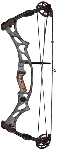 |
| Brace Height | 6.875 " | 7 " | 7 " |
| AtA Length | 33.375 " | 33 " | 33 " |
| Draw Length | 25 " - 30 " | 25 " - 30 " | 25 " - 31 " |
| Draw Weight | 40 lbs - 70 lbs | 40 lbs - 70 lbs | 40 lbs - 80 lbs |
| IBO Speed | 318 fps - 326 fps | 318 fps | 316 fps |
| Weight | 4.063 lbs | 4.34 lbs | lbs |
| Let-Off | 65% - 80% | 65% or 80% | 65% or 80% |
| Where to buy Best prices online | |||
| compare more bows | |||
Set against the two bows a mid-2000s buyer actually cross-shopped, the Patriot's identity comes into focus. The Mathews Switchback was the single-cam benchmark of the era, a 33-inch, 7-inch-brace bow prized above all for how smooth and quiet it drew and shot; against it, the single-cam Patriot competes closely on quiet and vibration but the Switchback generally wins the smoothness contest, while the Patriot Dually clearly wins on raw speed. The Hoyt Trykon brought Hoyt's Cam & 1/2 system on a similar 33-inch, 7-inch-brace hunting chassis, and it splits the difference: smoother to draw than the Patriot Dually, but the Patriot is the faster bow, a trade-off owners of the day described directly when comparing the two systems. What none of the three gives away is accuracy or build; all were serious hunting bows. The decision comes down to priorities: the Switchback for the shooter who ranks a buttery draw above everything, the Trykon for the Hoyt loyalist wanting a balanced cam-and-a-half feel, and the Patriot for the shooter who wants Bowtech's recoil-cancelling VFT shot and, in Dually form, the most speed of the three.